
Reaction mechanisms seem confusing, reaction pathways feel overwhelming, and memorized information suddenly disappears during exams.
This experience is extremely common in organic chemistry courses.
Unlike many subjects that rely heavily on direct memorization, organic chemistry usually requires students to understand reaction behavior, recognize patterns, and apply concepts logically across unfamiliar problems.
Because of this, studying organic chemistry effectively often requires a different approach than students used successfully in earlier science classes.
What Effective Organic Chemistry Study Often Includes
- Understanding reaction mechanisms
- Recognizing chemistry patterns
- Practicing reaction problems consistently
- Using active learning instead of passive reading
- Reviewing concepts regularly
- Connecting reactions logically
Why Memorization Alone Usually Does Not Work
Many students initially try to memorize large numbers of reactions, reagents, and mechanisms individually.
Although some memorization is necessary, organic chemistry exams often test:
- Reaction reasoning
- Mechanism understanding
- Problem-solving ability
- Pattern recognition
- Concept application
Students who only memorize reactions frequently struggle when exam questions present unfamiliar situations or require deeper conceptual understanding.
Learning Perspective:
Organic chemistry usually becomes easier when students begin understanding why reactions happen instead of trying to memorize every reaction separately.
Why Active Learning Works Better
Passive studying often feels productive but may not build strong chemistry problem-solving skills.
Passive review usually includes:
- Rereading notes repeatedly
- Highlighting textbooks
- Watching lectures without practice
- Reviewing mechanisms without solving problems
Active learning, however, forces students to apply concepts directly.
More effective study methods often involve:
- Drawing reaction mechanisms
- Solving practice problems
- Predicting reaction outcomes
- Explaining mechanisms step-by-step
- Practicing ACS-style chemistry questions
| Study Method | Why It Helps Organic Chemistry Students |
|---|---|
| Mechanism Practice | Improves reaction understanding and electron-flow reasoning |
| Reaction Problems | Builds problem-solving confidence and reaction familiarity |
| Pattern Recognition | Helps organize large amounts of chemistry information |
| Consistent Review | Prevents small knowledge gaps from growing larger |
Source: General undergraduate organic chemistry education principles and STEM learning strategies.
Why Understanding Mechanisms Matters So Much
Reaction mechanisms help explain how and why reactions occur.
Students who understand mechanisms often become better at:
- Predicting products
- Recognizing reaction patterns
- Understanding electron movement
- Connecting reactions together logically
- Handling unfamiliar chemistry problems
Mechanism understanding usually provides much stronger long-term chemistry confidence than memorizing isolated reaction lists.
Why Consistent Practice Is Important
Organic chemistry concepts build heavily on earlier understanding.
Because of this, students who wait until the last minute often feel overwhelmed by the amount of material.
Consistent practice helps students:
- Strengthen reaction familiarity
- Review mechanisms regularly
- Recognize common chemistry patterns
- Identify weaker concepts earlier
- Build confidence gradually over time
Many students improve confidence using ACS Organic Chemistry Exam Prep Kit because repeated exposure to mechanisms and exam-style chemistry problems helps concepts feel more organized and manageable.
Why Pattern Recognition Helps Organic Chemistry Feel Simpler
One of the biggest improvements many students experience in organic chemistry happens when reactions stop feeling random.
Students gradually begin noticing:
- Repeated reaction behaviors
- Common mechanism pathways
- Functional-group relationships
- Predictable electron movement patterns
- Similar reaction conditions across chapters
Pattern recognition helps students organize chemistry information more logically instead of treating every reaction as completely separate material.
Important Study Insight:
Strong organic chemistry students often focus less on memorizing isolated reactions and more on understanding the recurring reaction patterns connecting them together.
Why Practice Problems Matter More Than Reading Alone
Many students spend too much time reviewing notes passively instead of actively solving chemistry problems.
Organic chemistry understanding usually improves more effectively through:
- Reaction prediction exercises
- Mechanism drawing practice
- Reaction pathway analysis
- Structure identification
- ACS-style chemistry questions
Practice problems force students to apply chemistry concepts actively rather than simply recognizing information while reading.
| Organic Chemistry Challenge | Helpful Study Approach |
|---|---|
| Reaction Confusion | Practice mechanism reasoning step-by-step |
| Information Overload | Organize reactions into related patterns and concepts |
| Exam Anxiety | Use repeated timed practice problems |
| Falling Behind | Review concepts consistently instead of cramming |
Source: General undergraduate organic chemistry education principles and STEM learning practices.
Why Students Often Fall Behind in Organic Chemistry
Organic chemistry courses move quickly, and later concepts depend heavily on earlier understanding.
If students struggle with foundational topics such as:
- Functional groups
- Electron movement
- Mechanism basics
- Bonding concepts
- Reaction logic
new chapters can become increasingly difficult to follow.
Students who understand why organic chemistry feels overwhelming for many students often realize that early conceptual gaps can create much larger learning problems later in the course.
Learning Reality:
Small improvements in understanding reaction mechanisms early can significantly improve confidence later in the semester.
Why Drawing Mechanisms Repeatedly Helps
Mechanism drawing forces students to slow down and think carefully about reaction behavior.
Repeated mechanism practice helps students:
- Visualize electron movement more clearly
- Recognize reaction steps logically
- Understand structural changes
- Improve reaction prediction skills
- Strengthen chemistry reasoning confidence
Many students notice major improvements once they stop passively reviewing mechanisms and begin actively drawing them repeatedly during study sessions.
Why Organic Chemistry Requires Patience
Organic chemistry understanding usually develops gradually rather than instantly.
Students often become frustrated because reactions and mechanisms may feel confusing for weeks before concepts begin connecting together more naturally.
Consistent practice, repetition, and conceptual review usually help students build confidence slowly over time.
Why ACS Organic Chemistry Exams Require Conceptual Thinking
ACS Organic Chemistry exams often test much more than simple memorization.
Students may need to:
- Analyze unfamiliar reactions
- Predict products logically
- Recognize mechanism patterns
- Apply concepts under time pressure
- Connect reactions across multiple topics
Because of this, students who focus mainly on memorizing isolated reaction lists sometimes struggle when exam questions require deeper reasoning and problem-solving.
Exam Preparation Perspective:
Strong ACS preparation usually involves repeated exposure to reaction-based problems and conceptual chemistry reasoning instead of last-minute memorization alone.
Why Reviewing Mistakes Is So Important
Many students improve significantly when they begin carefully reviewing why mistakes happened instead of only checking correct answers.
Reviewing mistakes helps students:
- Identify weak chemistry concepts
- Recognize recurring reaction confusion
- Strengthen mechanism understanding
- Improve reaction reasoning skills
- Avoid repeating the same errors later
Organic chemistry improvement often comes from understanding thinking mistakes rather than simply completing large numbers of problems mechanically.
| Helpful Study Habit | Why It Improves Chemistry Understanding |
|---|---|
| Mechanism Practice | Strengthens reaction reasoning and electron-flow understanding |
| Problem Review | Helps identify conceptual weaknesses and recurring mistakes |
| Pattern Recognition | Makes large reaction sets easier to organize mentally |
| Consistent Study Sessions | Prevents reaction overload and long-term confusion |
Source: General undergraduate organic chemistry education principles and STEM learning strategies.
Why Confidence Improves Through Repetition
Organic chemistry often feels intimidating because students initially encounter unfamiliar reactions, mechanisms, and chemical structures all at once.
However, repeated exposure gradually helps students:
- Recognize common mechanisms faster
- Understand reaction logic more clearly
- Predict products more confidently
- Identify reaction patterns naturally
- Feel calmer during chemistry exams
Over time, chemistry problems that once felt overwhelming often become much easier to analyze logically.
Important Reminder:
Organic chemistry confidence usually develops gradually through repeated practice and conceptual understanding rather than instant memorization success.
Why Consistency Usually Beats Long Study Marathons
Many students try to study organic chemistry through intense cramming sessions before exams.
However, smaller and more consistent study sessions often work better because they allow students to:
- Review mechanisms repeatedly
- Strengthen long-term memory
- Build reaction familiarity gradually
- Identify weak areas earlier
- Reduce chemistry-related stress
Consistent chemistry exposure helps students stay connected to reaction patterns and mechanism logic throughout the course.
Final Thoughts
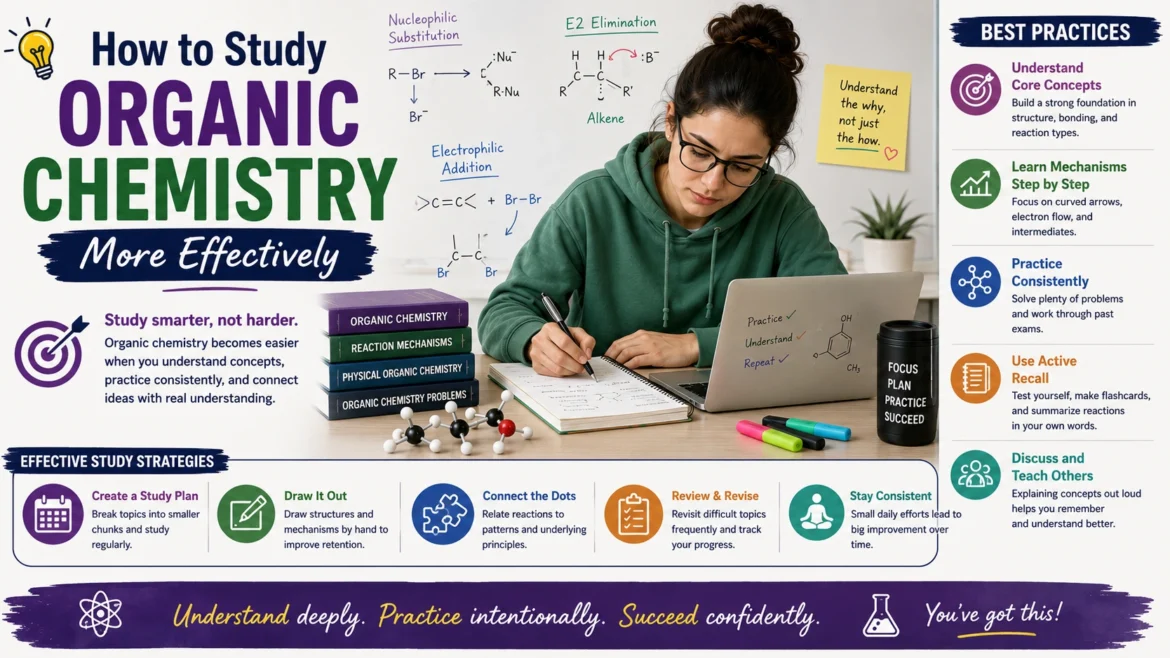
Studying organic chemistry more effectively usually involves shifting away from passive memorization toward active problem-solving, mechanism understanding, pattern recognition, and consistent practice.
Students often improve significantly once they begin focusing on reaction logic and conceptual understanding instead of trying to memorize every reaction individually.
Although organic chemistry can initially feel overwhelming, repeated exposure to mechanisms, reaction patterns, and ACS-style chemistry problems gradually helps many students build stronger confidence and problem-solving ability.
With patience, consistent study habits, and active chemistry practice, organic chemistry often becomes far more manageable and understandable over time.