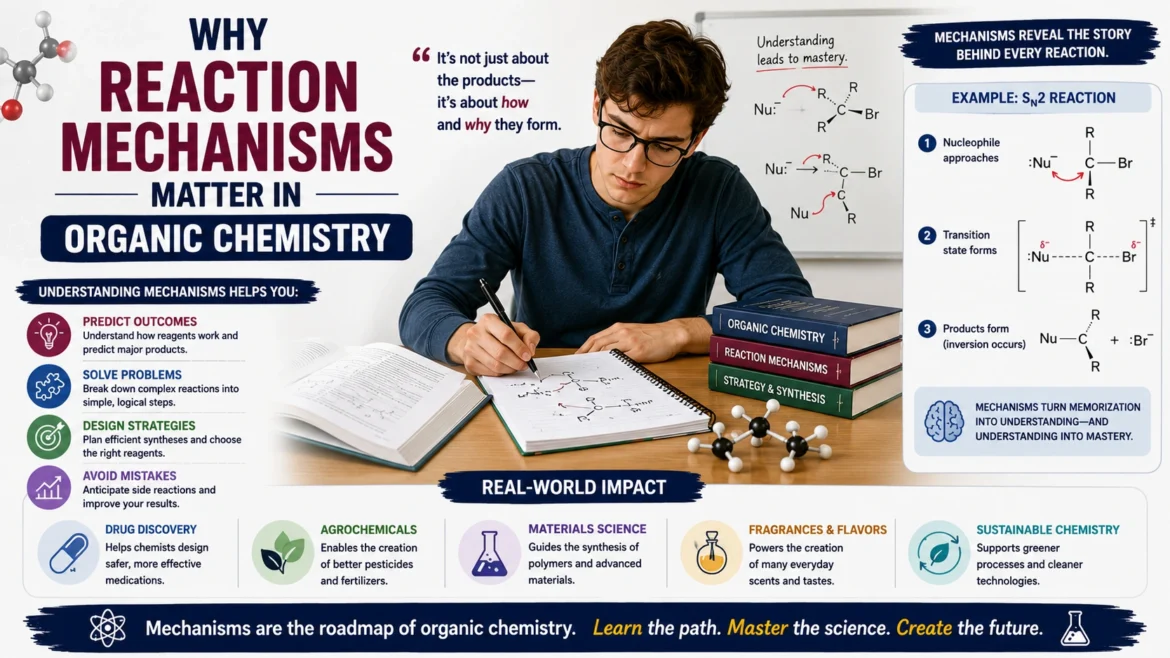

Students often wonder:
- Why does this reaction happen?
- Why do electrons move this way?
- How can products be predicted logically?
- Why are some reactions more stable than others?
These questions are closely connected to reaction mechanisms.
Reaction mechanisms are one of the most important concepts in organic chemistry because they explain how and why chemical reactions occur step-by-step.
What Reaction Mechanisms Help Students Understand
- Electron movement during reactions
- Why products form
- How reaction steps connect together
- Why certain reactions are favored
- How to predict unfamiliar reactions
- Reaction logic instead of memorization alone
Why Mechanisms Feel Difficult at First
Reaction mechanisms often feel overwhelming because students are introduced to:
- Curved-arrow notation
- Electron movement concepts
- Multiple reaction steps
- Intermediate structures
- Complex reaction pathways
At first, these mechanisms may appear random or impossible to follow logically.
However, mechanisms gradually become more understandable once students begin recognizing repeated chemistry patterns and reaction behaviors.
Learning Perspective:
Many students improve dramatically once they stop viewing mechanisms as isolated diagrams and begin understanding them as logical explanations of chemical behavior.
What Mechanisms Actually Show
Reaction mechanisms show how molecules change during a chemical reaction.
Mechanisms often explain:
- Where electrons move
- Which bonds break
- Which new bonds form
- How intermediate structures appear
- Why reactions proceed in certain directions
Instead of memorizing reactions blindly, mechanisms help students understand the reasoning behind chemical transformations.
| Mechanism Concept | Why It Matters in Organic Chemistry |
|---|---|
| Electron Movement | Explains how reactions occur step-by-step |
| Reaction Intermediates | Shows temporary structures formed during reactions |
| Reaction Logic | Helps students predict chemical behavior more logically |
| Pattern Recognition | Makes reactions easier to organize and understand |
Source: General undergraduate organic chemistry education principles and reaction mechanism instruction practices.
Why Memorization Becomes Less Effective Without Mechanisms
Students sometimes try to memorize reactions without understanding the mechanism behind them.
This approach often causes problems because organic chemistry exams frequently require:
- Predicting unfamiliar reactions
- Analyzing mechanism steps
- Explaining reaction outcomes
- Recognizing incorrect products
- Applying concepts logically
Without mechanism understanding, students may struggle whenever reactions appear in slightly different forms during exams.
Why Electron Movement Is So Important
Organic chemistry reactions are heavily connected to electron behavior.
Reaction mechanisms help students visualize:
- Where electrons begin
- How bonds change
- Why certain atoms react
- How products form step-by-step
- Why some pathways are more favorable
Understanding electron movement helps transform reactions from random memorization into organized chemical reasoning.
Many students improve confidence using ACS Organic Chemistry Problems because repeated exposure to reaction pathways helps complex chemistry concepts feel more logical and predictable over time.
Why Mechanisms Help Students Predict Reactions
One of the biggest advantages of understanding reaction mechanisms is the ability to predict unfamiliar reactions more logically.
Instead of relying entirely on memorized reaction lists, students begin recognizing:
- How electrons typically move
- Which atoms are likely to react
- How bonds form and break
- Why certain products are favored
- How reaction patterns repeat across chapters
This deeper understanding helps students feel more confident when solving unfamiliar organic chemistry problems.
Important Learning Insight:
Students who understand reaction logic often become much better at handling difficult chemistry questions than students who rely mainly on memorization alone.
Why Pattern Recognition Matters in Mechanisms
Organic chemistry reactions may initially appear completely unrelated, but many mechanisms actually follow recurring patterns.
Students often improve significantly once they begin recognizing:
- Repeated electron-movement behaviors
- Common mechanism pathways
- Similar intermediate structures
- Recurring reaction conditions
- Predictable reaction trends
Pattern recognition helps students organize chemistry information more effectively and reduce reaction confusion.
| Mechanism Skill | How It Helps Students |
|---|---|
| Electron-Flow Understanding | Improves reaction reasoning and prediction skills |
| Pattern Recognition | Makes complex reactions easier to organize mentally |
| Mechanism Practice | Builds confidence with unfamiliar chemistry problems |
| Reaction Logic | Reduces dependence on memorization alone |
Source: General undergraduate organic chemistry education principles and mechanism-based STEM learning practices.
Why Students Often Fear Mechanism Questions
Many students become anxious when they see long reaction mechanisms on exams because mechanisms often require multiple layers of reasoning simultaneously.
Students may need to:
- Track electron movement carefully
- Recognize intermediate structures
- Predict product formation
- Analyze reaction stability
- Connect several reaction steps together
Students who understand why organic chemistry feels overwhelming for many learners often realize that mechanism confusion is extremely common during early chemistry study.
Learning Reality:
Mechanisms often feel intimidating initially because students are learning an entirely new way of visualizing chemical behavior and reaction flow.
Why Mechanism Practice Improves Confidence
Repeated mechanism practice helps students become more comfortable following reaction logic step-by-step.
Over time, students often improve their ability to:
- Recognize common mechanism pathways
- Predict reaction outcomes faster
- Visualize electron movement more clearly
- Connect reactions across different topics
- Analyze chemistry questions more calmly
Mechanism understanding gradually transforms organic chemistry from memorization overload into more organized scientific reasoning.
Why Mechanisms Are Important for ACS Organic Chemistry Exams
ACS Organic Chemistry exams frequently test conceptual reasoning, reaction analysis, and mechanism understanding rather than direct memorization alone.
Students preparing for ACS-style questions often benefit from:
- Mechanism drawing practice
- Reaction prediction exercises
- Conceptual chemistry review
- Pattern-recognition study methods
- Repeated reaction analysis practice
Mechanism understanding helps students approach difficult chemistry questions with stronger reasoning and greater confidence.
Why Mechanisms Help Organic Chemistry Feel More Logical
Many students initially view organic chemistry as a subject filled with endless reactions and impossible memorization.
However, reaction mechanisms often help students realize that reactions follow understandable patterns and chemical logic.
Mechanisms help explain:
- Why molecules react certain ways
- How electrons influence reactions
- Why some products are favored
- How reaction pathways develop
- Why reaction conditions matter
As students become more comfortable with mechanisms, many reactions begin feeling less random and more predictable.
Learning Perspective:
Reaction mechanisms often act like a “language” that helps students interpret and organize organic chemistry reactions more logically.
Why Drawing Mechanisms Repeatedly Helps Students Learn
Many students improve significantly once they begin actively drawing mechanisms instead of only reviewing them passively.
Mechanism drawing forces students to think carefully about:
- Electron movement
- Bond changes
- Reaction steps
- Intermediate structures
- Product formation
Repeated mechanism practice strengthens reaction reasoning and helps chemistry concepts become more familiar over time.
| Mechanism Learning Habit | Why It Helps Chemistry Students |
|---|---|
| Repeated Mechanism Practice | Improves familiarity with reaction behavior and electron movement |
| Reaction Analysis | Builds stronger conceptual chemistry understanding |
| Pattern Recognition | Helps organize reactions into understandable systems |
| Problem-Solving Practice | Strengthens confidence during ACS-style chemistry exams |
Source: General undergraduate organic chemistry education principles and STEM learning strategies.
Why Mechanism Understanding Improves Exam Performance
Students who understand mechanisms often perform better on challenging chemistry exams because they can reason through unfamiliar problems more logically.
Instead of panicking when encountering new reactions, mechanism-focused students may:
- Analyze electron behavior carefully
- Predict likely products logically
- Recognize familiar reaction patterns
- Identify reaction trends
- Apply concepts more flexibly
Mechanism understanding helps reduce dependence on memorization alone and supports stronger chemistry reasoning under exam pressure.
Learning Reality:
Many students begin improving in organic chemistry only after they shift from memorizing reactions toward understanding the mechanisms driving those reactions.
Why Study Strategy and Mechanisms Work Together
Mechanism understanding becomes much easier when students combine it with consistent problem-solving practice and active chemistry review.
Students who understand effective organic chemistry study strategies and active learning methods often improve their ability to analyze mechanisms, recognize patterns, and solve reaction-based chemistry questions more confidently.
Why Mechanisms Remain Central to Organic Chemistry
Reaction mechanisms remain one of the most important foundations of organic chemistry because they connect:
- Reaction logic
- Electron movement
- Product prediction
- Chemical behavior
- Problem-solving reasoning
Mechanism understanding helps students move beyond memorization and develop stronger conceptual chemistry thinking throughout the course.
Final Thoughts
Reaction mechanisms matter in organic chemistry because they explain how reactions occur, why products form, and how chemical behavior can be analyzed logically.
Students who understand mechanisms often become better at recognizing reaction patterns, solving unfamiliar problems, and reasoning through ACS-style chemistry questions with greater confidence.
Although mechanisms may initially feel intimidating, repeated practice and conceptual understanding gradually help many students view organic chemistry as a more organized and understandable subject.
Over time, reaction mechanisms often become one of the most valuable tools helping students connect reactions, predict outcomes, and think more confidently about organic chemistry overall.