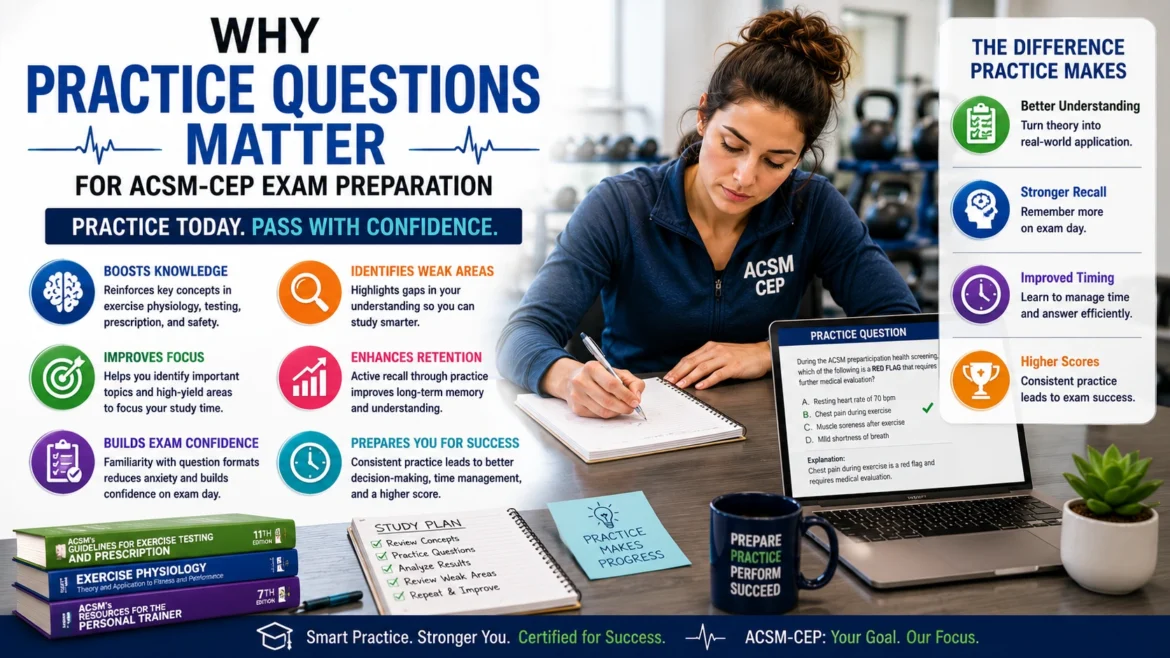
Preparing for the ACSM Clinical Exercise Physiologist (ACSM-CEP) certification exam involves far more than reviewing textbooks and memorizing definitions. Because the exam evaluates clinical reasoning, patient safety awareness, exercise prescription knowledge, and exercise physiology concepts, candidates often need repeated exposure to realistic scenarios before feeling fully prepared. One of the most effective ways to build that confidence is through consistent practice questions.Practice questions help candidates apply theoretical knowledge in ways that resemble real testing situations. Instead of simply recalling isolated facts, students must interpret patient information, recognize physiological responses, evaluate exercise testing results, and determine the safest or most appropriate clinical decisions. This process strengthens understanding while improving long-term retention.
Why Practice Questions Improve Clinical Understanding
Many candidates initially focus heavily on reading textbooks, highlighting notes, and reviewing study guides. While foundational review is important, passive studying alone often creates a false sense of confidence. Information may feel familiar during review sessions, yet become difficult to recall during exam-style questions.Practice questions improve learning because they require active engagement with the material. Candidates must analyze information, recall concepts under pressure, and apply knowledge within realistic clinical situations. Over time, this repeated mental retrieval strengthens both memory and clinical reasoning skills.
| Passive Study Methods | Practice Question Benefits |
|---|
| Reading notes repeatedly | Strengthens active recall skills |
| Highlighting textbooks | Improves application of knowledge |
| Memorizing isolated facts | Builds clinical reasoning abilities |
| Reviewing without testing | Reveals weak areas more clearly |
| Studying passively for long hours | Improves retention through repetition |
How Practice Questions Simulate Real Clinical Thinking
The ACSM-CEP exam is designed to measure whether candidates can safely apply exercise physiology knowledge within clinical environments. Because of this, many questions include patient case studies, exercise testing data, ECG findings, or exercise prescription scenarios that require careful interpretation.Practice questions help candidates become more comfortable navigating these situations before exam day. Repeated exposure to clinical-style scenarios improves the ability to recognize patterns, identify safety concerns, and make informed decisions under pressure.
Candidates who regularly practice application-based questions often feel more confident interpreting clinical scenarios during the actual exam.
Identifying Weak Areas Earlier in Preparation
One major advantage of practice questions is their ability to expose weak areas early in the preparation process. Many students believe they understand a topic until they attempt to apply it during realistic questions. Practice testing helps reveal gaps in understanding that may otherwise remain hidden.For example, a candidate may feel comfortable reviewing blood pressure responses during exercise but struggle when interpreting abnormal exercise testing results within a patient scenario. Discovering these weaknesses early allows candidates to focus additional review time where it is needed most.
Study Strategy Tip
Keep a separate notebook or digital document for missed practice questions. Reviewing common mistakes regularly can improve retention and strengthen weaker content areas over time.
Why Reviewing Explanations Is So Important
Simply answering practice questions is not enough. Much of the learning happens during the review process after the question has been completed. Candidates who carefully analyze explanations often gain deeper understanding than those who focus only on final scores.Reviewing explanations helps candidates understand:
- Why the correct answer was appropriate
- Why other answer choices were incorrect
- Which clinical concept was being tested
- How patient safety influenced the correct response
- How similar scenarios may appear on future questions
This type of review strengthens critical thinking and helps candidates avoid repeating the same mistakes throughout preparation.
Improving Time Management Through Practice
Time management becomes increasingly important during certification exams that contain lengthy clinical scenarios and detailed answer choices. Candidates who rarely practice under timed conditions sometimes struggle with pacing during the actual exam.Practice questions help students become more efficient at identifying important information, eliminating incorrect choices, and making decisions confidently without rushing unnecessarily. Over time, candidates often become more comfortable balancing speed with accuracy.
| Skill Improved Through Practice Questions | Why It Matters for the ACSM-CEP Exam |
|---|
| Clinical reasoning | Supports safer decision-making during scenarios |
| Time management | Reduces stress during timed exams |
| Knowledge retention | Strengthens long-term memory |
| Pattern recognition | Improves interpretation of patient scenarios |
| Confidence under pressure | Helps candidates remain calm during testing |
Building Confidence Before Exam Day
Confidence rarely develops from passive review alone. Most candidates build confidence gradually through repeated exposure to realistic questions, steady improvement in weak areas, and increased familiarity with clinical-style testing scenarios.Many students preparing for certification exams use
realistic clinical exercise physiology exam questions to strengthen clinical reasoning, improve pacing, and become more comfortable with application-based testing before exam day.Although preparation can feel challenging at times, consistent practice combined with structured review often helps candidates develop stronger understanding and greater confidence throughout the study process.
Why Application-Based Questions Are More Effective Than Memorization
Many ACSM-CEP candidates initially approach preparation by memorizing definitions, formulas, and terminology. While foundational knowledge is important, the certification exam often evaluates whether candidates can apply those concepts safely within clinical situations. This is where application-based practice questions become especially valuable.Application-focused questions require candidates to analyze patient information, recognize abnormal responses, interpret exercise data, and determine the safest course of action. Instead of simply recalling isolated facts, candidates must think critically and apply multiple concepts simultaneously.
| Memorization-Based Learning | Application-Based Learning |
|---|
| Focuses on recalling facts | Focuses on clinical decision-making |
| Often short-term retention | Strengthens long-term understanding |
| Limited clinical context | Uses realistic patient scenarios |
| May create false confidence | Reveals true understanding gaps |
| Less effective under pressure | Improves performance during testing |
How Practice Questions Improve Clinical Reasoning
Clinical reasoning is one of the most important skills evaluated during the ACSM-CEP exam. Candidates must understand how exercise physiology concepts apply during patient assessment, exercise testing, exercise prescription, and patient monitoring.Practice questions help strengthen clinical reasoning by exposing candidates to different patient populations, physiological responses, and exercise scenarios repeatedly. Over time, candidates become more comfortable identifying patterns and recognizing important safety considerations within complex situations.For example, candidates may need to determine whether an exercise session should continue after abnormal blood pressure responses or identify the safest exercise intensity recommendation for a patient with cardiovascular disease. Repeated exposure to these scenarios improves confidence and decision-making ability.
Strong clinical reasoning develops gradually through repeated practice, detailed review, and exposure to realistic patient scenarios.
The Importance of Repetition During Exam Preparation
Repetition plays a major role in long-term retention during certification preparation. Reviewing concepts only once often leads to rapid forgetting, especially when candidates are studying large amounts of complex information across multiple clinical subjects.Practice questions naturally reinforce repetition because important concepts appear repeatedly in different ways. A candidate may encounter cardiovascular physiology concepts in one question, exercise prescription in another, and patient monitoring scenarios in a third. This repeated exposure strengthens understanding and helps information move into long-term memory.
Retention Tip
Review missed questions several days later instead of immediately rereading explanations only once. Spaced repetition improves retention far more effectively than short-term cramming.
Learning to Recognize Common Exam Patterns
Another major benefit of practice questions is pattern recognition. Many ACSM-CEP exam scenarios follow similar clinical structures involving patient symptoms, exercise responses, ECG findings, contraindications, or exercise prescription decisions.As candidates complete more realistic questions, they often begin recognizing recurring concepts and common testing patterns. This familiarity can improve efficiency during the actual exam because candidates become better at identifying critical clues within clinical scenarios.
| Common Clinical Pattern | Why It Appears Frequently |
|---|
| Abnormal exercise responses | Evaluates patient safety understanding |
| Exercise prescription decisions | Tests clinical application skills |
| Risk stratification scenarios | Measures safety assessment abilities |
| ECG interpretation questions | Supports monitoring competency |
| Exercise testing protocols | Evaluates procedural understanding |
Reducing Exam Anxiety Through Repeated Practice
Exam anxiety is common among ACSM-CEP candidates, especially because the certification covers multiple clinical topics and application-based scenarios. Repeated practice questions can help reduce stress by making the testing process feel more familiar over time.Candidates who regularly practice under realistic conditions often become more comfortable managing time, interpreting long questions, and making decisions under pressure. Familiarity with exam-style formatting can improve confidence and reduce uncertainty during the actual test.Many students preparing for certification exams use
advanced ACSM clinical exercise prep materials to strengthen pacing, improve application skills, and gain more exposure to realistic patient-based scenarios before exam day.
Why Consistency Matters More Than Cramming
Some candidates attempt to complete large numbers of practice questions in a single day shortly before the exam. While intensive review may feel productive temporarily, long-term retention usually improves far more through consistent practice spread across several weeks.Shorter and more frequent study sessions help reinforce information gradually while reducing mental fatigue. Candidates who consistently review questions, explanations, and weak areas often build stronger understanding than those who rely primarily on last-minute cramming.Developing a steady practice routine allows candidates to improve progressively while maintaining better concentration and confidence throughout the preparation process.
Using Full-Length Practice Exams More Effectively
Full-length practice exams can help ACSM-CEP candidates evaluate their readiness more realistically before the actual exam day. While many students focus heavily on overall scores, the real value often comes from reviewing mistakes, identifying weak areas, and improving clinical reasoning skills over time.Simulated testing sessions also help candidates become more comfortable with exam pacing, mental endurance, and application-based question formats. Repeated exposure to realistic scenarios can reduce uncertainty and improve confidence during the actual certification exam.
| Practice Exam Strategy | Why It Helps Candidates |
|---|
| Practicing under timed conditions | Improves pacing and concentration |
| Reviewing missed questions carefully | Strengthens long-term understanding |
| Tracking recurring weak areas | Helps guide future review sessions |
| Repeating difficult concepts regularly | Improves retention over time |
| Simulating realistic testing sessions | Reduces anxiety before exam day |
Why Patient Safety Questions Are So Important
Patient safety remains one of the most important themes throughout clinical exercise physiology. The ACSM-CEP exam frequently evaluates whether candidates can identify unsafe conditions, recognize abnormal physiological responses, and make appropriate decisions during exercise testing or exercise prescription.Practice questions help candidates become more comfortable recognizing safety concerns such as abnormal blood pressure responses, exercise intolerance, contraindications for testing, and concerning ECG findings. These scenarios strengthen clinical judgment while reinforcing the importance of safe patient care.Candidates who regularly practice patient safety scenarios often improve their ability to analyze clinical situations calmly and make safer decisions under pressure.
Clinical Safety Reminder
Many ACSM-CEP exam questions include subtle patient safety clues. Pay close attention to symptoms, contraindications, exercise responses, and abnormal findings during clinical scenarios.
How Practice Questions Improve Exercise Prescription Skills
Exercise prescription is another major area where repeated practice becomes extremely valuable. Candidates are expected to understand how to create safe and effective exercise programs for individuals with different medical histories, exercise capacities, and clinical conditions.Practice questions expose candidates to realistic exercise prescription decisions involving exercise intensity, progression, duration, and frequency. Over time, this repeated exposure improves understanding of how exercise recommendations should be adjusted based on patient safety and exercise tolerance.
| Exercise Prescription Skill | How Practice Questions Help |
|---|
| Selecting safe exercise intensity | Improves clinical decision-making |
| Applying FITT principles | Strengthens exercise programming skills |
| Adjusting exercise progression | Builds patient-centered planning skills |
| Interpreting exercise tolerance | Supports safer recommendations |
| Recognizing exercise limitations | Improves patient safety awareness |
Combining Study Strategies With Practice Questions
Practice questions are most effective when combined with structured review strategies. Candidates who balance question practice with textbook review, concept reinforcement, and active recall techniques often build stronger long-term understanding throughout preparation.Students looking to improve their overall preparation approach may also benefit from reviewing additional study techniques discussed in
How to Study for the ACSM-CEP Exam More Effectively, including active recall strategies, clinical reasoning methods, and long-term retention techniques.Combining multiple preparation methods can improve consistency while helping candidates understand how different exercise physiology concepts connect together clinically.
Common Mistakes Candidates Make During Practice
Although practice questions are extremely useful, some candidates unintentionally reduce their effectiveness through poor study habits. Recognizing these common mistakes early can improve both retention and exam readiness.
- Completing large numbers of questions without reviewing explanations
- Memorizing answer patterns instead of understanding concepts
- Ignoring weaker topics during review sessions
- Studying inconsistently throughout preparation
- Focusing only on final scores rather than clinical reasoning
- Rushing through clinical scenarios too quickly
Candidates who focus on understanding concepts deeply rather than simply improving scores often build stronger confidence and long-term retention before exam day.
Frequently Asked Questions
Why are practice questions important during ACSM-CEP preparation?
Practice questions help candidates apply exercise physiology concepts, strengthen clinical reasoning, improve retention, and become more comfortable with patient-based scenarios.
Should candidates review explanations after each question?
Yes. Reviewing explanations carefully improves understanding, strengthens clinical reasoning, and helps candidates identify weak areas more effectively.
Can practice questions help reduce exam anxiety?
Repeated exposure to realistic testing scenarios often improves confidence and familiarity with exam structure, which can help reduce stress before the official exam.
How often should candidates practice questions?
Short and consistent practice sessions throughout preparation are usually more effective than occasional large study sessions or last-minute cramming.
Final Thoughts
Practice questions remain one of the most effective tools for ACSM-CEP exam preparation because they improve clinical reasoning, strengthen retention, reinforce patient safety concepts, and increase familiarity with application-based testing scenarios. Candidates who consistently combine realistic practice with structured review often feel more confident as exam day approaches.Many students preparing for certification exams use
comprehensive ACSM-CEP preparation resources to improve exercise prescription understanding, strengthen clinical application skills, and gain more realistic exam experience before taking the official certification exam.With consistent preparation, active review, and repeated exposure to realistic clinical questions, candidates can develop stronger understanding and greater confidence throughout the ACSM-CEP study process.