
This experience is extremely common because reading information repeatedly does not always create strong long-term retention by itself.
In many cases, candidates remember concepts more effectively once they begin actively applying information instead of only reviewing it passively.
Why Learning Style Matters
Many certification candidates study for long periods but still struggle during exams because their preparation focuses heavily on recognition instead of active recall and applied reasoning.
Active learning often helps information feel more practical, memorable, and easier to apply during realistic fitness situations.
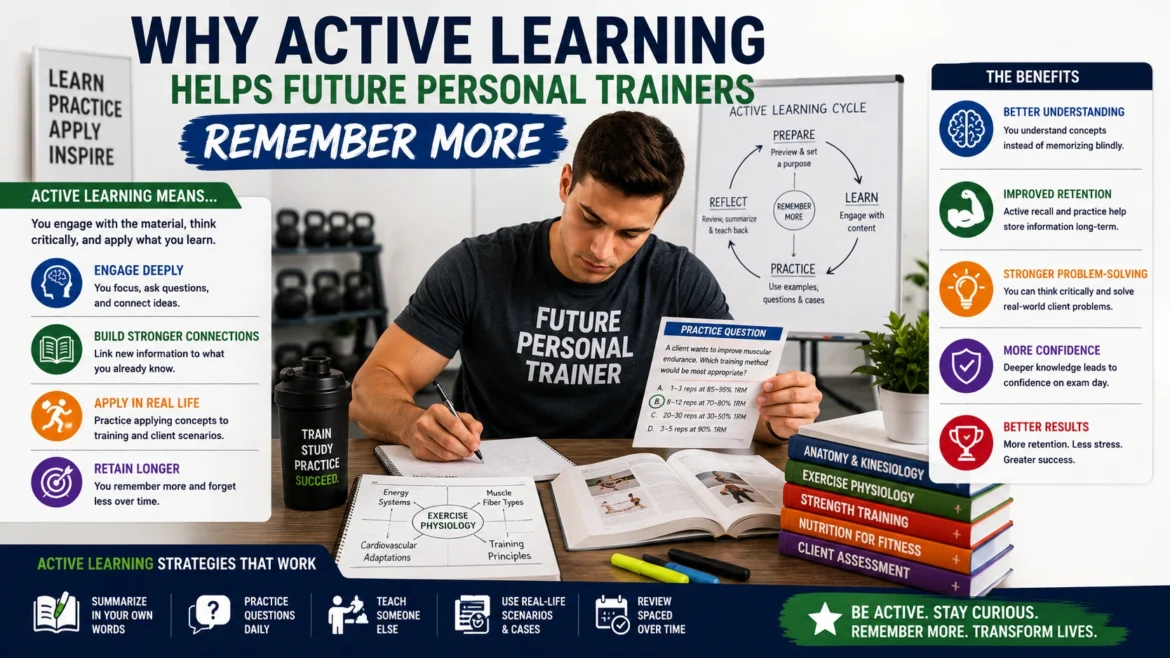
What Active Learning Actually Means
Active learning involves engaging directly with information instead of simply reviewing it repeatedly.
Rather than passively rereading notes, active learners often:
- Answer practice questions
- Analyze realistic scenarios
- Apply exercise-science concepts
- Explain ideas in their own words
- Practice movement-analysis reasoning
- Test their understanding regularly
This process encourages the brain to retrieve and use information repeatedly, which often strengthens long-term retention much more effectively than passive review alone.
Why Passive Studying Often Feels Misleading
Passive studying can create a false sense of confidence because information feels familiar while reading or reviewing it repeatedly.
However, familiarity is not always the same as true understanding or recall ability.
During certification exams, candidates usually cannot rely on recognition alone. Instead, they often need to:
- Interpret exercise situations
- Analyze movement concerns
- Apply fitness concepts logically
- Identify safer recommendations
- Make decisions under pressure
Active learning methods often prepare candidates more effectively for these types of applied reasoning situations.
Why Recognition Is Not Enough
Many candidates recognize exercise-science concepts while reading notes but struggle to explain or apply those concepts independently during realistic exam scenarios.
Why Applying Information Strengthens Memory
One reason active learning works so well is that applying information forces the brain to organize and retrieve concepts repeatedly.
This often strengthens:
Long-Term Retention
Repeated retrieval helps exercise concepts remain easier to remember over time.
Concept Understanding
Candidates develop deeper understanding of movement and training principles.
Applied Reasoning
Fitness concepts become easier to use in realistic client situations.
Many future trainers notice that difficult concepts gradually begin feeling more manageable once they repeatedly apply information through active learning methods.
Why Scenario-Based Learning Helps Future Trainers
Personal training is highly practical and client-focused, which means many certification exams emphasize applied reasoning instead of memorization alone.
Scenario-based learning often helps candidates practice:
- Client-assessment thinking
- Movement-analysis reasoning
- Exercise-program decisions
- Safety-focused recommendations
- Fitness problem-solving
Realistic learning situations often make exercise-science concepts easier to connect with practical fitness applications instead of feeling isolated and abstract.
Why Repetition Helps Information Become Easier to Recall
Many exercise-science concepts initially feel difficult because candidates are exposed to large amounts of new terminology, movement principles, anatomy concepts, and training information within a relatively short period of time.
Repetition often helps reduce this difficulty because repeated exposure strengthens familiarity and improves recall speed over time.
However, the type of repetition used during studying matters significantly.
Not All Repetition Works Equally
Simply rereading information repeatedly may improve familiarity temporarily, but active repetition often strengthens understanding much more effectively.
Candidates usually remember concepts better when they repeatedly apply and retrieve information instead of only reviewing it visually.
Why Active Recall Strengthens Learning
Active recall involves retrieving information from memory instead of immediately looking at notes or study materials for answers.
This process often forces candidates to think more deeply about exercise-science concepts and helps identify areas that still feel unclear.
Active recall methods may involve:
- Answering practice questions
- Explaining concepts aloud
- Reviewing realistic client situations
- Testing movement-analysis understanding
- Applying training concepts independently
Many future trainers improve retention significantly once they begin practicing active recall consistently throughout exam preparation.
Why Passive Review Sometimes Fails
Candidates may feel confident while reading familiar material repeatedly but struggle to retrieve that same information independently during certification exams.
How Practice Questions Encourage Active Learning
Practice questions are often effective because they combine active recall with realistic application.
Candidates must not only remember concepts, but also apply them within situations involving:
Client Safety
Evaluating safer exercise and training recommendations.
Movement Analysis
Applying biomechanics and movement-related reasoning.
Program Decisions
Using exercise-science concepts within realistic fitness scenarios.
Many candidates who understand why practice questions improve personal trainer exam readiness often realize that realistic scenario exposure strengthens both confidence and long-term retention much more effectively than memorization alone.
Why Active Learning Helps Reduce Exam Anxiety
Exam anxiety is extremely common during certification preparation, especially when candidates feel uncertain about their ability to apply information under pressure.
Active learning often reduces anxiety because candidates become more familiar with:
- Scenario-based thinking
- Certification-style questions
- Applied fitness reasoning
- Exercise-science problem-solving
- Timed testing situations
Repeated exposure gradually helps exam situations feel more manageable and less intimidating over time.
Confidence Often Builds Through Practice
Many successful certification candidates become more confident not because the material suddenly becomes easy, but because repeated active practice helps them handle realistic testing situations more comfortably.
Why Practical Application Improves Understanding
Exercise-science concepts often feel easier to understand once candidates begin connecting them to practical fitness situations.
Instead of viewing concepts as isolated textbook information, active learners often begin recognizing how:
- Movement principles affect exercise form
- Program design influences client progress
- Exercise modifications support safety
- Assessment concepts guide training decisions
- Exercise science connects to real-world coaching
This type of practical understanding often helps certification material feel more meaningful, organized, and easier to remember over time.
Why Active Learning Often Improves Long-Term Retention
Many candidates preparing for personal training certifications notice that some concepts disappear quickly from memory after passive study sessions, especially when information is reviewed only once or twice without application.
Active learning often improves long-term retention because candidates repeatedly interact with concepts instead of simply observing them.
This repeated interaction may involve:
- Applying exercise-science principles
- Analyzing realistic client situations
- Answering certification-style questions
- Explaining movement concepts independently
- Practicing scenario-based reasoning
Repeated retrieval and application usually help exercise-science concepts remain more accessible during exams and practical fitness situations later on.
Why Understanding Feels Different From Memorization
Candidates who truly understand fitness concepts often feel more comfortable applying information flexibly in unfamiliar situations instead of depending entirely on memorized wording.
Active learning frequently helps build this deeper level of understanding over time.
Why Future Trainers Benefit From Thinking Through Scenarios
Personal trainers regularly work with clients who have different movement abilities, fitness goals, exercise limitations, and safety concerns.
Because of this, certification exams often test applied reasoning instead of simple recall alone.
Scenario-based active learning may help candidates improve:
Movement Reasoning
Understanding how exercise-science concepts apply to realistic movement situations.
Client Awareness
Evaluating fitness situations with greater safety and practical understanding.
Decision-Making
Building confidence applying concepts during certification-style scenarios.
Over time, realistic application often helps candidates feel more comfortable handling complex fitness questions logically during certification exams.
Why Passive Memorization Becomes Limiting
Candidates who rely heavily on memorization sometimes struggle when certification questions present unfamiliar scenarios requiring flexible reasoning and applied fitness understanding.
Why Consistent Active Learning Usually Works Better Than Cramming
Many future trainers benefit more from smaller and repeated active-learning sessions than from intense last-minute study marathons immediately before certification exams.
Consistent active learning often helps strengthen:
- Long-term concept retention
- Scenario-analysis ability
- Exercise-science understanding
- Testing confidence
- Problem-solving skills
Gradual repetition frequently allows information to feel more organized and easier to retrieve under exam pressure.
Why Better Study Habits Improve Certification Readiness
Many candidates who struggle during certification preparation eventually improve significantly after changing how they study rather than simply studying longer hours.
Candidates who understand common personal trainer exam preparation mistakes and ineffective study habits often realize that active learning strategies help build stronger understanding, better retention, and greater confidence during certification testing situations.
Learning Improvement Usually Happens Gradually
Many successful certification candidates build stronger understanding step-by-step through consistent application, realistic scenario practice, and repeated active engagement with fitness concepts.
Many future trainers improve confidence using ACSM CPT Practice Exam Questions because repeated exposure to realistic certification-style scenarios helps exercise-science concepts feel more practical, organized, and easier to apply during exam situations.
Final Thoughts
Active learning helps future personal trainers remember more because it encourages repeated retrieval, practical application, and deeper engagement with exercise-science concepts instead of passive recognition alone.
Techniques such as practice questions, scenario analysis, movement reasoning, and applied fitness problem-solving often strengthen long-term retention much more effectively than simple memorization.
As personal training certifications continue emphasizing practical reasoning and client-focused thinking, active learning remains one of the most effective ways to improve exam readiness and develop stronger professional understanding.
For many future trainers, active learning helps transform complex exercise-science information into practical knowledge that feels easier to apply confidently during certification exams and real-world fitness coaching situations.