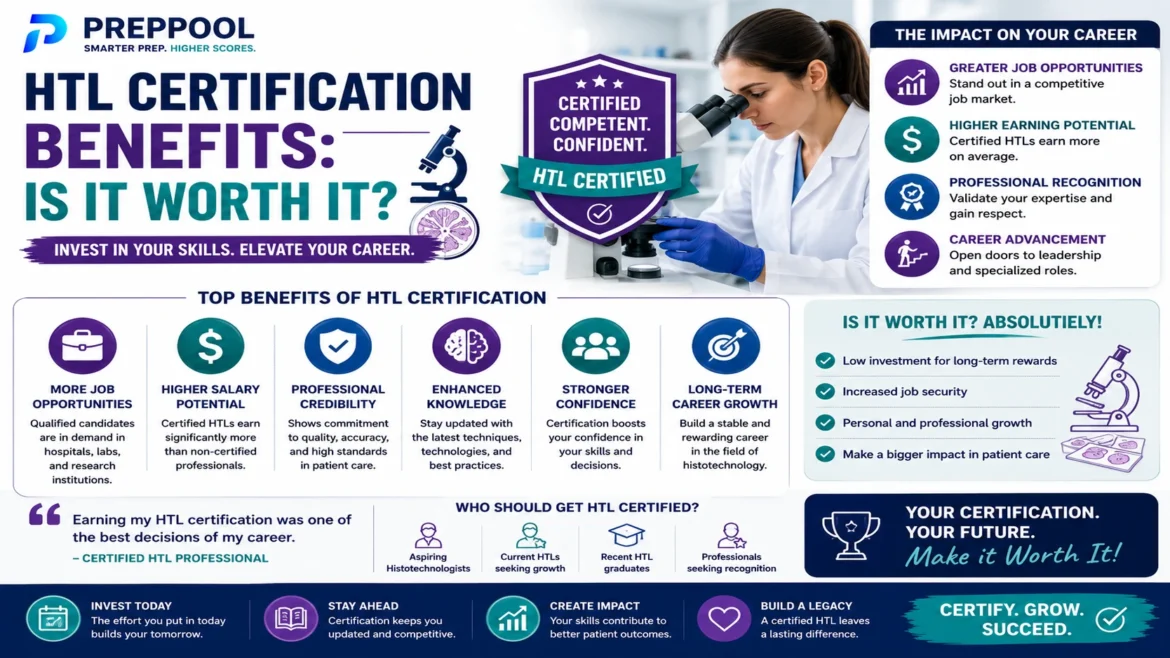

For histotechnologists and laboratory professionals working in pathology and diagnostic medicine, professional certification often represents an important career milestone. Among the most respected credentials in the field is the Histotechnologist (HTL) certification awarded by the American Society for Clinical Pathology (ASCP).
Many professionals considering certification ask the same question: Is HTL certification worth it?
The answer depends on individual career goals, professional aspirations, and personal circumstances. However, for many laboratory professionals, the benefits extend far beyond earning a credential.
HTL certification can strengthen professional credibility, support career advancement, increase confidence, validate technical expertise, and demonstrate commitment to high standards of laboratory practice.
In a healthcare environment that increasingly emphasizes quality, competency, and continuing education, certification remains a valuable way to distinguish yourself professionally.
This guide explores the practical and professional benefits of HTL certification and explains why many histotechnologists view it as an investment in long-term career success.
- Professional recognition.
- Career advancement opportunities.
- Increased confidence.
- Validation of technical expertise.
- Support for leadership opportunities.
- Commitment to professional excellence.
What Is HTL Certification?
The Histotechnologist (HTL) credential is an advanced professional certification designed for laboratory professionals who specialize in tissue preparation and histologic techniques.
Histotechnologists perform highly specialized procedures that help pathologists diagnose disease through microscopic examination of tissue specimens.
The certification demonstrates competency across multiple areas of histotechnology, including tissue processing, embedding, microtomy, staining procedures, immunohistochemistry, laboratory operations, and quality assurance.
Because of the complexity and importance of these responsibilities, certification is widely respected within laboratory medicine.
Why Professional Credentials Matter in Healthcare
Healthcare organizations increasingly rely on professional credentials to help verify competency and maintain quality standards.
Certification provides objective evidence that an individual has met established professional requirements and demonstrated the knowledge expected within a specialized field.
For employers, certification often serves as an indicator of professionalism, technical competence, and dedication to continuous learning.
For employees, certification offers recognition of expertise and commitment to professional growth.
Professional Credibility and Industry Recognition
One of the most immediate benefits of HTL certification is enhanced professional credibility.
Certification demonstrates that a laboratory professional has successfully met nationally recognized standards and possesses advanced knowledge in histotechnology.
This recognition can strengthen professional reputation among supervisors, colleagues, pathologists, laboratory directors, and healthcare organizations.
In many laboratory environments, certification serves as a visible indicator of expertise and commitment to excellence.
Building Confidence Through Certification
Preparing for certification requires candidates to review core concepts, strengthen technical knowledge, and develop a deeper understanding of histotechnology principles.
As candidates work through the certification process, they often gain confidence in both their theoretical knowledge and practical skills.
This increased confidence can positively influence daily job performance, troubleshooting abilities, quality assurance activities, and communication within laboratory teams.
Many certified professionals report that the preparation process itself was one of the most valuable aspects of certification.
Demonstrating Commitment to Professional Excellence
Earning HTL certification requires dedication, discipline, and a willingness to invest time in professional development.
Because of this commitment, employers often view certification as evidence that an individual takes their profession seriously and strives to maintain high standards.
Certification reflects a proactive approach to career growth and continuous improvement.
These qualities are often valued in healthcare environments where quality and accuracy are essential.
How Certification Can Support Career Advancement
Many laboratory professionals pursue certification because they want to strengthen future career opportunities.
Although certification alone does not guarantee promotions or leadership positions, it can enhance a professional profile and demonstrate readiness for greater responsibility.
Employers frequently consider a combination of experience, performance, education, and professional credentials when evaluating advancement opportunities.
Certification can become an important component of that overall professional portfolio.
| Benefit Area | Professional Impact |
|---|---|
| Credibility | Recognition of expertise. |
| Confidence | Improved professional performance. |
| Career Growth | Supports advancement opportunities. |
| Knowledge Development | Strengthens technical competency. |
| Professional Reputation | Enhances industry recognition. |
Why Certification Matters in Pathology Laboratories
Pathology laboratories depend on accurate tissue preparation and reliable laboratory procedures to support diagnostic decision-making.
Histotechnologists play a critical role in this process because specimen quality directly affects microscopic evaluation and diagnostic outcomes.
Certification reinforces the knowledge and skills necessary to maintain these high standards.
As a result, certified professionals often contribute positively to quality assurance efforts and laboratory excellence initiatives.
The Value of Lifelong Learning in Histotechnology
Healthcare and laboratory science continue to evolve as new technologies, diagnostic techniques, and regulatory standards emerge.
Professionals who embrace continuous learning are often better prepared to adapt to these changes and maintain high levels of performance.
Certification reflects a commitment to ongoing professional development and lifelong learning.
This mindset remains valuable throughout an entire laboratory career.
Personal Achievement and Professional Pride
For many laboratory professionals, certification represents more than a credential. It serves as recognition of years of education, training, experience, and dedication.
Successfully earning certification can create a strong sense of accomplishment and reinforce professional identity.
Many certified histotechnologists take pride in knowing they have achieved a respected credential that reflects their expertise and commitment to quality laboratory practice.
This sense of achievement often becomes one of the most rewarding benefits of certification.
The Preparation Process Provides Value Beyond the Exam
One often-overlooked benefit of certification is the preparation process itself. Studying for the examination encourages candidates to revisit important concepts, strengthen weak areas, and deepen their understanding of histotechnology.
Many professionals discover that certification preparation improves their overall laboratory knowledge and enhances their ability to solve technical problems.
Candidates preparing for certification frequently strengthen readiness by working through realistic ASCP HTL practice test explanations that reinforce key concepts while helping identify knowledge gaps before exam day.
The knowledge gained during preparation often continues providing value long after certification has been earned.
How HTL Certification Can Strengthen Your Professional Reputation
Professional reputation is built over time through knowledge, reliability, technical competence, and consistent performance. Certification can support this reputation by providing independent verification of specialized histotechnology expertise.
When colleagues, supervisors, and laboratory leaders see a professional credential, they often recognize the dedication required to earn it. Certification demonstrates that an individual has invested time and effort into expanding their knowledge and validating their skills.
Although a credential alone does not define professional performance, it can strengthen confidence in a person’s capabilities and commitment to quality laboratory work.
For many histotechnologists, certification becomes an important part of their professional identity.
Why Employers Value Certified Histotechnologists
Pathology laboratories and healthcare organizations depend on accuracy, consistency, and quality assurance. Errors in tissue preparation can affect microscopic interpretation and ultimately influence diagnostic outcomes.
Because of these responsibilities, employers often appreciate professionals who demonstrate advanced knowledge and commitment to professional standards.
Certification provides evidence that a candidate has met recognized competency expectations and successfully completed a rigorous certification process.
This can help strengthen an employer’s confidence in an individual’s technical expertise and professional readiness.
- Demonstrates specialized knowledge.
- Supports quality assurance objectives.
- Reflects commitment to professional development.
- Reinforces competency standards.
- Promotes laboratory excellence.
The Relationship Between Certification and Career Growth
Career advancement is often influenced by multiple factors, including experience, performance, education, leadership ability, and professional credentials.
Certification can become a valuable part of this overall professional profile.
Many laboratory professionals pursue certification because they want to position themselves for future opportunities. While certification does not guarantee advancement, it demonstrates initiative and a commitment to continuous improvement.
These qualities are often valued when leadership, supervisory, or specialized positions become available.
Building Leadership Potential Through Professional Development
Laboratory leadership requires more than technical expertise. It also involves communication, problem-solving, quality management, and the ability to support continuous improvement initiatives.
Certification preparation often strengthens many of these skills by encouraging candidates to think critically about laboratory processes and quality standards.
As professionals gain knowledge and confidence, they may feel better prepared to take on additional responsibilities within their organizations.
For some individuals, certification becomes an important step toward future leadership opportunities.
Expanding Technical Knowledge Beyond Daily Responsibilities
Many histotechnologists become highly skilled in the specific procedures performed within their laboratory environment. However, no single workplace exposes professionals to every aspect of histotechnology.
Certification preparation encourages candidates to review a broad range of concepts and procedures that may not be encountered regularly in their current roles.
This expanded perspective often strengthens overall technical competency and promotes a deeper understanding of laboratory science.
Broader knowledge can improve adaptability and support long-term professional growth.
Why Continuing Education Matters in Histotechnology
Advances in pathology, laboratory instrumentation, immunohistochemistry, molecular diagnostics, and quality management continue to shape the future of laboratory medicine.
Professionals who embrace continuing education are often better positioned to adapt to these developments and maintain high standards of performance.
Certification reflects a commitment to ongoing learning and professional excellence.
This commitment remains valuable regardless of future career goals or workplace settings.
Increasing Confidence in Technical Decision-Making
Histotechnologists routinely make decisions that affect specimen quality, staining outcomes, section integrity, and overall laboratory efficiency.
Certification preparation strengthens understanding of the scientific principles behind these decisions.
As knowledge increases, many professionals feel more confident troubleshooting laboratory problems, identifying quality concerns, and implementing corrective actions.
This confidence can positively influence daily job performance and professional satisfaction.
| Professional Benefit | Potential Impact |
|---|---|
| Professional Credibility | Enhanced recognition of expertise. |
| Knowledge Expansion | Broader understanding of histotechnology. |
| Confidence | Improved technical decision-making. |
| Career Development | Supports future opportunities. |
| Leadership Potential | Strengthens professional growth. |
How Certification Supports Laboratory Quality Initiatives
Modern laboratories place significant emphasis on quality assurance, regulatory compliance, and continuous improvement.
Certification reinforces many of the concepts that support these objectives, including specimen integrity, process control, documentation standards, and error prevention.
Professionals who understand these principles can contribute meaningfully to laboratory quality programs and operational excellence initiatives.
These contributions benefit both healthcare organizations and patient outcomes.
The Role of Certification in Specialized Laboratory Practice
Histotechnology is a highly specialized discipline within laboratory medicine. Professionals working in this field perform procedures that require precision, technical expertise, and scientific understanding.
Certification helps validate this specialized knowledge and demonstrates competency within a focused area of laboratory practice.
For many professionals, this recognition represents one of the most valuable aspects of earning the HTL credential.
Specialized expertise often becomes increasingly important as laboratory medicine continues to evolve.
Understanding the Commitment Behind HTL Certification
Earning certification requires dedication. Candidates invest significant time reviewing concepts, strengthening technical knowledge, and preparing for a comprehensive professional examination.
This effort reflects a commitment to personal and professional growth that extends beyond the credential itself.
Many certified professionals view the preparation process as an opportunity to become stronger practitioners while reinforcing the knowledge needed for long-term success.
The commitment required to earn certification often becomes one of its most meaningful benefits.
How Certification Complements Professional Experience
Experience remains one of the most valuable assets in laboratory medicine. However, certification and experience often work best when combined.
Experience provides practical knowledge gained through daily responsibilities, while certification validates broader technical understanding and professional competency.
Together, they create a powerful combination that supports professional credibility and career growth.
Many employers value both practical experience and recognized credentials when evaluating laboratory professionals.
The value of HTL certification extends beyond passing an examination. The knowledge gained, confidence developed, and professional growth achieved during preparation often continue providing benefits throughout an entire career.
Can HTL Certification Increase Earning Potential?
One of the most common questions laboratory professionals ask is whether certification can influence earning potential. While salary levels vary based on location, experience, employer, education, and job responsibilities, professional credentials can strengthen an individual’s overall professional profile.
Many healthcare organizations value certified professionals because certification demonstrates competency, commitment to quality, and dedication to professional development.
Although certification should not be viewed solely as a salary tool, it can contribute positively to long-term career growth and professional opportunities that may influence future earning potential.
For many histotechnologists, certification represents an investment in professional development rather than simply a short-term financial decision.
Career Opportunities Available to Certified Histotechnologists
Histotechnologists work in a variety of laboratory environments that support patient diagnosis, research, education, and scientific advancement.
Certification can strengthen qualifications for opportunities across multiple healthcare settings.
Common employment environments include:
- Hospital pathology laboratories.
- Reference laboratories.
- Academic medical centers.
- Research institutions.
- Biotechnology companies.
- Specialized diagnostic laboratories.
- Government and public health laboratories.
These diverse opportunities make histotechnology an attractive career path for individuals who enjoy laboratory science and diagnostic medicine.
Why Certification Can Support Career Advancement
Career growth often results from a combination of experience, performance, education, leadership ability, and professional credentials.
Certification helps demonstrate initiative and a commitment to maintaining professional standards.
Employers frequently seek individuals who actively invest in their own development and pursue opportunities to expand their knowledge.
Certification can become one important factor that supports future advancement opportunities within laboratory organizations.
- Enhanced professional credibility.
- Recognition of specialized expertise.
- Support for advancement opportunities.
- Greater confidence in technical skills.
- Stronger professional reputation.
- Commitment to continuous learning.
The Growing Importance of Histotechnology in Healthcare
Advances in pathology, cancer diagnostics, molecular medicine, and laboratory technology continue to increase the importance of high-quality tissue preparation and analysis.
Pathologists depend on properly processed specimens, high-quality tissue sections, and accurate staining procedures to make informed diagnostic decisions.
Histotechnologists play a critical role in supporting this process.
As healthcare continues to evolve, specialized laboratory professionals remain essential contributors to patient care and diagnostic excellence.
How Certification Demonstrates Commitment to Quality
Certification reflects more than technical knowledge. It also demonstrates a commitment to quality, professionalism, and accountability.
Healthcare organizations operate in environments where accuracy and consistency are critical. Laboratory professionals who pursue certification often show a willingness to meet higher professional standards and invest in continuous improvement.
This commitment can positively influence how colleagues, supervisors, and employers perceive professional competency.
Quality-focused professionals remain valuable assets within laboratory teams.
The Personal Satisfaction of Achieving Certification
For many candidates, certification represents the culmination of years of education, training, and professional experience.
Successfully earning the HTL credential often provides a strong sense of accomplishment and reinforces professional identity.
The achievement itself can be highly rewarding because it reflects dedication, persistence, and commitment to excellence.
Many certified professionals view the credential as one of the most meaningful milestones in their laboratory careers.
| Certification Advantage | Professional Value |
|---|---|
| Industry Recognition | Demonstrates competency. |
| Professional Credibility | Strengthens reputation. |
| Knowledge Growth | Expands technical expertise. |
| Career Development | Supports advancement opportunities. |
| Confidence | Improves workplace performance. |
Is HTL Certification Worth the Time and Effort?
Preparing for certification requires a meaningful investment of time and energy. Candidates must review histotechnology concepts, strengthen weak areas, complete practice questions, and prepare for a comprehensive examination.
For many professionals, however, the long-term benefits justify the effort required.
Certification supports professional growth, validates expertise, strengthens confidence, and demonstrates commitment to quality laboratory practice.
Many certified histotechnologists report that the knowledge gained during preparation continues to provide value throughout their careers.
How to Prepare for HTL Certification Successfully
While the benefits of certification are significant, achieving those benefits begins with effective preparation.
Candidates who understand exam expectations, develop structured study habits, and focus on concept-based learning often perform more confidently during certification testing.
Individuals beginning the certification process frequently benefit from reviewing a comprehensive ASCP HTL exam guide covering exam content, preparation strategies, and certification success principles before creating a detailed study plan.
Having a clear roadmap often makes preparation more organized and productive.
Why Practice Tests Help Maximize Certification Success
Practice tests provide one of the most effective ways to prepare for certification because they help candidates apply knowledge under realistic testing conditions.
They strengthen recall, improve critical thinking, reveal weak areas, and increase familiarity with certification-style questions.
Practice testing also helps build confidence by reducing uncertainty about the examination process.
Many successful candidates incorporate comprehensive ASCP HTL practice tests and exam-style questions into their preparation strategy to improve readiness before exam day.
Who Benefits Most From HTL Certification?
Although certification can provide value to many laboratory professionals, it is especially beneficial for:
- Histotechnicians seeking career advancement.
- Recent graduates entering the profession.
- Laboratory professionals pursuing specialized expertise.
- Individuals interested in leadership opportunities.
- Candidates seeking professional recognition.
Each professional’s goals may differ, but certification often provides advantages that support both immediate and long-term career development.
Final Verdict: Is HTL Certification Worth It?
For many laboratory professionals, the answer is yes.
HTL certification provides benefits that extend beyond earning a credential. It validates expertise, strengthens credibility, supports professional growth, and demonstrates commitment to quality laboratory practice.
The certification process also encourages continuous learning and helps professionals deepen their understanding of histotechnology.
Whether the goal is career advancement, professional recognition, increased confidence, or personal achievement, HTL certification remains a valuable investment for many individuals working in laboratory medicine.
HTL certification is more than a professional credential. It represents expertise, dedication, continuous learning, and a commitment to maintaining high standards within the field of histotechnology.
Conclusion
HTL certification continues to be one of the most respected credentials within histotechnology and pathology laboratory practice. It validates professional competency, supports career growth, and demonstrates commitment to quality and excellence.
Although certification requires dedication and preparation, many professionals consider it a worthwhile investment that provides benefits throughout their careers.
For histotechnologists seeking professional recognition, expanded opportunities, and stronger confidence in their expertise, HTL certification remains a valuable and rewarding achievement.
Frequently Asked Questions
Is HTL certification worth it?
Many laboratory professionals believe HTL certification is worthwhile because it strengthens credibility, supports career growth, and validates specialized histotechnology expertise.
Can HTL certification help with career advancement?
Certification can strengthen a professional profile and may support future advancement opportunities when combined with experience and strong job performance.
Do employers value HTL certification?
Many employers appreciate certification because it demonstrates competency, commitment to professional standards, and dedication to continuous learning.
Does HTL certification improve professional confidence?
Yes. Many certified professionals report increased confidence after strengthening their knowledge and successfully earning a respected credential.
What is the best way to prepare for HTL certification?
Successful candidates often combine content review, concept-based learning, practice tests, and structured study schedules to improve exam readiness.