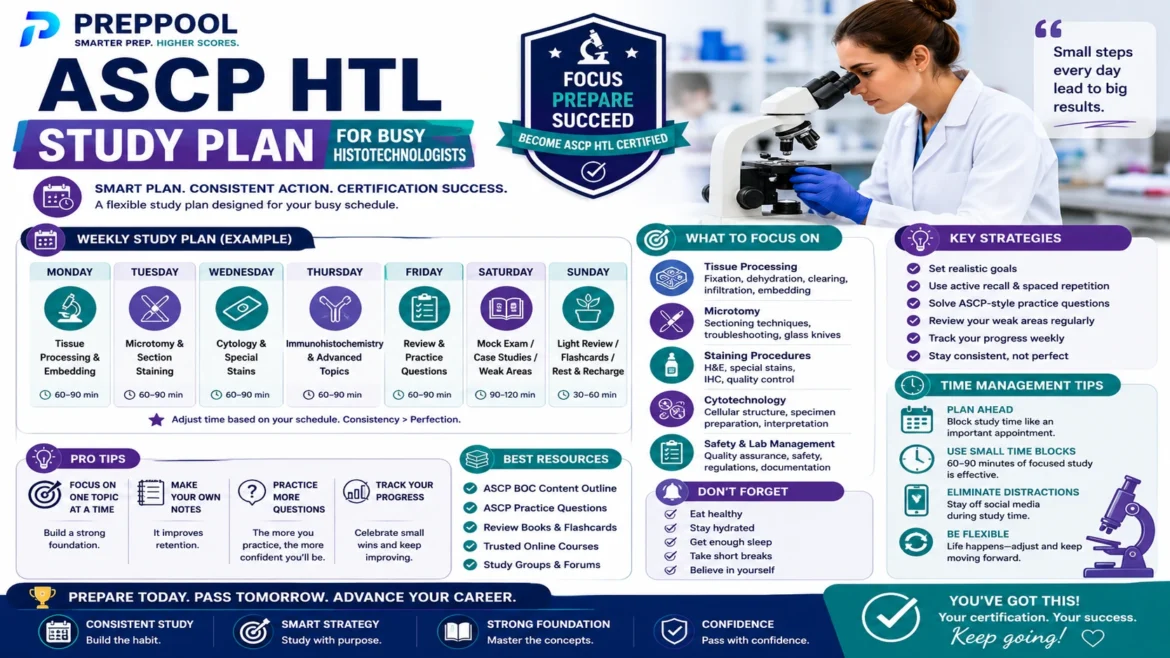

Introduction: Preparing for the ASCP HTL Exam With a Busy Schedule
Preparing for the ASCP Histotechnologist (HTL) certification exam can feel challenging when you’re balancing work responsibilities, family commitments, continuing education, and everyday life. Many candidates assume they need several hours of study time every day to succeed, but that is rarely the case.
In reality, successful exam preparation is usually built on consistency rather than marathon study sessions.
The HTL exam covers a broad range of histotechnology concepts, including tissue fixation, processing, embedding, microtomy, staining procedures, immunohistochemistry, laboratory operations, quality assurance, and safety. Attempting to review everything at once often leads to frustration and burnout.
A structured study plan helps candidates break preparation into manageable steps while ensuring that every major content area receives appropriate attention.
This guide provides a practical study strategy specifically designed for busy histotechnologists who want to prepare efficiently and maximize their chances of passing the HTL exam on their first attempt.
- Improve study efficiency.
- Reduce preparation stress.
- Strengthen weak content areas.
- Increase confidence.
- Build long-term knowledge retention.
- Support first-attempt exam success.
Why Many Candidates Struggle With Exam Preparation
Most HTL candidates are already working professionals. Unlike traditional students, they often have limited study time available each week.
As a result, one of the biggest challenges is finding a study routine that fits into an already busy schedule.
Some candidates delay preparation because they feel they cannot dedicate enough time to studying. Others attempt to study too much at once and eventually become overwhelmed.
A realistic study plan helps solve both problems by creating a sustainable approach that can be maintained over time.
Consistency Matters More Than Study Hours
Many professionals believe they need to study for several hours every day to pass the examination. While extensive study can be helpful, consistency is usually more important than total study hours.
Studying for forty-five minutes several times each week often produces better long-term retention than studying for six hours on a single weekend.
Regular review strengthens memory and helps candidates stay connected to the material throughout the preparation process.
Small study sessions performed consistently can produce significant results over time.
How Much Time Should You Spend Preparing?
The amount of preparation required varies depending on education, laboratory experience, strengths, weaknesses, and familiarity with histotechnology concepts.
Some candidates may need only a few months of structured review, while others may benefit from a longer preparation period.
Rather than focusing exclusively on total study hours, candidates should concentrate on making each study session productive and purposeful.
Quality of study is often more important than quantity.
| Weekly Study Time | Suggested Approach |
|---|---|
| 3–4 Hours | Focused review of one major topic per week. |
| 5–6 Hours | Content review plus practice questions. |
| 7–10 Hours | Comprehensive preparation with assessments. |
| 10+ Hours | Accelerated preparation schedule. |
Start With the HTL Exam Content Areas
Before creating a study schedule, candidates should understand the major subjects covered on the examination.
Many professionals waste valuable time reviewing low-priority material while overlooking topics that appear more frequently during certification testing.
A clear understanding of exam content helps candidates allocate study time more effectively.
This approach also reduces the risk of major preparation gaps.
Breaking the Exam Into Manageable Sections
The broad scope of histotechnology can seem overwhelming when viewed as a single subject. Dividing preparation into smaller content areas makes studying more manageable and organized.
Major study categories typically include:
- Tissue fixation.
- Tissue processing.
- Embedding techniques.
- Microtomy.
- Routine staining procedures.
- Special stains.
- Immunohistochemistry.
- Laboratory operations.
- Quality assurance.
- Safety procedures.
Studying one content area at a time helps candidates maintain focus while gradually building confidence.
Creating a Monthly Study Roadmap
Many successful candidates organize preparation into phases rather than attempting to learn everything simultaneously.
A structured roadmap helps establish priorities and provides a clear sense of progress.
For example, one phase may focus on content review, another on practice questions, and a final phase on weak-area improvement and exam readiness.
This type of organization often makes preparation less stressful and more productive.
Identifying High-Yield Histotechnology Topics
Although every content area deserves attention, some topics often require additional review because they involve complex procedures or large amounts of information.
Many candidates spend extra time reviewing:
- Tissue processing.
- Microtomy.
- Staining procedures.
- Immunohistochemistry.
- Quality assurance principles.
Building confidence in these subjects early often improves overall preparation.
Focus on understanding why laboratory procedures are performed rather than simply memorizing procedural steps. Conceptual understanding often leads to better exam performance.
Why Practice Questions Should Be Included From the Beginning
Many candidates wait until the final weeks before the exam to begin using practice questions. This approach can delay the discovery of important knowledge gaps.
Introducing practice questions early allows candidates to identify weak areas while there is still plenty of time to improve.
Regular use of realistic ASCP HTL practice exam questions helps reinforce learning, improve recall, and build confidence throughout the preparation process.
Practice questions transform passive studying into active learning.
A Real-World Example of Effective Exam Preparation
Jason worked full-time in a pathology laboratory while preparing for HTL certification. Initially, he attempted to study whenever he found spare time, but his approach lacked consistency and direction.
After creating a structured weekly study schedule, he began focusing on one major content area at a time and incorporated practice questions into every study session.
This change allowed him to track progress more effectively and reduce preparation stress.
His experience highlights an important lesson: successful exam preparation is often the result of organization and consistency rather than simply studying longer hours.
Building a Weekly Study Schedule That Fits a Busy Lifestyle
One of the biggest mistakes HTL candidates make is creating study schedules that look good on paper but are impossible to maintain in real life.
Many working professionals begin with ambitious plans that require several hours of study every day. After a few weeks, competing responsibilities make the schedule difficult to maintain, leading to frustration and inconsistency.
The most effective study plans are realistic, flexible, and sustainable.
A study schedule should support your daily responsibilities rather than compete with them.
A Sample Four-Week HTL Study Framework
Although every candidate’s situation is different, a structured framework can provide a useful starting point.
| Week | Primary Focus |
|---|---|
| Week 1 | Tissue fixation, processing, and embedding. |
| Week 2 | Microtomy and routine staining procedures. |
| Week 3 | Special stains and immunohistochemistry. |
| Week 4 | Laboratory operations, quality assurance, and review. |
This type of structure helps candidates maintain organization while ensuring all major content areas receive attention.
Balancing Content Review and Practice Questions
Successful preparation requires both knowledge acquisition and knowledge application.
Many candidates spend most of their time reading textbooks or reviewing notes while neglecting practice questions. Although content review is essential, practice questions help determine whether information can be applied effectively.
A balanced approach often works best:
- Review concepts.
- Complete related practice questions.
- Analyze incorrect answers.
- Revisit weak areas.
- Repeat the process consistently.
This cycle reinforces learning while helping candidates identify opportunities for improvement.
Why Reviewing Mistakes Is More Valuable Than Tracking Scores
Practice-question scores can be helpful indicators of progress, but they do not tell the entire story.
The greatest learning opportunities often come from incorrect answers.
Each missed question highlights a concept that requires additional attention. Candidates who carefully analyze their mistakes often improve faster than those who focus exclusively on achieving higher scores.
Understanding why an answer was incorrect frequently produces more learning than simply knowing the correct answer.
How to Identify Weak Areas Early
One advantage of using practice questions throughout preparation is the ability to identify patterns.
For example, a candidate may consistently perform well in tissue processing but struggle with immunohistochemistry or quality assurance concepts.
Recognizing these trends allows study time to be allocated more strategically.
Focusing on weak subjects often produces the largest improvements in exam readiness.
Studying Tissue Processing More Effectively
Tissue processing forms the foundation of many histotechnology procedures. Because processing errors can affect every subsequent stage of specimen preparation, this topic deserves careful attention.
Rather than memorizing isolated procedures, candidates should focus on understanding the purpose of dehydration, clearing, infiltration, and processing schedules.
When professionals understand why each step is necessary, they often find it easier to troubleshoot laboratory problems and answer application-based questions.
Conceptual understanding remains one of the strongest predictors of exam success.
Mastering Microtomy Without Becoming Overwhelmed
Microtomy is one of the most recognizable responsibilities of a histotechnologist, and many candidates spend considerable time preparing for questions in this area.
Instead of trying to memorize every possible artifact or troubleshooting scenario, focus on understanding the causes of common sectioning problems.
Questions frequently evaluate reasoning and problem-solving rather than simple recall.
Building a strong foundation in microtomy principles often makes advanced topics easier to understand.
Approaching Staining Procedures Strategically
Staining procedures can seem overwhelming because of the large number of techniques, reagents, and applications involved.
A practical strategy is to group related staining methods together and focus on understanding their purpose rather than memorizing extensive lists.
Candidates who understand what a stain demonstrates and why it is used often perform better than those who rely entirely on memorization.
This approach improves both retention and application.
Making Immunohistochemistry Easier to Learn
Immunohistochemistry is an important component of modern pathology laboratories and often appears challenging because of its scientific complexity.
Rather than focusing immediately on technical details, begin with the fundamental concepts behind antibody-antigen interactions and diagnostic applications.
Once these foundations are understood, more advanced topics become easier to learn and retain.
Building knowledge progressively helps prevent information overload.
| High-Yield Topic | Recommended Focus |
|---|---|
| Tissue Processing | Purpose and troubleshooting. |
| Embedding | Tissue orientation principles. |
| Microtomy | Artifact recognition and correction. |
| Staining | Function and interpretation. |
| Immunohistochemistry | Core concepts and applications. |
Using Active Learning Techniques
Passive reading often creates the illusion of progress while producing limited retention.
Active learning strategies encourage deeper engagement with the material and often improve long-term memory.
Examples include:
- Explaining concepts aloud.
- Teaching a coworker or classmate.
- Creating laboratory case scenarios.
- Writing notes from memory.
- Completing practice questions.
These techniques force the brain to retrieve information, which strengthens learning and recall.
Managing Fatigue During Exam Preparation
Preparing for a professional certification exam while working full-time can be demanding. Many candidates experience periods of fatigue, frustration, or declining motivation.
To avoid burnout:
- Take regular breaks.
- Maintain healthy sleep habits.
- Set realistic study goals.
- Celebrate small milestones.
- Focus on progress rather than perfection.
Long-term consistency is generally more valuable than short bursts of intense studying.
Why Understanding the Exam Structure Improves Preparation
Many candidates focus exclusively on content review while overlooking the importance of understanding the examination itself.
Knowing how the certification process works, what topics are emphasized, and what skills are evaluated can make preparation more efficient.
Candidates who want a broader understanding of certification expectations often benefit from reviewing a comprehensive ASCP HTL exam guide that explains exam content, study priorities, and preparation strategies before finalizing their study plans.
The more familiar you become with the exam, the more focused and effective your preparation can be.
A successful HTL study plan is not built around studying more. It is built around studying consistently, focusing on high-yield topics, and learning from mistakes throughout the preparation process.
The Final Two Weeks Before the HTL Exam
The final two weeks before the ASCP HTL examination should focus on reinforcement rather than information overload. At this stage, candidates should avoid attempting to learn large amounts of entirely new material.
Instead, attention should be directed toward strengthening existing knowledge, reviewing weak areas, and improving confidence through consistent practice.
The purpose of the final preparation phase is to transform knowledge into exam readiness.
Candidates who maintain a structured review process during this period often feel more confident and less stressed on exam day.
A Seven-Day Review Strategy Before Exam Day
The final week should be organized and intentional. Rather than studying randomly, focus on major content areas in a systematic way.
| Day | Primary Focus |
|---|---|
| Day 1 | Tissue fixation and processing review. |
| Day 2 | Embedding and microtomy concepts. |
| Day 3 | Routine staining procedures. |
| Day 4 | Special stains and immunohistochemistry. |
| Day 5 | Quality assurance and laboratory operations. |
| Day 6 | Mixed practice questions and weak areas. |
| Day 7 | Light review and mental preparation. |
This approach helps ensure balanced preparation while preventing last-minute cramming.
How to Know You’re Ready for the Exam
Many candidates wonder whether they are truly prepared. While no one feels perfectly ready, there are several signs that indicate strong exam readiness.
- You understand major histotechnology concepts.
- You can explain procedures without relying heavily on notes.
- You consistently perform well on practice questions.
- You understand why previous mistakes occurred.
- You feel comfortable solving laboratory scenarios.
Readiness is not about perfection. It is about demonstrating competency across the major content areas tested on the examination.
Common Study Mistakes to Avoid During the Final Weeks
Even well-prepared candidates can make mistakes during the final phase of preparation.
Some of the most common include:
- Cramming excessive amounts of information.
- Ignoring weaker subjects.
- Taking too many practice exams without reviewing mistakes.
- Studying while exhausted.
- Comparing progress to other candidates.
- Changing study resources at the last minute.
Maintaining consistency and avoiding unnecessary changes often produces the best results.
Why Reviewing Incorrect Answers Matters
Incorrect answers provide some of the most valuable learning opportunities available during exam preparation.
Every mistake reveals a concept that deserves additional attention.
Candidates who carefully analyze why they missed a question frequently improve faster than those who simply move on to the next topic.
The goal is not merely answering questions correctly but understanding the reasoning behind each answer.
Preparing Mentally for Exam Day
Certification exams evaluate both knowledge and composure. Even highly prepared candidates can struggle if anxiety interferes with concentration.
During the final days before the examination:
- Maintain a normal routine.
- Prioritize sleep.
- Avoid excessive studying.
- Prepare testing materials in advance.
- Focus on confidence-building review.
A calm and organized approach often contributes significantly to performance.
Exam-Day Success Strategies
Exam-day preparation begins before arriving at the testing center.
Successful candidates typically:
- Arrive early.
- Bring required identification.
- Read questions carefully.
- Manage time effectively.
- Avoid rushing difficult questions.
- Trust their preparation.
Simple habits can help reduce stress and improve focus throughout the examination.
Why Practice Questions Remain Essential Until the End
Practice questions should remain a central component of preparation right up until exam day.
They reinforce learning, improve recall, strengthen problem-solving skills, and help candidates become comfortable with certification-style testing.
Most importantly, practice questions expose knowledge gaps while there is still time to address them.
Many successful candidates use realistic ASCP HTL practice tests and exam-style questions throughout the final weeks of preparation to maintain confidence and improve readiness.
Understanding the Long-Term Value of Certification
As exam day approaches, it can be helpful to remember why certification matters in the first place.
Certification is not simply about passing a test. It represents professional growth, advanced knowledge, technical competency, and commitment to quality laboratory practice.
Professionals interested in the broader impact of certification often explore the many professional and career benefits associated with earning HTL certification as additional motivation during the preparation process.
Keeping long-term goals in mind can make studying feel more meaningful and rewarding.
Balancing Study, Work, and Personal Responsibilities
Most HTL candidates are working professionals who must balance certification preparation with other commitments.
While it is important to take preparation seriously, it is equally important to maintain balance.
Protecting time for rest, family, and personal well-being helps support sustained concentration and long-term motivation.
Successful preparation is rarely about sacrificing everything else. It is about managing priorities effectively.
| Preparation Habit | Benefit |
|---|---|
| Consistent Study Sessions | Improves retention. |
| Practice Questions | Builds exam readiness. |
| Weak-Area Review | Increases confidence. |
| Proper Rest | Supports concentration. |
| Structured Planning | Reduces stress. |
Your Final HTL Study Plan Checklist
Before exam day, confirm that you have:
- Reviewed all major content areas.
- Completed multiple practice-question sessions.
- Strengthened weak subjects.
- Reviewed incorrect answers thoroughly.
- Developed a time-management strategy.
- Prepared exam-day logistics.
- Maintained healthy study habits.
- Stayed consistent throughout preparation.
This checklist can help ensure that preparation has been both comprehensive and organized.
The most effective HTL study plans are not necessarily the most complicated. They are realistic, consistent, focused on high-yield topics, and designed to fit the candidate’s actual lifestyle.
Conclusion
Preparing for the ASCP HTL exam while managing work and personal responsibilities can be challenging, but it is entirely achievable with the right approach.
By creating a structured study plan, focusing on high-yield content areas, using practice questions regularly, and maintaining consistency, candidates can prepare effectively without becoming overwhelmed.
The most successful candidates are rarely those who study the longest. They are usually the ones who study strategically, learn from mistakes, and remain committed to steady progress over time.
With a realistic plan and consistent effort, passing the HTL certification exam on the first attempt becomes a highly attainable goal.
Frequently Asked Questions
How long should I study for the ASCP HTL exam?
Preparation time varies by candidate, but most professionals benefit from several weeks or months of consistent review combined with practice questions.
What is the best study method for the HTL exam?
A combination of concept-based learning, structured scheduling, practice questions, and weak-area review is often the most effective approach.
Can I prepare for the HTL exam while working full-time?
Yes. Many candidates successfully earn certification while working full-time by following realistic and sustainable study schedules.
When should I start using practice questions?
Practice questions should be introduced early in preparation to identify weaknesses and improve familiarity with certification-style testing.
Is consistency more important than study hours?
In most cases, yes. Consistent study habits often produce stronger retention and better exam readiness than occasional long study sessions.