
Preparing for the Progressive Care Certified Nurse (PCCN) exam can feel overwhelming, especially for nurses balancing demanding work schedules, family responsibilities, and personal commitments. Between long shifts, rotating schedules, continuing education requirements, and everyday obligations, finding consistent study time is often one of the biggest challenges candidates face.
Fortunately, passing the PCCN exam does not require studying for hours every day. What matters most is having a realistic study plan, focusing on high-yield topics, and using available study time efficiently.
Many nurses who successfully earn PCCN certification are not full-time students. They are working professionals who develop practical study routines that fit their lifestyles. The key is consistency, not perfection.
This guide outlines a structured PCCN study plan designed specifically for busy nurses who want to prepare effectively without sacrificing work-life balance.
- Create a realistic study schedule.
- Focus on the highest-yield exam topics.
- Improve retention despite limited study time.
- Strengthen clinical reasoning skills.
- Build confidence before exam day.
Why Most PCCN Study Plans Fail
Many candidates begin preparation with ambitious goals that are difficult to maintain. They schedule lengthy study sessions, attempt to review too much material at once, and become discouraged when life interrupts their plans.
The problem is not a lack of motivation. The problem is often an unrealistic approach.
Busy nurses need study plans that accommodate shift work, changing schedules, and unexpected responsibilities. A plan that looks perfect on paper but cannot be followed consistently is unlikely to produce strong results.
Successful PCCN preparation focuses on sustainability. Small, consistent efforts typically outperform occasional marathon study sessions.
The Reality of Studying While Working Full-Time
Most PCCN candidates continue working while preparing for the exam. Some work twelve-hour shifts, rotating schedules, nights, weekends, or overtime hours. Others balance professional responsibilities with parenting, caregiving, or educational commitments.
These realities make flexibility essential.
Instead of expecting the same study schedule every week, candidates should create adaptable plans that allow for changing circumstances. This flexibility helps maintain momentum even during particularly busy periods.
The goal is not to study perfectly every day. The goal is to make steady progress over time.
How Much Time Should Busy Nurses Spend Studying?
One of the most common questions candidates ask is how many hours they need to study to pass the PCCN exam.
The answer depends on several factors, including clinical experience, familiarity with exam content, current knowledge level, and available preparation time.
For many nurses, studying three to six hours per week over several months is sufficient when combined with focused review and consistent practice questions.
Rather than concentrating solely on total study hours, candidates should focus on study quality. A focused thirty-minute session is often more productive than several hours of distracted reviewing.
| Weekly Availability | Suggested Study Approach |
|---|---|
| 3–4 Hours | Short daily sessions and weekend review. |
| 5–6 Hours | Balanced content review and practice questions. |
| 7+ Hours | Expanded review, practice exams, and weak-area focus. |
The Three Phases of an Effective PCCN Study Plan
Many successful candidates divide preparation into three distinct phases. Each phase builds upon the previous one and serves a different purpose.
Phase 1: Content Review
This stage focuses on understanding major concepts, body systems, patient assessment findings, and evidence-based nursing principles.
Phase 2: Application and Practice
Candidates begin applying knowledge through practice questions, case scenarios, and clinical reasoning exercises.
Phase 3: Exam Readiness
The final phase focuses on practice exams, time management, confidence building, and targeted review of weaker topics.
Following a structured progression often prevents information overload and improves long-term retention.
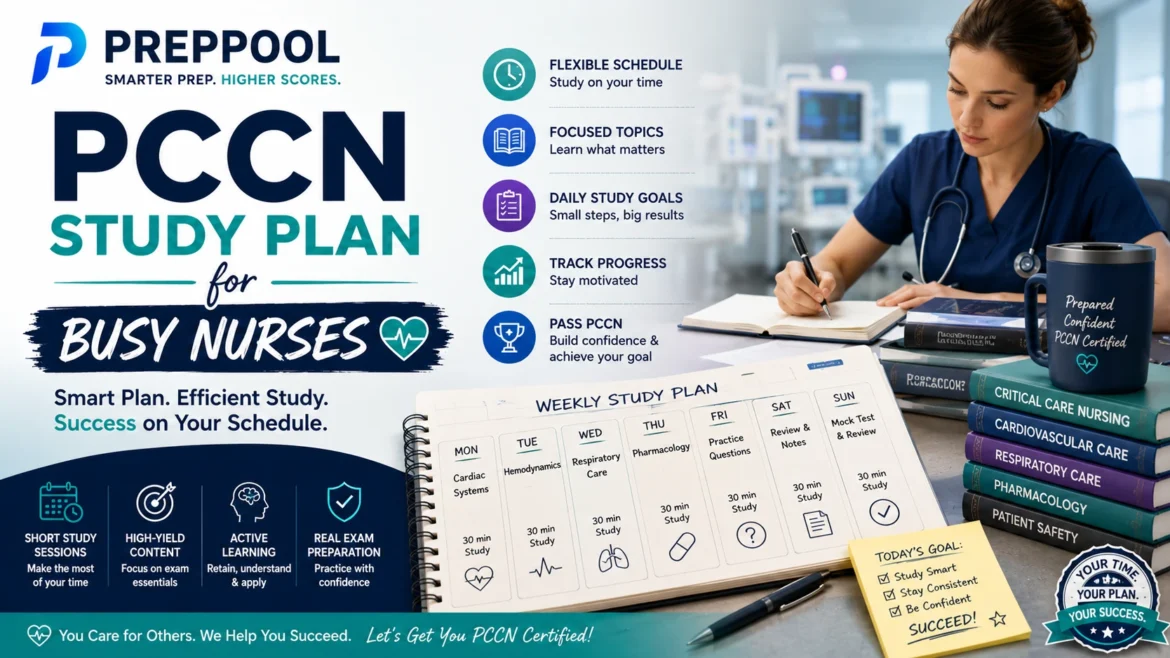
Creating a Weekly PCCN Study Schedule
Busy nurses often benefit from breaking preparation into manageable study blocks rather than attempting lengthy review sessions.
A typical weekly schedule may include:
- Two content review sessions.
- Two practice-question sessions.
- One mistake-analysis session.
- One focused review of weak topics.
This format allows candidates to reinforce knowledge while continuously improving critical thinking skills.
Consistency is more important than duration. Even brief study sessions can produce significant results when repeated regularly.
Keep study materials easily accessible. Many nurses use short breaks, lunch periods, or commute time to review notes, flashcards, or practice questions.
Starting With High-Yield PCCN Topics
Not all exam topics carry equal weight during preparation. While candidates should understand the entire content outline, focusing on high-yield areas early can improve efficiency.
Cardiovascular and respiratory disorders often represent major portions of progressive care nursing practice. Developing a strong understanding of these topics provides a foundation that supports success across multiple question types.
Other important areas include neurological conditions, endocrine disorders, renal complications, multisystem patient care, and professional nursing practice.
Beginning with these high-yield concepts helps candidates build confidence while maximizing study time.
Why Clinical Reasoning Matters More Than Memorization
Many nurses initially approach PCCN preparation as a memorization exercise. While knowledge remains important, certification questions often require candidates to interpret patient information and make sound clinical judgments.
For example, candidates may be asked to identify priority interventions, recognize deteriorating patient conditions, or determine the most significant assessment finding.
These questions require reasoning rather than simple recall.
Successful candidates focus on understanding relationships between symptoms, pathophysiology, assessment findings, and interventions rather than memorizing isolated facts.
Making Practice Questions Part of Your Routine
Practice questions are one of the most efficient tools available to busy nurses because they reinforce knowledge while improving exam readiness.
Even completing a small number of questions each day can strengthen critical thinking skills and reveal knowledge gaps that need additional review.
Many candidates incorporate practice questions into short study sessions because they provide immediate feedback and help maintain engagement.
Working through realistic PCCN practice exam questions and clinical scenarios can help nurses become more comfortable with certification-style thinking while identifying areas that require further study.
A Real-World Example of Successful PCCN Preparation
Daniel worked full-time on a busy telemetry unit while preparing for the PCCN exam. Initially, he struggled to maintain a study schedule because he believed every session needed to last several hours.
After adjusting his approach, he began studying in shorter, focused blocks throughout the week. He reviewed one major topic at a time, completed practice questions regularly, and spent time analyzing mistakes.
Over several months, these small but consistent efforts produced noticeable improvement. By exam day, he felt prepared because he had built knowledge gradually rather than attempting to learn everything at once.
His experience demonstrates an important principle: successful PCCN preparation is often about consistency and strategy rather than sheer study volume.
Building a Monthly PCCN Preparation Roadmap
One of the easiest ways to reduce stress during exam preparation is to create a long-term roadmap. Rather than worrying about everything that needs to be learned, candidates can focus on smaller goals that build toward exam readiness.
A monthly study roadmap provides structure while allowing flexibility for changing work schedules and personal commitments.
| Preparation Stage | Primary Objective |
|---|---|
| Month 1 | Review major body systems and foundational concepts. |
| Month 2 | Increase practice questions and clinical reasoning exercises. |
| Month 3 | Focus on weak areas and exam-style practice. |
| Final Weeks | Complete practice exams and confidence-building review. |
This gradual progression helps candidates stay organized while avoiding the pressure of trying to master everything simultaneously.
How to Study Effectively After a Long Nursing Shift
Studying after a twelve-hour shift can be challenging. Mental fatigue often makes it difficult to concentrate for extended periods, and many nurses find that traditional study methods become less effective when they are exhausted.
Instead of forcing lengthy review sessions, candidates should focus on shorter, high-quality study periods.
Thirty focused minutes reviewing important concepts or completing practice questions can often be more productive than attempting several hours of distracted studying.
On particularly demanding workdays, even reviewing key notes, flashcards, or a small set of practice questions can help maintain momentum without causing burnout.
- Study in short sessions.
- Focus on one topic at a time.
- Use active learning methods.
- Review high-yield concepts first.
- Avoid trying to learn everything in one sitting.
Prioritizing High-Yield PCCN Content Areas
Busy nurses must use study time efficiently. This means focusing on areas that appear frequently in progressive care nursing practice and are commonly represented on certification exams.
Candidates should prioritize:
- Cardiovascular conditions.
- Respiratory disorders.
- Neurological assessment.
- Renal complications.
- Endocrine emergencies.
- Hemodynamic concepts.
- Multisystem patient care.
- Professional caring practices.
Building confidence in these high-yield areas often produces the greatest return on study time invested.
Using Clinical Experience as a Study Advantage
One advantage many PCCN candidates possess is practical nursing experience. Unlike students learning concepts for the first time, working nurses have already encountered many of the conditions discussed during preparation.
Candidates can strengthen retention by connecting study topics to real patient situations they have managed throughout their careers.
For example, reviewing heart failure concepts may be easier when linked to previous patient experiences involving fluid management, medication administration, and symptom monitoring.
Making these real-world connections often improves understanding and helps transform abstract information into practical knowledge.
The Power of Active Learning During PCCN Preparation
Not all study methods are equally effective. Passive techniques such as rereading notes may create a feeling of familiarity, but they do not always improve long-term retention.
Active learning requires candidates to engage directly with the material.
Examples include:
- Answering practice questions.
- Explaining concepts aloud.
- Teaching information to colleagues.
- Creating concept maps.
- Analyzing patient scenarios.
These methods strengthen memory and improve the clinical reasoning skills required for certification success.
Why Reviewing Mistakes Accelerates Learning
Many candidates focus exclusively on scores when completing practice questions. While scores provide useful information, the greatest learning opportunities often come from reviewing incorrect answers.
Every missed question reveals an area that requires additional attention. By understanding why an answer was incorrect, candidates can address misunderstandings before they appear on the actual exam.
Strong candidates treat mistakes as valuable feedback rather than evidence of failure.
This mindset encourages continuous improvement and helps build confidence over time.
Creating a Personalized PCCN Study Schedule
No two nurses have identical schedules, responsibilities, or learning preferences. Because of this, the most effective study plans are personalized rather than copied from someone else.
Some candidates prefer studying before work when energy levels are highest. Others perform better during evenings or weekends. The key is identifying a routine that can be maintained consistently.
When building a schedule, consider:
- Work shifts.
- Family responsibilities.
- Energy levels.
- Learning preferences.
- Available study resources.
A realistic schedule is far more effective than an overly ambitious plan that becomes impossible to maintain.
Balancing Content Review and Practice Questions
One common mistake is spending too much time reviewing information and too little time applying it. While content review is important, candidates also need opportunities to use that knowledge in realistic scenarios.
A balanced approach often includes both content review and question practice within the same week.
This combination reinforces learning while helping candidates become comfortable with certification-style thinking and clinical decision-making.
As exam day approaches, many successful nurses gradually increase the proportion of time spent completing practice questions and analyzing rationales.
Staying Motivated During Long-Term PCCN Preparation
Motivation naturally rises and falls during any extended study process. Busy nurses may experience periods where work demands, personal obligations, or fatigue make studying difficult.
Maintaining motivation often depends on focusing on long-term goals rather than short-term challenges.
Many candidates find it helpful to remind themselves why they are pursuing certification in the first place. Whether the goal is professional growth, increased confidence, career advancement, or personal achievement, keeping that purpose in mind can make difficult study sessions feel more meaningful.
Celebrating small milestones along the way can also help maintain momentum and reinforce progress.
Using a Comprehensive PCCN Exam Guide as a Foundation
Many nurses find it helpful to begin preparation with a broad overview of the certification process before diving into detailed content review. Understanding the exam structure, tested topics, and preparation expectations can make studying more organized and effective.
Candidates looking for a complete overview of certification requirements, study strategies, and exam preparation methods often benefit from reviewing this comprehensive PCCN certification success guide before developing a personalized study plan.
Having a clear understanding of the overall preparation process often makes it easier to prioritize topics and build an efficient study schedule.
Busy nurses do not need unlimited study time to succeed. Consistent effort, smart prioritization, and effective study methods often matter far more than the total number of hours spent preparing.
Your Final 30-Day PCCN Study Plan
The final month before the PCCN exam should focus on refinement rather than information overload. At this stage, candidates should strengthen existing knowledge, improve clinical reasoning, and become comfortable with certification-style questions.
Rather than attempting to learn everything at once, focus on systematic review and targeted improvement.
| Week | Primary Focus |
|---|---|
| Week 1 | Review cardiovascular and respiratory concepts. |
| Week 2 | Review neurological, endocrine, renal, and multisystem topics. |
| Week 3 | Increase practice questions and identify weak areas. |
| Week 4 | Complete practice exams and focus on confidence building. |
This approach helps ensure comprehensive preparation while reducing the stress often associated with last-minute studying.
A Practical 7-Day PCCN Review Schedule
The final week should focus on reinforcement and confidence rather than intensive cramming. Candidates who overload themselves with new information often feel more anxious and less prepared.
- Day 7: Review major body systems and high-yield concepts.
- Day 6: Complete a timed practice-question session.
- Day 5: Review difficult topics and weak areas.
- Day 4: Complete another focused practice session.
- Day 3: Review notes and important clinical concepts.
- Day 2: Light review and confidence-building exercises.
- Day 1: Rest, relax, and prepare for exam day.
This schedule helps candidates remain mentally fresh while keeping key concepts readily accessible.
Common PCCN Study Mistakes Busy Nurses Should Avoid
Even motivated candidates can make preparation mistakes that limit their progress. Recognizing these pitfalls early can improve efficiency and reduce frustration.
- Waiting too long to begin studying.
- Attempting to memorize everything.
- Ignoring weak areas.
- Skipping practice questions.
- Studying inconsistently.
- Failing to review incorrect answers.
- Overloading the final week with new information.
Most of these mistakes are preventable and can be corrected through better planning and consistent execution.
Managing Time During the PCCN Exam
Preparation is important, but candidates should also develop a strategy for exam day itself. Time management can influence performance, especially when dealing with complex clinical scenarios.
During the exam:
- Read each question carefully.
- Identify the patient priority.
- Look for assessment clues.
- Eliminate clearly incorrect options.
- Avoid spending excessive time on a single question.
- Maintain a steady pace throughout the exam.
Many candidates perform better when they focus on clinical reasoning rather than second-guessing every answer.
What to Do the Night Before the PCCN Exam
The evening before the exam should not be spent attempting to learn large amounts of new material. At this point, preparation should shift toward rest and mental readiness.
Helpful actions include:
- Reviewing brief notes if desired.
- Preparing identification and testing materials.
- Confirming travel arrangements.
- Getting adequate sleep.
- Avoiding unnecessary stress.
A rested and focused candidate is generally more likely to perform well than one who studies late into the night.
Building Confidence Before Test Day
Confidence does not come from hoping for success. It comes from preparation. Every practice session, content review, and clinical concept mastered contributes to readiness.
Many candidates underestimate how much they have learned during the preparation process. Reviewing completed study materials and practice results can help reinforce progress and reduce anxiety.
Remember that certification exams are designed to evaluate professional competence. They are not intended to be impossible obstacles.
Trusting the preparation process often helps candidates remain calm and focused during testing.
Balancing Work, Life, and Certification Goals
One of the most impressive aspects of PCCN certification is that many candidates achieve it while managing demanding professional and personal responsibilities.
Working nurses frequently prepare during busy periods of their lives, yet they still succeed because they remain committed to steady progress.
Certification preparation does not require perfection. It requires consistency, adaptability, and a willingness to keep moving forward even when schedules become challenging.
Every small study session contributes to the larger goal of professional growth and certification success.
Why Consistency Beats Intensity
Many candidates believe they need large amounts of uninterrupted study time to pass the PCCN exam. In reality, consistent effort often produces better results than occasional marathon study sessions.
Studying a little each week allows concepts to build gradually and remain fresh over time. This approach also reduces burnout and helps candidates maintain a healthy balance between work, life, and exam preparation.
The nurses who succeed most often are not necessarily the ones who study the longest. They are the ones who study consistently and strategically.
Final PCCN Study Checklist
Before exam day arrives, candidates should confirm that they have completed the following preparation tasks:
- Reviewed major body systems.
- Completed multiple sets of practice questions.
- Analyzed incorrect answers thoroughly.
- Focused on weaker content areas.
- Strengthened clinical reasoning skills.
- Practiced exam-style questions.
- Developed an exam-day strategy.
- Prepared testing logistics in advance.
Completing this checklist can provide reassurance that preparation has been comprehensive and effective.
The best PCCN study plan is not the most complicated one. It is the plan that fits your schedule, supports consistent progress, and helps you stay focused on your certification goal.
Conclusion
Preparing for the PCCN exam while working as a nurse can be challenging, but it is entirely achievable with the right strategy. A realistic study plan, consistent effort, and a focus on clinical reasoning can help candidates make steady progress without becoming overwhelmed.
Successful preparation is not measured by the number of hours spent studying. It is measured by how effectively candidates use their available time to build knowledge, strengthen decision-making skills, and improve confidence.
By creating a structured plan, focusing on high-yield content, practicing regularly, and learning from mistakes, busy nurses can position themselves for success and approach the PCCN exam with confidence.
Frequently Asked Questions
How many weeks should I study for the PCCN exam?
Many nurses begin preparing several weeks or months before their exam date. The ideal timeline depends on experience, knowledge level, and available study time.
Can I pass the PCCN exam while working full-time?
Yes. Many successful candidates prepare while working full-time by using structured study plans and consistent, focused study sessions.
What is the most important part of a PCCN study plan?
Consistency is often the most important factor. Regular review and practice typically produce better results than occasional intensive study sessions.
How many hours per week should I study?
Many candidates study between three and six hours per week, though individual needs vary depending on experience and preparation goals.
Should I focus more on content review or practice questions?
A balanced approach is generally most effective. Content review builds knowledge, while practice questions strengthen clinical reasoning and exam readiness.