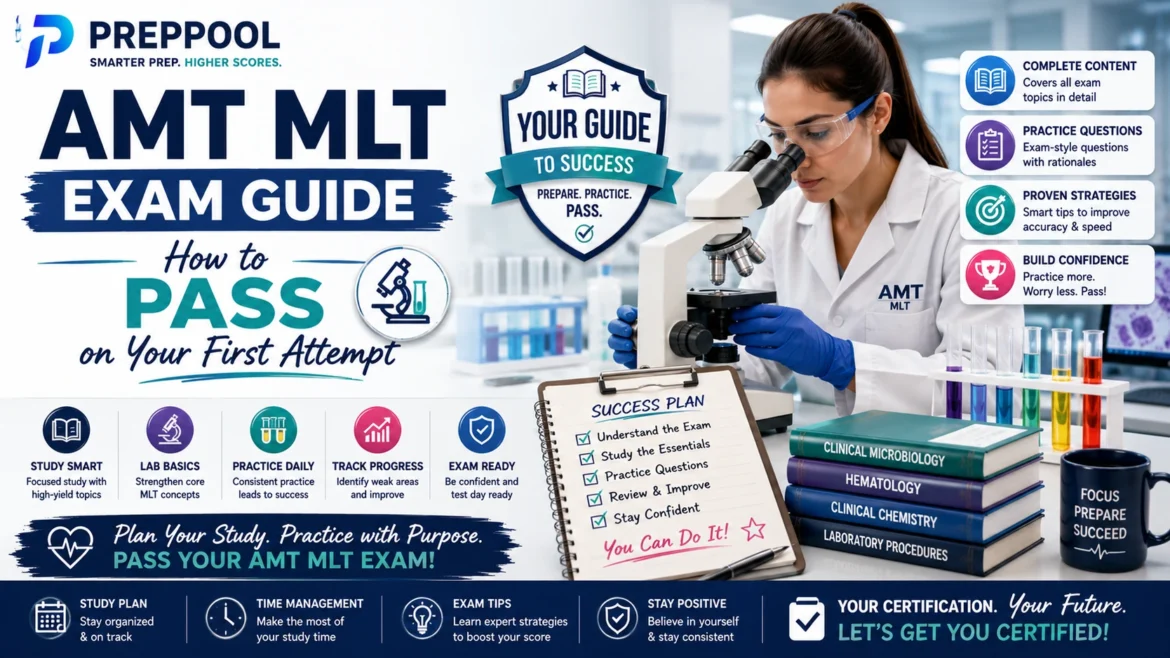

The Medical Laboratory Technician (MLT) certification offered by the American Medical Technologists (AMT) is one of the most recognized credentials for laboratory professionals in the United States. For individuals pursuing a career in clinical laboratory science, earning the AMT MLT certification can demonstrate competency, strengthen employment opportunities, and validate essential laboratory skills.
Healthcare facilities rely heavily on laboratory professionals to provide accurate test results that help physicians diagnose, monitor, and treat patients. Because laboratory findings influence many medical decisions, employers often seek technicians who possess verified knowledge and professional credentials.
The AMT MLT exam serves as an important benchmark for demonstrating readiness to perform laboratory testing in real-world healthcare environments.
For many candidates, the certification process can seem overwhelming at first. Questions about eligibility requirements, exam difficulty, study methods, and passing expectations are common. Understanding the certification process early can help reduce uncertainty and improve preparation.
- What the AMT MLT certification is.
- Who should pursue certification.
- How the exam is structured.
- What topics are tested.
- How to prepare effectively.
- Career opportunities after certification.
What Is the AMT MLT Certification?
The AMT Medical Laboratory Technician certification is a professional credential designed for individuals who perform laboratory testing and diagnostic procedures under established laboratory protocols.
Medical laboratory technicians play a critical role in healthcare by analyzing blood, urine, tissue samples, and other specimens. Their work contributes to the diagnosis and monitoring of countless medical conditions.
The certification demonstrates that a candidate possesses the knowledge and skills required to perform laboratory duties safely, accurately, and professionally.
Employers often recognize certification as evidence of technical competence and commitment to professional standards.
Why AMT MLT Certification Matters
Laboratory medicine remains one of the most important components of modern healthcare. Physicians depend on accurate laboratory results to guide treatment decisions and evaluate patient outcomes.
Certification helps establish confidence in a technician’s abilities by validating knowledge across multiple laboratory disciplines.
For many employers, certification also serves as an indicator of professionalism, accountability, and dedication to quality patient care.
As healthcare organizations continue emphasizing quality and accuracy, professional credentials remain valuable tools for career development.
Who Should Take the AMT MLT Exam?
The AMT MLT certification is intended for individuals who want to work as medical laboratory technicians or who are already working in laboratory settings and wish to obtain professional certification.
Candidates often include:
- Recent graduates of accredited MLT programs.
- Laboratory professionals seeking certification.
- Individuals pursuing career advancement.
- Healthcare professionals transitioning into laboratory roles.
- Candidates meeting AMT eligibility requirements.
Because certification requirements can vary depending on education and experience pathways, candidates should verify eligibility before scheduling the examination.
The Role of a Medical Laboratory Technician
Medical laboratory technicians perform a wide range of duties that support patient diagnosis and treatment. Although laboratory professionals often work behind the scenes, their contributions are essential to healthcare delivery.
Common responsibilities include:
- Collecting and preparing specimens.
- Performing laboratory testing.
- Operating laboratory equipment.
- Analyzing test results.
- Maintaining quality control procedures.
- Following safety and regulatory standards.
These responsibilities require strong technical knowledge, attention to detail, and a commitment to accuracy.
Why Many Candidates Choose AMT Certification
Several organizations offer laboratory certifications, but AMT certification remains a popular choice among healthcare professionals.
Candidates often pursue AMT certification because of its recognition within the healthcare industry, established certification standards, and relevance to laboratory practice.
For many professionals, certification represents both a personal achievement and a valuable career credential.
The process also encourages candidates to strengthen their knowledge and better prepare for real-world laboratory responsibilities.
| Benefit | Why It Matters |
|---|---|
| Professional Recognition | Demonstrates laboratory competence. |
| Career Development | Supports future employment opportunities. |
| Knowledge Validation | Confirms technical understanding. |
| Professional Growth | Encourages continuous learning. |
| Industry Credibility | Recognized within healthcare settings. |
Major Content Areas Covered on the AMT MLT Exam
The certification exam evaluates knowledge across multiple laboratory disciplines. Candidates are expected to understand both technical concepts and laboratory procedures.
Major content areas typically include:
- Hematology.
- Clinical chemistry.
- Microbiology.
- Immunology and serology.
- Urinalysis.
- Laboratory operations.
- Quality assurance and safety.
Success requires a broad understanding of laboratory science as well as the ability to apply knowledge in practical situations.
How Difficult Is the AMT MLT Exam?
One of the most common concerns among candidates involves exam difficulty. While the AMT MLT exam is certainly challenging, it is designed to evaluate competence rather than create obstacles.
Candidates who complete accredited laboratory training programs and prepare consistently often find the exam manageable.
The greatest challenges typically involve applying laboratory knowledge, interpreting results, and understanding procedures across multiple content areas.
Strong preparation and regular practice can significantly improve confidence and performance.
Why Practice Questions Are Important for MLT Success
Reading textbooks and reviewing notes provide important foundational knowledge, but practice questions help candidates understand how concepts are tested.
Practice questions strengthen recall, improve critical thinking, and reveal weak areas that require additional attention.
They also help candidates become comfortable with certification-style questions and testing expectations.
Many successful candidates improve readiness by regularly working through realistic AMT MLT practice exam questions with detailed answer explanations that reinforce both laboratory knowledge and exam confidence.
A Real Example of Certification Supporting Career Growth
Jessica completed a medical laboratory technician program and began working in a community hospital laboratory. Although she possessed strong academic knowledge, she wanted a professional credential that would validate her skills and strengthen future career opportunities.
After earning her AMT MLT certification, she reported increased confidence, stronger professional credibility, and greater recognition of her expertise within the laboratory environment.
Her experience reflects a common theme among certified laboratory professionals: certification often serves as both a professional milestone and a foundation for continued growth.
Understanding the Core Subjects on the AMT MLT Exam
The AMT MLT examination evaluates knowledge across several major laboratory disciplines. Candidates are expected to demonstrate an understanding of laboratory procedures, specimen handling, quality assurance practices, and diagnostic testing principles.
Rather than focusing on a single specialty area, the exam measures competency across multiple aspects of laboratory medicine. This broad approach reflects the real-world responsibilities of medical laboratory technicians who often perform a variety of testing procedures during their daily work.
Building a strong foundation in each content area is essential for long-term success.
Hematology: A High-Importance Exam Topic
Hematology is one of the most important subjects encountered during MLT certification preparation. This discipline focuses on blood components, blood disorders, and diagnostic testing related to the circulatory system.
Candidates should be comfortable with:
- Blood cell identification.
- Complete blood count interpretation.
- Coagulation concepts.
- Anemia classifications.
- Blood smear evaluation.
- Hematologic disorders.
Questions frequently require candidates to recognize abnormal findings and understand their clinical significance.
Clinical Chemistry and Laboratory Analysis
Clinical chemistry involves the analysis of substances found in blood and other body fluids. These tests play a major role in diagnosing disease, monitoring treatment, and evaluating overall health.
Medical laboratory technicians are expected to understand testing methodologies, quality control procedures, reference ranges, and common chemistry analytes.
Strong preparation should include reviewing:
- Glucose testing.
- Electrolyte analysis.
- Liver function studies.
- Renal function testing.
- Enzyme measurements.
- Quality assurance procedures.
Because chemistry testing is widely used in healthcare settings, it remains a major focus of certification preparation.
Microbiology and Infectious Disease Testing
Microbiology is another major component of the AMT MLT exam. Medical laboratory technicians frequently assist with the identification and analysis of microorganisms that cause disease.
Successful candidates should understand:
- Bacterial identification principles.
- Culture techniques.
- Specimen collection requirements.
- Microbial growth characteristics.
- Laboratory safety procedures.
- Basic infectious disease concepts.
Microbiology questions often evaluate both technical laboratory knowledge and practical application skills.
Immunology and Serology Concepts
Immunology and serology focus on the body’s immune response and the detection of antibodies, antigens, and other immune-related components.
These concepts are important because many diagnostic procedures rely on immunologic testing methods.
Candidates should understand the principles behind common laboratory tests as well as the clinical significance of test results.
Developing a solid understanding of immune system fundamentals can make this section much easier to master.
Urinalysis and Body Fluid Examination
Urinalysis remains a routine yet highly valuable diagnostic procedure in healthcare. Laboratory professionals analyze physical, chemical, and microscopic characteristics to assist in disease detection and monitoring.
Candidates should be familiar with:
- Urine specimen evaluation.
- Chemical testing procedures.
- Microscopic examination findings.
- Renal disease indicators.
- Common abnormalities.
Questions may require interpretation of laboratory findings and identification of abnormal results.
Laboratory Operations and Quality Assurance
Technical laboratory skills alone are not enough to ensure accurate patient results. Modern laboratories depend on strict operational standards, quality assurance programs, and safety procedures.
The AMT MLT exam often evaluates a candidate’s understanding of:
- Quality control processes.
- Quality assurance systems.
- Laboratory regulations.
- Safety protocols.
- Specimen handling procedures.
- Documentation requirements.
These topics are critical because laboratory accuracy directly affects patient care and medical decision-making.
Why Understanding Concepts Beats Memorization
Many candidates make the mistake of approaching certification preparation as a memorization exercise. While memorization certainly has a place in exam preparation, understanding laboratory concepts generally provides a greater advantage.
For example, understanding why a laboratory value changes during a disease process often makes it easier to answer multiple questions than simply memorizing isolated facts.
The AMT MLT exam frequently tests application and interpretation rather than simple recall.
Developing conceptual understanding allows candidates to adapt more effectively when encountering unfamiliar scenarios.
| Study Method | Long-Term Effectiveness |
|---|---|
| Memorization Only | Limited retention and application. |
| Concept-Based Learning | Stronger understanding and flexibility. |
| Practice Questions | Improved exam readiness. |
| Clinical Application | Better problem-solving skills. |
Creating an Effective AMT MLT Study Schedule
One of the biggest challenges candidates face is organizing study time efficiently. Without a plan, it is easy to spend too much time on familiar topics while neglecting weaker areas.
An effective study schedule should divide preparation into manageable sections and provide regular opportunities for review and practice.
Many successful candidates dedicate specific study periods to each major content area while incorporating regular practice-question sessions throughout the preparation process.
Consistency is often more important than the total number of hours studied.
How Practice Exams Help Build Confidence
Practice exams play a valuable role in certification preparation because they simulate the experience of answering exam-style questions under realistic conditions.
They also provide insight into strengths and weaknesses, allowing candidates to adjust study priorities before the actual examination.
Many laboratory professionals discover that their confidence increases significantly after completing multiple practice sessions because they become more familiar with testing formats and question styles.
Confidence built through preparation often translates into stronger exam-day performance.
Learning From Mistakes During Preparation
Every incorrect answer represents an opportunity to improve. Candidates who carefully analyze mistakes often make faster progress than those who simply focus on scores.
Reviewing missed questions helps identify knowledge gaps, clarify misunderstandings, and strengthen retention.
Rather than viewing mistakes negatively, successful candidates use them as tools for continuous improvement.
This mindset helps transform preparation into a more productive and rewarding experience.
Candidates who combine content review, conceptual understanding, practice questions, and mistake analysis typically develop stronger exam readiness than those who rely on memorization alone.
How to Pass the AMT MLT Exam on Your First Attempt
Many candidates approach certification with one primary goal: passing the exam on the first try. While there is no single formula that guarantees success, certain preparation habits consistently appear among successful candidates.
Individuals who perform well typically begin preparing early, follow a structured study plan, focus on understanding concepts rather than memorizing facts, and complete large numbers of practice questions throughout their preparation period.
They also identify weak areas early and spend additional time strengthening those topics before exam day.
Success is rarely the result of last-minute cramming. It is usually the outcome of steady, consistent preparation over time.
Common AMT MLT Exam Mistakes to Avoid
Even strong candidates can make preparation mistakes that negatively affect performance. Understanding these common pitfalls can help improve exam readiness.
- Waiting too long to begin studying.
- Focusing only on memorization.
- Ignoring weaker content areas.
- Skipping practice questions.
- Using too many study resources.
- Failing to review incorrect answers.
- Cramming during the final week.
Most of these mistakes are preventable. Candidates who recognize them early often enjoy a smoother and more effective preparation experience.
Developing Strong Test-Taking Skills
Knowledge alone is not always enough to guarantee success. Candidates also benefit from developing effective test-taking strategies.
Some helpful techniques include:
- Reading questions carefully.
- Identifying important laboratory clues.
- Eliminating obviously incorrect answers.
- Avoiding unnecessary assumptions.
- Managing time effectively.
- Remaining calm during difficult questions.
These skills help candidates apply their knowledge more effectively and reduce avoidable errors during testing.
Exam-Day Strategies for AMT MLT Candidates
Exam day should be approached with the same professionalism and preparation that laboratory professionals bring to their daily responsibilities.
Candidates should arrive early, ensure all required identification is available, and allow sufficient time to settle in before testing begins.
During the examination, focus on the information provided in each question. Avoid overthinking scenarios or adding details that are not present.
Maintaining a steady pace and trusting your preparation can help improve both confidence and performance.
How Certification Supports Career Growth
The AMT MLT credential can support career development in several ways. Certification demonstrates technical competence and a commitment to professional standards, qualities that many healthcare employers value.
Certified laboratory professionals often use their credentials to strengthen employment opportunities, pursue advancement, and demonstrate dedication to the profession.
While certification alone does not guarantee promotions or new positions, it can enhance a professional profile and provide an additional level of credibility.
For many technicians, certification becomes an important milestone in their career journey.
Career Opportunities for Medical Laboratory Technicians
Medical laboratory technicians work in a variety of healthcare settings. Their skills are needed wherever diagnostic testing is performed.
Common employment environments include:
- Hospitals.
- Reference laboratories.
- Physician offices.
- Outpatient clinics.
- Public health laboratories.
- Research facilities.
- Specialty testing laboratories.
These diverse opportunities make laboratory medicine an attractive career path for individuals interested in science, healthcare, and diagnostic testing.
| Work Setting | Typical Responsibilities |
|---|---|
| Hospital Laboratory | Routine and specialized patient testing. |
| Reference Laboratory | High-volume specimen analysis. |
| Physician Office Laboratory | Point-of-care and routine testing. |
| Public Health Laboratory | Disease surveillance and public health testing. |
| Research Facility | Scientific testing and data collection. |
Why Medical Laboratory Professionals Remain Essential
Modern healthcare depends heavily on laboratory testing. Physicians use laboratory results to diagnose illnesses, monitor treatment effectiveness, identify infections, and evaluate patient health.
Studies frequently estimate that a large percentage of medical decisions are influenced by laboratory data. This highlights the importance of qualified professionals who can perform testing accurately and maintain high quality standards.
Medical laboratory technicians play a vital role in supporting patient care, even though their work often occurs behind the scenes.
The demand for reliable laboratory services continues to make these professionals valuable members of the healthcare team.
Why AMT MLT Certification Matters in the United States
Healthcare employers increasingly seek professionals who can demonstrate competency through recognized credentials. Certification helps provide assurance that a candidate possesses the knowledge and skills required to perform laboratory duties effectively.
In addition to supporting employment opportunities, certification reflects commitment to professional growth and continuous learning.
As laboratory technology continues to evolve, maintaining professional standards remains important for both healthcare organizations and individual practitioners.
Certification helps reinforce those standards while promoting confidence in laboratory services.
The Long-Term Value of Professional Certification
The benefits of certification often extend well beyond the initial examination. Preparation encourages candidates to strengthen laboratory knowledge, improve critical thinking skills, and deepen their understanding of diagnostic testing.
These improvements can contribute to stronger job performance, increased confidence, and continued professional growth throughout a technician’s career.
Many certified professionals view the credential as an investment in their future rather than simply a test result.
The knowledge gained during preparation often remains valuable long after the examination has been completed.
Using Practice Questions to Build Exam Readiness
One of the most effective ways to prepare for the AMT MLT exam is through consistent practice with realistic certification-style questions.
Practice questions help reinforce content knowledge, improve recall, strengthen problem-solving abilities, and increase familiarity with exam formats.
They also expose weak areas that may require additional study before exam day.
Candidates seeking a comprehensive review often benefit from working through a large collection of AMT MLT practice exam questions designed to simulate real testing conditions while providing detailed explanations for both correct and incorrect answers.
Your Final AMT MLT Preparation Checklist
Before taking the exam, candidates should confirm that they have completed the following preparation steps:
- Reviewed all major content areas.
- Completed multiple practice-question sessions.
- Analyzed incorrect answers carefully.
- Focused on weaker subjects.
- Strengthened laboratory concepts.
- Practiced time management skills.
- Prepared testing logistics.
- Maintained a consistent study routine.
Completing this checklist can help improve confidence and ensure readiness for exam day.
Passing the AMT MLT exam is not about knowing everything. It is about demonstrating competency across key laboratory disciplines through consistent preparation, strong study habits, and effective application of knowledge.
Conclusion
The AMT MLT certification represents an important achievement for aspiring and practicing medical laboratory technicians. It validates technical knowledge, supports professional development, and demonstrates commitment to high standards of laboratory practice.
While the examination requires dedication and preparation, candidates who study consistently, focus on conceptual understanding, and use practice questions strategically can significantly improve their chances of success.
Certification is more than a credential. It is an investment in professional growth, career opportunities, and the ability to contribute meaningfully to patient care through accurate laboratory testing.
With the right preparation and mindset, earning the AMT MLT credential is an achievable and rewarding goal.
Frequently Asked Questions
How hard is the AMT MLT exam?
The exam is challenging because it covers multiple laboratory disciplines, but candidates who prepare consistently and understand key concepts often find it manageable.
What subjects are included on the AMT MLT exam?
Major content areas include hematology, clinical chemistry, microbiology, immunology, urinalysis, laboratory operations, safety, and quality assurance.
How should I study for the AMT MLT exam?
A balanced approach that includes content review, concept-based learning, practice questions, and mistake analysis is generally the most effective strategy.
Is certification important for laboratory technicians?
Certification can strengthen professional credibility, support career growth, and demonstrate competency in laboratory science and diagnostic testing.
Do practice questions help improve AMT MLT exam scores?
Yes. Practice questions help candidates reinforce knowledge, identify weak areas, improve recall, and become more comfortable with certification-style testing.