
Most nurses who pursue the Progressive Care Certified Nurse (PCCN) credential are highly motivated professionals with valuable clinical experience. Many have spent years caring for acutely ill patients, managing complex situations, and developing strong bedside skills.
Despite this experience, some candidates do not achieve the results they expect on their first attempt. Surprisingly, the issue is often not intelligence, work ethic, or clinical competence.
Instead, many unsuccessful attempts can be traced back to preparation mistakes, ineffective study habits, poor exam strategies, or misunderstandings about what the PCCN exam actually measures.
The good news is that many of these mistakes are completely preventable. By recognizing common pitfalls early, candidates can avoid unnecessary setbacks and significantly improve their chances of success.
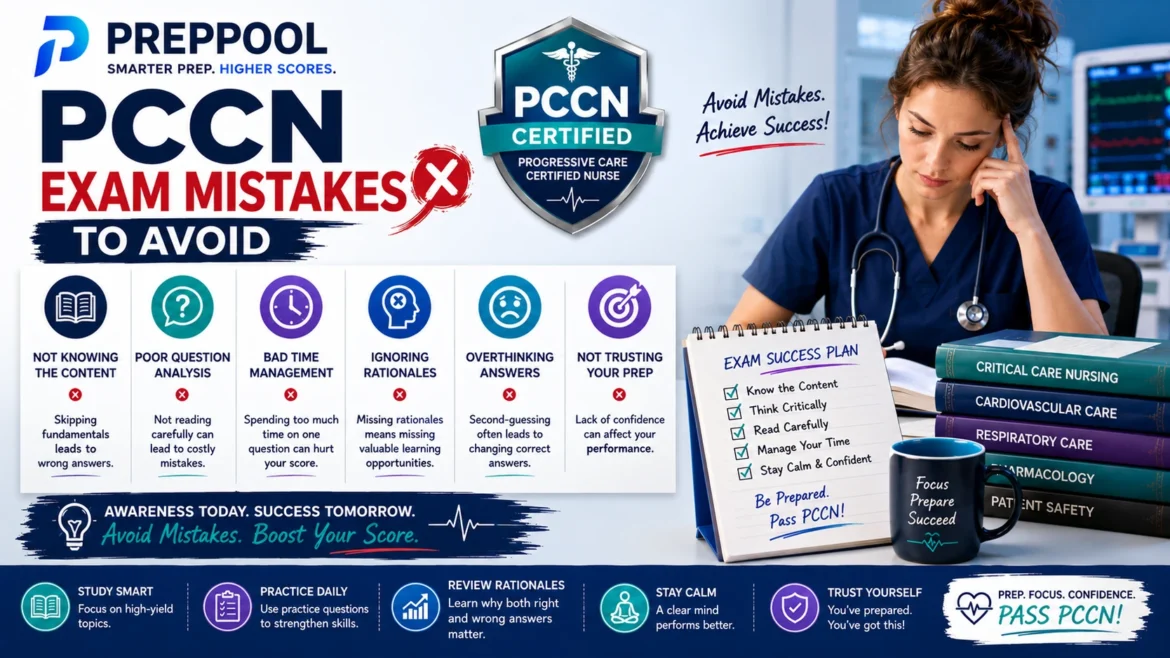
Most Common PCCN Preparation Mistakes
- Starting preparation too late.
- Relying on memorization alone.
- Ignoring weaker content areas.
- Skipping practice questions.
- Failing to review mistakes.
- Underestimating the exam.
Mistake #1: Underestimating the PCCN Exam
One of the most common errors candidates make is assuming that years of clinical experience alone will be enough to guarantee success.
While experience provides a valuable foundation, certification exams evaluate knowledge and clinical reasoning in a structured testing environment. The ability to care for patients effectively and the ability to perform well on an exam are related but not identical skills.
Some nurses postpone preparation because they believe daily practice will naturally prepare them. Unfortunately, this assumption can lead to disappointing results.
Successful candidates respect the exam, prepare intentionally, and approach certification as a professional challenge that requires focused effort.
Mistake #2: Waiting Too Long to Start Studying
Many nurses delay preparation because of busy schedules, family commitments, work responsibilities, or uncertainty about where to begin.
While these concerns are understandable, postponing preparation often creates unnecessary pressure. Candidates who wait until the final weeks before the exam frequently find themselves rushing through large amounts of content.
This last-minute approach can increase stress while reducing long-term retention.
Beginning early allows candidates to study gradually, reinforce concepts consistently, and identify weak areas before exam day arrives.
Mistake #3: Focusing Only on Memorization
Nursing exams often require more than simple recall, and the PCCN exam is no exception. Many questions are designed to evaluate how candidates apply knowledge rather than whether they can memorize isolated facts.
Candidates who spend all their time memorizing laboratory values, definitions, or medication details may struggle when faced with complex patient-care scenarios.
Progressive care nursing requires critical thinking, assessment interpretation, and prioritization. The exam reflects these realities.
Understanding why clinical findings matter is usually more valuable than simply memorizing information about them.
Mistake #4: Ignoring Weak Areas
Most nurses have topics they enjoy studying and topics they would rather avoid. Unfortunately, many candidates spend too much time reviewing familiar material because it feels comfortable.
This creates a false sense of confidence while allowing genuine weaknesses to remain unresolved.
Strong candidates actively seek out areas where they struggle. They use practice questions, content reviews, and self-assessment tools to identify weaknesses and address them systematically.
Growth typically occurs when candidates focus on areas that require improvement rather than repeatedly reviewing concepts they already understand.
Mistake #5: Not Using Practice Questions Early Enough
Some candidates spend months reading textbooks and reviewing notes before attempting any practice questions. While content review is important, delaying practice questions can limit progress.
Practice questions provide insight into how concepts are tested and reveal weaknesses that may not be obvious during passive review.
They also help candidates become comfortable with the style and structure of certification exams.
The earlier practice questions are incorporated into preparation, the more opportunities candidates have to strengthen clinical reasoning and correct misunderstandings.
| Preparation Approach | Potential Problem |
|---|---|
| Memorization Only | Weak clinical application skills. |
| No Practice Questions | Limited exam familiarity. |
| Late Preparation | Higher stress levels. |
| Avoiding Weak Areas | Knowledge gaps remain unresolved. |
| Inconsistent Studying | Poor long-term retention. |
Mistake #6: Studying Without a Plan
Many candidates begin preparing with enthusiasm but without structure. They review random topics, switch between resources frequently, and struggle to measure progress.
Without a plan, it becomes difficult to determine whether preparation is moving in the right direction.
A structured approach helps candidates organize content, prioritize important topics, and maintain consistent momentum throughout the preparation process.
Even a simple study schedule can significantly improve efficiency and reduce uncertainty.
Mistake #7: Treating Every Topic Equally
Not all content areas carry the same weight during certification preparation. While candidates should understand the full exam blueprint, some topics appear more frequently and deserve greater attention.
Failing to prioritize high-yield content can lead to inefficient use of study time.
Successful candidates identify the areas most relevant to progressive care nursing and ensure those concepts receive adequate attention throughout preparation.
This approach helps maximize learning while improving overall readiness.
Mistake #8: Comparing Yourself to Other Candidates
Certification preparation is a personal journey. Unfortunately, many nurses become discouraged when comparing their progress, scores, or study habits to those of colleagues.
Every candidate enters the process with different clinical experiences, strengths, and learning preferences.
What works for one nurse may not work for another. Constant comparison can create unnecessary stress and distract candidates from their own preparation goals.
The most productive approach is focusing on personal improvement rather than external comparisons.
Mistake #9: Ignoring the Importance of Clinical Reasoning
Clinical reasoning sits at the center of progressive care nursing. The PCCN exam frequently requires candidates to evaluate information, recognize patterns, prioritize interventions, and make sound decisions.
Some candidates focus heavily on content review while neglecting opportunities to strengthen reasoning skills.
This can create challenges when answering scenario-based questions that require analysis rather than simple recall.
Developing strong clinical reasoning skills often leads to more consistent performance across all content areas.
A Real Example of How Preparation Mistakes Affect Performance
Maria had several years of progressive care experience and felt confident about her clinical knowledge. Because of her experience, she delayed preparation and spent most of her study time reviewing topics she already understood well.
When she began taking practice questions, she discovered that many of her mistakes involved prioritization and clinical reasoning rather than factual knowledge.
After adjusting her study approach, focusing on weaker areas, and completing regular practice questions, her performance improved dramatically.
Her experience illustrates an important lesson: success often depends less on how much candidates know and more on how effectively they prepare.
Mistake #10: Using Too Many Study Resources at Once
Many PCCN candidates assume that using more study resources automatically leads to better preparation. While having access to quality materials is important, relying on too many resources can actually create confusion.
Different books, courses, notes, and study tools often present information in slightly different ways. Jumping constantly between resources can make it difficult to identify priorities and track progress.
Successful candidates typically select a manageable set of trusted resources and use them consistently throughout preparation.
Depth of understanding is usually more valuable than constantly searching for new materials.
Mistake #11: Studying Passively Instead of Actively
Passive studying is one of the most common reasons candidates feel prepared without actually being ready for the exam. Reading notes repeatedly may create familiarity, but familiarity is not the same as mastery.
Active learning requires candidates to engage directly with the material and apply what they know.
Examples of active learning include:
- Answering practice questions.
- Explaining concepts aloud.
- Teaching material to colleagues.
- Creating clinical scenarios.
- Analyzing patient cases.
These techniques strengthen retention while improving the clinical reasoning skills required for certification success.
Warning SignIf most of your study time involves simply rereading notes, you may be learning less than you think. Active engagement generally produces stronger long-term results.
Mistake #12: Skipping Mistake Analysis
Many candidates complete practice questions, check their scores, and immediately move on. Unfortunately, this approach misses one of the most valuable learning opportunities available.
Every incorrect answer contains information about a knowledge gap, misunderstanding, or reasoning error.
Strong candidates review mistakes carefully and ask themselves:
- Why was my answer incorrect?
- What concept did I misunderstand?
- How can I avoid repeating this mistake?
This process helps transform practice questions into powerful learning tools rather than simple performance measurements.
Mistake #13: Neglecting Time Management Skills
Some candidates focus entirely on content knowledge while ignoring exam-day performance skills. Time management is one of the most important of these skills.
Without proper pacing, candidates may spend too much time on difficult questions and create unnecessary pressure later in the exam.
Developing time-management habits during practice sessions helps create confidence and consistency.
The goal is to maintain a steady pace while still reading questions carefully and evaluating answer choices thoughtfully.
Mistake #14: Letting Anxiety Control Preparation
Feeling nervous about a certification exam is completely normal. However, excessive anxiety can interfere with learning, concentration, and confidence.
Some candidates become so focused on the possibility of failure that they struggle to recognize the progress they are making.
Managing anxiety begins with preparation. The more familiar candidates become with the content, exam format, and testing process, the more confidence they often develop.
Preparation should focus on improvement rather than perfection.
Mistake #15: Cramming During the Final Week
Last-minute cramming remains one of the most common certification preparation mistakes. Candidates who attempt to learn large amounts of new information in the days before the exam often experience increased stress and reduced retention.
The final week should focus on reinforcement rather than overload.
Reviewing high-yield concepts, analyzing previous mistakes, and completing targeted practice questions generally produces better results than attempting to study everything at once.
Consistency throughout the preparation process is far more effective than panic-driven studying at the end.
Mistake #16: Ignoring the Exam Blueprint
The PCCN exam is designed around specific content areas and clinical competencies. Candidates who ignore the exam blueprint may spend significant amounts of time reviewing topics that have relatively little impact on overall performance.
Understanding what the exam emphasizes helps candidates prioritize study efforts and allocate time more effectively.
A strong preparation strategy aligns study activities with the knowledge and skills most relevant to certification success.
This targeted approach often improves efficiency while reducing unnecessary stress.
| Common Mistake | Potential Consequence |
|---|---|
| Too Many Resources | Information overload and confusion. |
| Passive Studying | Poor retention and application. |
| Skipping Mistake Reviews | Repeated errors. |
| Poor Time Management | Exam-day pressure. |
| Final-Week Cramming | Increased stress and fatigue. |
Why Structured Preparation Prevents Most PCCN Mistakes
Many of the mistakes discussed in this guide share a common cause: lack of structure. Candidates who prepare without a plan often struggle with prioritization, consistency, and progress tracking.
Establishing a clear preparation framework helps eliminate uncertainty and reduces the likelihood of overlooking important content areas.
Nurses seeking a complete overview of certification requirements, study expectations, and exam preparation strategies often benefit from reviewing this step-by-step PCCN certification preparation resource before creating their study schedule.
Having a roadmap makes preparation more efficient and less overwhelming.
How a Study Schedule Helps Candidates Avoid Burnout
Burnout is another issue that affects many candidates during certification preparation. Nurses already manage demanding work environments, making it important to balance studying with personal well-being.
A realistic schedule helps prevent exhaustion by spreading preparation across manageable study sessions rather than relying on marathon review periods.
Candidates who need a practical approach often find success by following a structured PCCN study plan created specifically for working nurses that accommodates shift work and other professional responsibilities.
Consistency and sustainability are usually more effective than intensity.
Mistake #17: Forgetting the Bigger Purpose of Certification
Some candidates become so focused on passing the exam that they lose sight of why certification matters in the first place.
The purpose of PCCN certification extends beyond earning a credential. It involves strengthening clinical knowledge, improving patient care, and supporting professional growth.
Remembering this broader purpose can help maintain motivation during difficult study periods and make the preparation process feel more meaningful.
Certification is not simply an exam—it is an investment in professional development and patient-care excellence.
Most PCCN exam mistakes are preventable. Candidates who prepare consistently, review mistakes, focus on clinical reasoning, and follow a structured study plan place themselves in a much stronger position for success.
Mistake #18: Ignoring Exam-Day Preparation
Many candidates devote significant attention to studying while overlooking the practical aspects of exam day itself. Even strong preparation can be undermined by avoidable logistical mistakes.
Waiting until the last minute to verify testing details, locate identification documents, or confirm travel plans can create unnecessary stress before the exam even begins.
Successful candidates prepare for exam day just as carefully as they prepare academically. They know where they are going, what they need to bring, and how they plan to arrive on time.
Reducing logistical stress allows more mental energy to be directed toward answering questions effectively.
Mistake #19: Losing Confidence After Difficult Questions
Almost every PCCN candidate encounters questions that feel challenging. One of the biggest mistakes nurses make is allowing a single difficult question to affect their confidence throughout the remainder of the exam.
Certification exams are designed to evaluate a broad range of knowledge and skills. Missing one question—or even several difficult questions—does not determine the final outcome.
Strong candidates recognize that uncertainty is normal. They answer the question to the best of their ability, move forward, and maintain focus on the next item.
Staying mentally resilient can have a significant impact on overall performance.
Confidence Mistake to AvoidDo not assume you are performing poorly simply because a question feels difficult. Challenging questions are a normal part of the certification process.
Mistake #20: Constantly Changing Answers
Many candidates second-guess themselves during the exam. While there are situations where changing an answer is appropriate, repeatedly revising answers without a clear reason can reduce accuracy.
Research across many testing environments has shown that first instincts are often correct when they are based on knowledge and reasoning rather than guessing.
If a candidate identifies a genuine mistake, changing an answer may be beneficial. However, changing answers purely because of uncertainty often creates unnecessary problems.
Trusting preparation and clinical judgment can help reduce this tendency.
Mistake #21: Focusing on Perfection Instead of Competence
Some candidates approach the PCCN exam believing they must answer nearly every question correctly in order to pass. This mindset creates unnecessary pressure and can increase anxiety.
The goal of certification is to demonstrate competence, not perfection. Candidates do not need flawless performance to succeed.
Focusing on consistent reasoning, patient priorities, and sound decision-making is far more productive than striving for impossible perfection.
Understanding this distinction often helps candidates approach the exam with a healthier and more effective mindset.
Mistake #22: Neglecting Self-Care During Preparation
Busy nurses often place professional responsibilities above their own well-being. During certification preparation, this tendency can become even more pronounced.
Some candidates sacrifice sleep, exercise, nutrition, and personal time in an attempt to maximize study hours. Ironically, these sacrifices can reduce concentration, memory retention, and overall performance.
Maintaining physical and mental health is an important part of exam preparation.
Rested, healthy candidates are often better able to process information and perform effectively under pressure.
How Successful PCCN Candidates Think Differently
Successful candidates often share several common characteristics. They understand that preparation is a long-term process rather than a last-minute event.
They focus on improvement rather than comparison, consistency rather than intensity, and understanding rather than memorization.
Most importantly, they view mistakes as opportunities to learn rather than evidence of failure.
This growth-oriented mindset helps them remain resilient throughout the preparation journey.
| Unsuccessful Approach | Successful Approach |
|---|---|
| Cramming | Consistent preparation |
| Memorization only | Clinical reasoning focus |
| Avoiding weak areas | Targeting weaknesses |
| Ignoring mistakes | Learning from mistakes |
| Seeking perfection | Demonstrating competence |
A Better Alternative to Common Preparation Mistakes
The best way to avoid most PCCN mistakes is to replace ineffective habits with proven preparation strategies.
Successful candidates typically:
- Start preparation early.
- Follow a structured study plan.
- Use practice questions consistently.
- Review mistakes carefully.
- Focus on clinical reasoning.
- Manage stress effectively.
- Maintain realistic expectations.
These habits create a strong foundation for certification success and reduce the likelihood of preventable errors.
Remember Why You Pursued PCCN Certification
Certification preparation can sometimes feel overwhelming, especially when balancing work, family, and other responsibilities. During difficult moments, it can be helpful to remember why the certification journey began.
For many nurses, the goal extends beyond passing an exam. PCCN certification supports professional growth, strengthens clinical expertise, and demonstrates commitment to high-quality patient care.
Nurses interested in the broader professional impact of specialty credentials often find motivation in exploring the many career, confidence, and professional development advantages associated with PCCN certification.
Keeping these long-term benefits in mind can help maintain focus and motivation throughout preparation.
Learn From Proven PCCN Success Strategies
Avoiding mistakes is only part of the equation. Candidates also benefit from learning the habits and strategies that consistently support exam success.
Understanding how to approach certification questions, prioritize patient needs, and manage exam-day challenges can strengthen performance significantly.
Many nurses improve readiness by reviewing proven PCCN test-taking techniques and exam success strategies that complement content review and practice-question preparation.
Combining strong knowledge with effective testing skills often produces the best results.
Your Final PCCN Preparation Checklist
Before sitting for the exam, candidates should confirm that they have completed the following steps:
- Reviewed major content areas.
- Completed multiple practice-question sessions.
- Focused on weaker topics.
- Analyzed incorrect answers.
- Developed a test-taking strategy.
- Practiced time management.
- Prepared exam-day logistics.
- Maintained healthy study habits.
Completing this checklist can provide reassurance that preparation has been both comprehensive and effective.
Most PCCN exam failures are not caused by a lack of intelligence or dedication. They are often the result of preventable preparation mistakes. Recognizing and avoiding these pitfalls can dramatically improve the likelihood of success.
Why Practicing with Realistic PCCN Questions Helps Prevent Costly Mistakes
Many of the preparation mistakes discussed in this guide share a common theme: candidates often do not discover weaknesses until it is too late. Reading notes and reviewing content can create a sense of confidence, but certification exams ultimately require nurses to apply knowledge in realistic patient-care situations.
Practice questions help bridge this gap by exposing candidates to the types of clinical scenarios, prioritization challenges, and decision-making situations commonly encountered during certification testing.
More importantly, practice questions provide immediate feedback. Candidates can identify knowledge gaps, strengthen weaker areas, and improve clinical reasoning skills long before exam day arrives.
Nurses who consistently work through realistic exam-style scenarios often become more comfortable recognizing patterns, evaluating patient priorities, and selecting the most appropriate interventions under pressure.
For candidates looking to strengthen exam readiness while reducing the risk of common preparation mistakes, using a comprehensive collection of PCCN practice questions with detailed rationales and exam-style scenarios can be one of the most effective ways to build confidence and improve performance before test day.
When combined with structured studying, mistake analysis, and strong test-taking strategies, consistent question practice helps transform knowledge into the clinical decision-making skills required for PCCN certification success.
Conclusion
The PCCN exam challenges candidates to apply clinical knowledge, prioritize patient needs, and demonstrate sound nursing judgment. While the exam is demanding, many common obstacles can be avoided through thoughtful preparation and effective study habits.
By starting early, focusing on clinical reasoning, using practice questions consistently, reviewing mistakes, and maintaining a structured approach, candidates can avoid the errors that commonly undermine performance.
Success rarely comes from perfection. It comes from preparation, consistency, and a willingness to learn throughout the certification journey.
Nurses who approach the PCCN exam with realistic expectations and proven strategies place themselves in a strong position to achieve certification and continue advancing their professional growth.
Frequently Asked Questions
What is the most common PCCN exam mistake?
One of the most common mistakes is relying on memorization alone instead of developing strong clinical reasoning and decision-making skills.
Can I pass the PCCN exam if I struggle with practice questions?
Yes. Practice questions are designed to identify weaknesses. Reviewing incorrect answers and learning from mistakes often leads to significant improvement.
How early should I begin preparing for the PCCN exam?
Most candidates benefit from starting preparation several weeks or months before their exam date to allow sufficient time for review and practice.
Should I focus on weak areas or strong areas during preparation?
While maintaining overall knowledge is important, targeting weaker areas often produces the greatest improvement in exam readiness.
How can I avoid feeling overwhelmed during PCCN preparation?
Following a structured study plan, setting realistic goals, and focusing on steady progress can make preparation more manageable and less stressful.