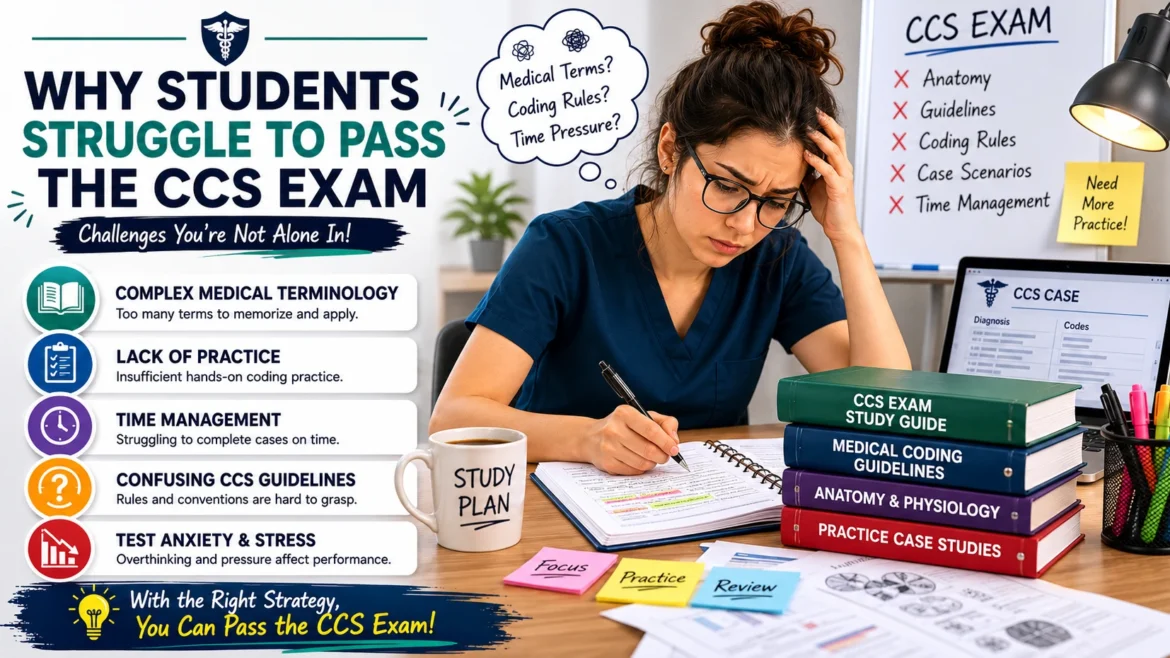

However, once they sit for the actual certification exam, many quickly realize the experience feels far more challenging than expected.
Some students leave the exam feeling overwhelmed by:
- Complex coding scenarios
- Documentation interpretation
- Time pressure
- Analytical coding decisions
- Operational healthcare logic
This experience is extremely common among CCS candidates.
Why Many Students Find CCS Difficult
- Memorizing without understanding coding logic
- Difficulty interpreting healthcare documentation
- Time-management pressure during coding scenarios
- Complex compliance and guideline questions
- Overconfidence from passive studying
The CCS Exam Tests More Than Memorization
One of the biggest surprises for many students is realizing that CCS preparation involves much more than memorizing codes or terminology.
The certification often evaluates how well students can:
- Interpret healthcare documentation
- Apply coding guidelines logically
- Analyze operational coding situations
- Identify documentation inconsistencies
- Understand healthcare workflow relationships
Students who rely only on memorization frequently struggle when coding questions require deeper analytical thinking.
Important Exam Reality:
The CCS exam often evaluates coding judgment and documentation interpretation more than simple memorization alone.
Why Documentation Interpretation Feels Challenging
Many students underestimate how important documentation analysis becomes during CCS preparation.
Healthcare records may contain:
- Complex terminology
- Incomplete details
- Multiple diagnoses
- Procedure documentation
- Operational healthcare context
Students who struggle reading documentation carefully often find coding decisions much harder during certification scenarios.
Because healthcare coding depends heavily on accurate documentation interpretation, students must learn to think beyond isolated code memorization.
Why Time Pressure Affects CCS Students So Much
Many CCS candidates perform reasonably well during untimed practice sessions but struggle once real testing pressure begins.
Students commonly experience:
- Overthinking coding decisions
- Spending too long on difficult cases
- Second-guessing answers
- Mental fatigue during long scenarios
Because coding questions often require careful documentation review, time pressure can quickly affect concentration and confidence.
| Common CCS Challenge | Why It Causes Problems |
|---|---|
| Documentation interpretation | Requires analytical reading and operational coding judgment |
| Coding guideline application | Students may memorize rules without understanding operational logic |
| Long coding scenarios | Mental fatigue increases during detailed case analysis |
| Time management | Students may spend too much time reviewing difficult cases |
Source: General CCS preparation challenges and healthcare coding workflow principles.
Why Passive Studying Often Fails
Some students spend hours reading textbooks or reviewing coding terminology without actively practicing documentation analysis and operational coding scenarios.
This often creates false confidence because recognizing information while studying is very different from applying coding logic during timed certification situations.
Many students preparing for coding careers improve confidence using CCS coding scenarios and certification-style questions because repeated exposure to operational documentation workflows helps coding decisions feel more natural and less overwhelming before exam day.
Why Coding Logic Feels Harder Than Expected
Many students initially believe CCS preparation mainly involves memorizing coding systems and guidelines.
However, coding scenarios often require students to apply operational reasoning rather than simply recalling definitions.
Students may need to evaluate:
- Documentation consistency
- Procedure relationships
- Diagnosis sequencing
- Coding guideline application
- Healthcare workflow context
This analytical side of coding is one reason many students find CCS significantly more difficult than expected.
Important Preparation Insight:
Strong CCS preparation usually comes from understanding documentation logic and operational coding workflows rather than memorizing isolated codes mechanically.
Why Students Often Misread Documentation Scenarios
Healthcare documentation can contain multiple diagnoses, procedures, abbreviations, and operational details within a single case.
Under testing pressure, students sometimes:
- Miss important documentation details
- Apply coding guidelines incorrectly
- Overlook sequencing logic
- Focus on terminology instead of context
- Rush through longer coding cases
Because CCS coding depends heavily on careful interpretation, small reading mistakes can quickly affect larger coding decisions.
| Study Habit | Possible Exam Problem |
|---|---|
| Passive reading only | Weak operational coding judgment during scenarios |
| Memorization without practice | Difficulty applying coding guidelines under pressure |
| Limited documentation review | Missed details inside coding scenarios |
| Untimed practice only | Poor pacing during the actual CCS exam |
Source: General CCS preparation patterns and healthcare coding workflow principles.
Why Students Sometimes Feel Mentally Exhausted
CCS preparation often requires students to process large amounts of detailed healthcare information repeatedly.
Students may study:
- Coding systems
- Healthcare terminology
- Documentation workflows
- Compliance concepts
- Operational healthcare logic
Over time, this information load can create mental fatigue — especially for students balancing work, family responsibilities, or healthcare coursework simultaneously.
Many candidates begin doubting themselves not because they lack ability, but because coding preparation requires sustained analytical concentration.
Helpful Perspective:
Many successful CCS candidates struggled during preparation initially. Coding confidence often improves gradually through repeated exposure to realistic documentation and operational coding scenarios.
Why Operational Understanding Improves Coding Confidence
Students who understand how coding accuracy affects healthcare operations and compliance systems often approach coding preparation with stronger long-term understanding instead of focusing only on memorization.
When students begin seeing how coding connects to reimbursement, reporting, documentation quality, and healthcare coordination, coding scenarios often become more logical and easier to analyze.
Why Anxiety Makes Coding Questions Feel Harder
Many CCS candidates place enormous pressure on themselves because certification often represents career advancement or long-term healthcare opportunities.
This pressure sometimes causes students to:
- Second-guess correct answers
- Rush documentation review
- Lose focus during difficult cases
- Overanalyze coding details
Students who build calmer and more structured study habits often perform more confidently during operational coding scenarios.
What Strong CCS Candidates Usually Do Differently
Students who perform well on the CCS exam often prepare differently from those who rely mainly on memorization.
Instead of focusing only on codes and terminology, strong candidates usually spend more time:
- Reviewing realistic documentation scenarios
- Practicing coding logic step by step
- Analyzing operational healthcare workflows
- Reviewing incorrect answers carefully
- Improving time-management habits
This type of preparation helps coding decisions feel more natural and organized during the actual exam.
Preparation Reality:
Many CCS students improve dramatically once they stop treating coding as memorization alone and begin understanding the operational logic behind documentation and coding decisions.
Why Reviewing Mistakes Matters So Much
Some students complete practice questions quickly but spend very little time reviewing why answers were incorrect.
However, many important coding lessons happen during error analysis.
Strong students often ask themselves:
- Did I misunderstand the documentation?
- Did I apply the guideline incorrectly?
- Did I miss sequencing logic?
- Was the issue operational reasoning or terminology?
This reflection process helps students strengthen both coding judgment and documentation analysis skills over time.
Why Confidence and Readiness Are Not Always the Same
Some CCS candidates feel confident because they recognize terminology and guidelines while studying.
However, recognition alone does not always translate into strong coding performance during timed operational scenarios.
The CCS exam often requires students to:
- Interpret detailed healthcare records
- Apply coding logic under pressure
- Analyze documentation relationships
- Maintain focus during longer cases
Students who actively practice realistic coding workflows usually develop much stronger operational readiness before exam day.
| Preparation Approach | Long-Term Result |
|---|---|
| Passive memorization | Lower confidence during operational coding scenarios |
| Scenario-based coding practice | Stronger analytical coding judgment and workflow understanding |
| Limited documentation review | Difficulty handling complex healthcare cases |
| Consistent realistic practice | Improved operational confidence and time management |
Source: General CCS preparation behaviors and healthcare coding operational learning principles.
Why Consistency Usually Works Better Than Cramming
Some students attempt to absorb large amounts of coding information quickly right before the exam.
However, coding logic and documentation analysis usually improve more effectively through gradual and repeated exposure over time.
Students who study consistently often develop:
- Stronger documentation interpretation skills
- Better coding judgment
- Improved operational reasoning
- More stable confidence during testing
Steady practice usually creates stronger long-term coding understanding than high-stress memorization sessions.
Important Reminder:
Struggling during CCS preparation does not automatically mean a student lacks coding ability. Medical coding requires analytical thinking, operational reasoning, and gradual experience with realistic healthcare documentation.
Final Thoughts
Many students struggle with the CCS exam because the certification evaluates much more than memorized terminology or isolated coding rules.
The exam often requires careful documentation interpretation, operational reasoning, analytical coding judgment, and organized time management under pressure.
Students who approach CCS preparation with realistic coding practice, operational healthcare understanding, and consistent study habits usually develop stronger confidence over time.
As healthcare systems continue becoming more digitally connected and operationally complex, coding professionals who understand documentation quality, coding logic, compliance standards, and healthcare workflows remain increasingly valuable throughout modern healthcare environments.