
Why an Organized NCLEX-PN Study Plan Matters
Preparing for the NCLEX-PN can feel overwhelming for many nursing students balancing classes, clinical rotations, family responsibilities, work schedules, and emotionally demanding healthcare environments.
One of the biggest reasons students struggle during preparation is not lack of intelligence or motivation. Instead, many candidates study without a structured long-term strategy.
Without organization, preparation often becomes:
- Stressful and inconsistent
- Poorly prioritized
- Focused on the wrong topics
- Emotionally exhausting
- Overwhelming before exam day
An organized study plan helps nursing students improve gradually while strengthening patient-safety awareness, clinical judgment, and long-term retention over time.
How Nursing Students Can Study More Efficiently
Many practical nursing students believe they must study endlessly every day to succeed on the NCLEX-PN.
In reality, effective preparation usually depends more on consistency and active learning than extreme study hours.
Successful students often focus on:
- Practice-question review
- Patient-care scenarios
- Clinical reasoning exercises
- Topic rotation schedules
- Weak-area review
- Short focused study sessions
Even 60–90 minutes of focused study several days each week can produce strong long-term progress when preparation is organized properly.
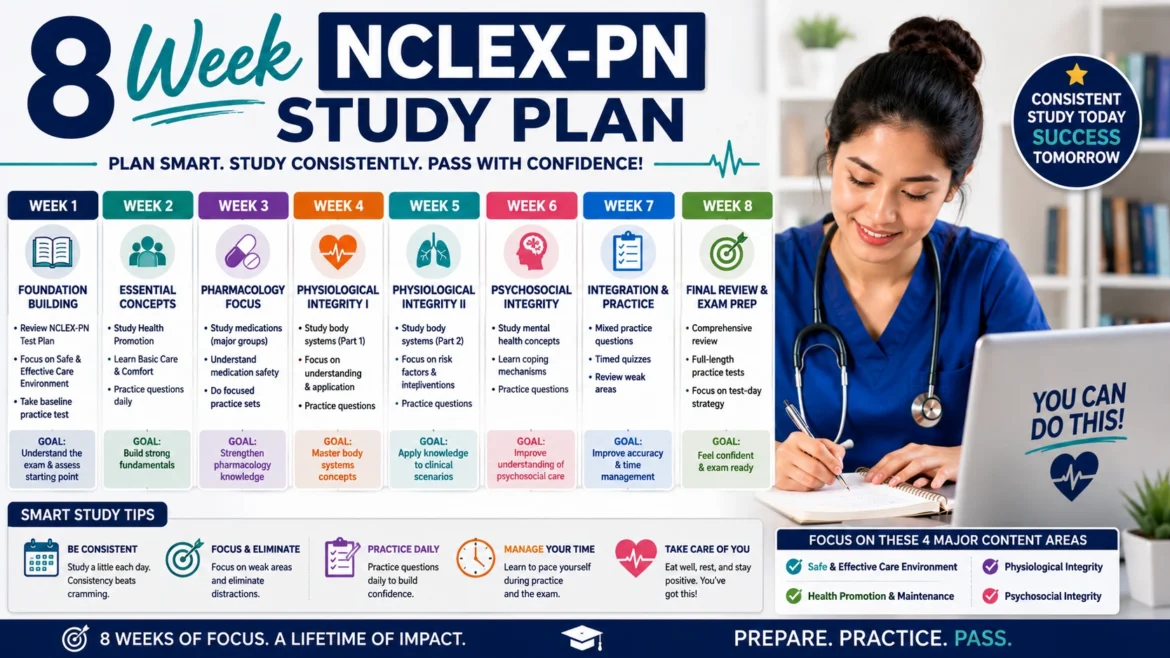
Week 1: Understanding the NCLEX-PN Structure
The first week should focus on understanding the exam structure, organizing study resources, and reviewing foundational nursing concepts.
Many nursing students begin preparation feeling overwhelmed because they attempt to study every topic simultaneously.
Week 1 should focus on building structure and clarity.
Main Goals for Week 1
- Understand NCLEX-PN question styles
- Review major nursing categories
- Create a realistic study schedule
- Identify weak subject areas
- Organize study resources
Important introductory review topics may include:
- Patient safety
- Clinical judgment
- Nursing fundamentals
- Medication safety
- Communication principles
The goal during this phase is not perfection. Instead, students should focus on building a sustainable study routine that fits realistically within nursing-school and clinical schedules.
Week 2: Patient Safety and Infection Control
Patient safety should become a major focus during Week 2 because safety concepts appear throughout many NCLEX-PN scenarios.
Students should strengthen understanding of:
- Medication safety
- Fall prevention
- Infection-control precautions
- Isolation procedures
- Sterile technique
- Emergency-response priorities
Strong patient-safety awareness helps nurses recognize dangerous healthcare situations more quickly and choose safer nursing interventions.
Because infection prevention remains a major healthcare responsibility, these concepts should receive repeated review throughout preparation.
Week 3: Pharmacology and Medication Safety
Pharmacology remains one of the most challenging areas for many nursing students preparing for the NCLEX-PN.
Week 3 should focus on understanding:
- Medication classifications
- Common side effects
- Adverse reactions
- Dosage safety
- Patient teaching priorities
- Medication administration precautions
Many students struggle because they attempt to memorize medications without understanding broader nursing safety concepts.
Strong pharmacology preparation focuses on understanding why medications are used, how nurses monitor patient responses, and which medication-related situations create safety risks.
Week 4: Clinical Judgment and Prioritization
Clinical judgment is one of the most important NCLEX-PN skills because practical nurses must continuously evaluate patient situations and determine appropriate nursing actions.
Week 4 should focus heavily on:
- Patient prioritization
- Emergency response situations
- Recognizing patient deterioration
- Clinical reasoning exercises
- Care-planning scenarios
Many students improve significantly once they begin focusing on patient stability and immediate safety risks instead of memorizing isolated textbook details.
Repeated prioritization practice helps nursing students become more comfortable analyzing patient-care situations under pressure.
Why Practice Questions Become More Important Over Time
As preparation progresses, practice questions become increasingly valuable because they help students combine multiple nursing concepts simultaneously within realistic patient-care situations.
Practice-based learning strengthens:
- Clinical reasoning
- Patient-safety awareness
- Medication understanding
- Communication confidence
- Emergency prioritization
- Testing endurance
Many nursing students preparing for licensure improve confidence and patient-care reasoning by consistently working through realistic NCLEX-PN practice quiz designed to mirror prioritization challenges, medication-safety situations, clinical judgment exercises, and modern nursing-care responsibilities commonly encountered in healthcare environments.
Week 5: Nursing Fundamentals and Basic Patient Care
Week 5 should focus heavily on nursing fundamentals because foundational patient-care concepts continue appearing throughout many NCLEX-PN scenarios.
Important nursing fundamentals may include:
- Vital sign assessment
- Patient positioning
- Mobility assistance
- Nutrition support
- Basic hygiene care
- Documentation principles
- Communication techniques
Strong nursing fundamentals support safer patient care and improve long-term clinical confidence across many healthcare environments.
These foundational concepts also strengthen nursing reasoning during more advanced clinical situations.
Week 6: Communication and Psychosocial Integrity
Nursing involves much more than medication administration and technical procedures. Nurses also support patients emotionally during stressful healthcare experiences.
Week 6 should focus on:
- Therapeutic communication
- Patient education
- Mental health support
- Cultural awareness
- Professional boundaries
- Healthcare teamwork
Strong communication skills help nurses:
- Reduce patient anxiety
- Improve healthcare coordination
- Prevent misunderstandings
- Build patient trust
- Support emotional wellbeing
The NCLEX-PN may include scenarios evaluating whether candidates understand effective communication and psychosocial patient-care principles.
Week 7: Timed Practice and Weak-Area Review
By Week 7, students should begin focusing more heavily on timed practice sessions and realistic nursing scenarios.
Many candidates understand nursing concepts individually but struggle combining multiple clinical responsibilities during longer exam situations.
Week 7 should emphasize:
- Timed practice questions
- Patient prioritization drills
- Clinical judgment exercises
- Medication-safety review
- Weak-area reinforcement
- Rationale analysis
Detailed rationale review becomes especially important during this stage because understanding why certain nursing actions are correct strengthens clinical reasoning much more effectively than memorization alone.
Week 8: Final Review and Confidence Building
The final week should focus on reinforcement, confidence building, and mental preparation rather than attempting to learn completely new material.
Many nursing students increase stress unnecessarily during the final days before the exam by trying to review everything at once.
Instead, Week 8 should focus on:
- Reviewing high-yield concepts
- Strengthening weak areas lightly
- Maintaining healthy sleep routines
- Managing stress levels
- Practicing lighter review sessions
- Improving testing confidence
This final phase should help students feel mentally prepared and emotionally calmer before exam day.
How Nursing Students Can Avoid Burnout
Many NCLEX-PN candidates balance nursing school, clinical rotations, work responsibilities, and family obligations during preparation.
Without proper balance, burnout may negatively affect:
- Concentration
- Memory retention
- Clinical reasoning
- Testing confidence
- Motivation
Healthy preparation habits often include:
- Reasonable study expectations
- Balanced schedules
- Consistent sleep routines
- Scheduled recovery time
- Stress-management strategies
Protecting mental energy is important because nursing itself already requires strong emotional and professional resilience.
Why Active Learning Improves Long-Term Retention
Many nursing students spend too much time passively reviewing textbooks without actively applying patient-care concepts.
Active learning methods are often much more effective because they require students to:
- Interpret patient symptoms
- Practice prioritization
- Analyze medication safety
- Evaluate nursing interventions
- Apply clinical judgment
Examples of effective active learning methods include:
| Learning Method | Main Benefit |
|---|---|
| Practice Questions | Improves clinical application. |
| Case Studies | Strengthens patient-care reasoning. |
| Timed Simulations | Builds testing confidence. |
| Prioritization Exercises | Improves emergency thinking. |
| Rationale Review | Strengthens long-term understanding. |
This type of active learning often improves retention far more effectively than memorization alone.
Learning From Nursing Preparation Resources
Many nursing students strengthen preparation quality by reviewing educational resources explaining broader nursing responsibilities, clinical expectations, and licensure concepts.
Helpful educational guidance may improve understanding of:
- Patient-care responsibilities
- Clinical judgment expectations
- Nursing communication standards
- Healthcare professionalism
- Patient-safety priorities
Students looking for broader understanding of nursing licensure expectations and patient-care responsibilities may benefit from reviewing a complete practical nursing licensure and career preparation guide while building stronger clinical reasoning and nursing confidence.
Nursing students may also improve study efficiency by understanding common nursing exam-preparation mistakes that frequently affect prioritization skills, medication understanding, patient-safety reasoning, and long-term retention.
How Consistency Builds Long-Term Nursing Confidence
Clinical judgment and patient-care reasoning develop gradually through repeated exposure to realistic healthcare situations and active nursing application.
Even shorter consistent study sessions often strengthen:
- Patient-safety awareness
- Clinical judgment
- Medication understanding
- Communication confidence
- Emergency prioritization
Over time, this consistency helps future practical nurses feel more prepared for both licensure testing and long-term healthcare responsibilities.
Why High-Yield Topic Review Improves Study Efficiency
Many nursing students preparing for the NCLEX-PN initially feel overwhelmed because the exam covers multiple patient-care responsibilities and clinical concepts.
Focusing on high-yield nursing topics often improves study efficiency by helping students prioritize the areas most closely connected to safe patient care and clinical judgment.
Important high-yield concepts may include:
- Patient safety
- Clinical judgment
- Prioritization
- Pharmacology
- Infection control
- Communication skills
- Nursing fundamentals
Students seeking stronger study organization may also benefit from reviewing educational resources covering the most heavily emphasized NCLEX-PN nursing concepts frequently associated with patient safety, emergency-response thinking, and practical nursing decision-making.
How Practice Questions Strengthen Weekly Progress
Practice questions become increasingly valuable throughout an 8-week study plan because they help students combine multiple nursing concepts simultaneously within realistic healthcare situations.
Practice-based learning helps strengthen:
- Clinical reasoning
- Patient-safety awareness
- Medication understanding
- Communication confidence
- Emergency prioritization
- Testing endurance
Repeated exposure to realistic patient-care scenarios helps nursing students improve familiarity with:
- Question wording
- Clinical decision-making patterns
- Prioritization challenges
- Medication-safety concerns
- Healthcare communication situations
Nursing students looking to strengthen long-term retention and exam confidence may also benefit from reviewing educational guidance explaining how NCLEX-PN practice questions improve clinical readiness during modern nursing licensure preparation.
Why Time Management Improves NCLEX-PN Performance
Time management remains extremely important during both NCLEX-PN preparation and the actual licensing exam.
Without structured pacing, students may:
- Overanalyze difficult questions
- Rush through patient scenarios
- Lose concentration during long sessions
- Experience unnecessary stress
- Struggle with testing endurance
Strong pacing habits help students maintain better concentration while improving clinical reasoning under pressure.
Many nursing students improve gradually once they begin practicing under realistic timed conditions.
How Clinical Judgment Improves Gradually
Many nursing students become frustrated when clinical reasoning skills do not improve immediately during the early stages of preparation.
However, clinical judgment usually develops gradually through repeated patient-care application and realistic nursing scenarios.
Over time, students often become better at:
- Recognizing patient deterioration
- Identifying safety concerns
- Prioritizing interventions
- Choosing safer nursing actions
- Interpreting symptoms correctly
This steady improvement helps future practical nurses feel more comfortable analyzing patient situations independently.
Why Mental Recovery Matters During Preparation
Many NCLEX-PN candidates underestimate how strongly exhaustion and stress can affect learning efficiency and clinical reasoning.
Without proper recovery, students may experience:
- Reduced concentration
- Poor memory retention
- Testing anxiety
- Mental fatigue
- Lower motivation
Healthy preparation routines often include:
- Balanced study schedules
- Consistent sleep routines
- Reasonable daily goals
- Mental recovery time
- Stress-management strategies
Protecting emotional wellbeing is especially important because nursing itself already requires significant professional resilience and mental focus.
How an 8 Week Plan Builds Professional Nursing Skills
An organized NCLEX-PN study plan strengthens much more than exam readiness alone.
Consistent active learning often improves:
- Clinical reasoning
- Communication abilities
- Medication awareness
- Patient-safety thinking
- Emergency-response confidence
- Professional accountability
These skills continue supporting nurses throughout careers in hospitals, rehabilitation facilities, clinics, long-term care centers, and physician offices.
Many experienced nurses later realize that the study habits developed during licensure preparation continued helping them throughout daily patient-care responsibilities.
Building a Sustainable Weekly Routine
Many successful students follow flexible but organized weekly routines that fit realistically within nursing school, clinical rotations, work schedules, and personal responsibilities.
For example:
| Study Day | Suggested Focus |
|---|---|
| Monday | Pharmacology review |
| Tuesday | Patient-safety scenarios |
| Wednesday | Prioritization exercises |
| Thursday | Communication and psychosocial care |
| Friday | Practice-question analysis |
| Weekend | Timed nursing simulations |
This balanced structure often improves consistency while reducing mental exhaustion during long-term preparation.
Final Thoughts
An organized 8-week NCLEX-PN study plan helps nursing students strengthen patient-safety awareness, clinical judgment, pharmacology understanding, communication confidence, and emergency-response reasoning.
Strong preparation usually involves:
- Consistent active learning
- Patient-care scenario review
- Practice-question analysis
- Clinical judgment exercises
- High-yield topic review
- Balanced mental recovery
Rather than relying on last-minute cramming, many successful nursing students improve gradually through repeated patient-care application and structured nursing review.
Over time, this balanced preparation approach helps future practical nurses feel more confident, clinically prepared, and professionally ready for both NCLEX-PN success and long-term healthcare careers.
Frequently Asked Questions (FAQs)
Is 8 weeks enough to prepare for the NCLEX-PN?
Yes. Many students prepare successfully within 6–10 weeks using structured schedules, practice questions, and consistent active learning.
What should students focus on most during NCLEX-PN preparation?
Important areas often include patient safety, pharmacology, prioritization, clinical judgment, communication, and infection control.
Why are practice questions important during an NCLEX-PN study plan?
Practice questions improve clinical reasoning, patient-safety awareness, prioritization skills, and testing confidence.
How can nursing students avoid burnout during preparation?
Balanced schedules, realistic goals, mental recovery time, and consistent sleep routines can help reduce burnout.
What is the best study method for the NCLEX-PN?
Active learning methods such as practice questions, patient scenarios, prioritization drills, and rationale review are highly effective.