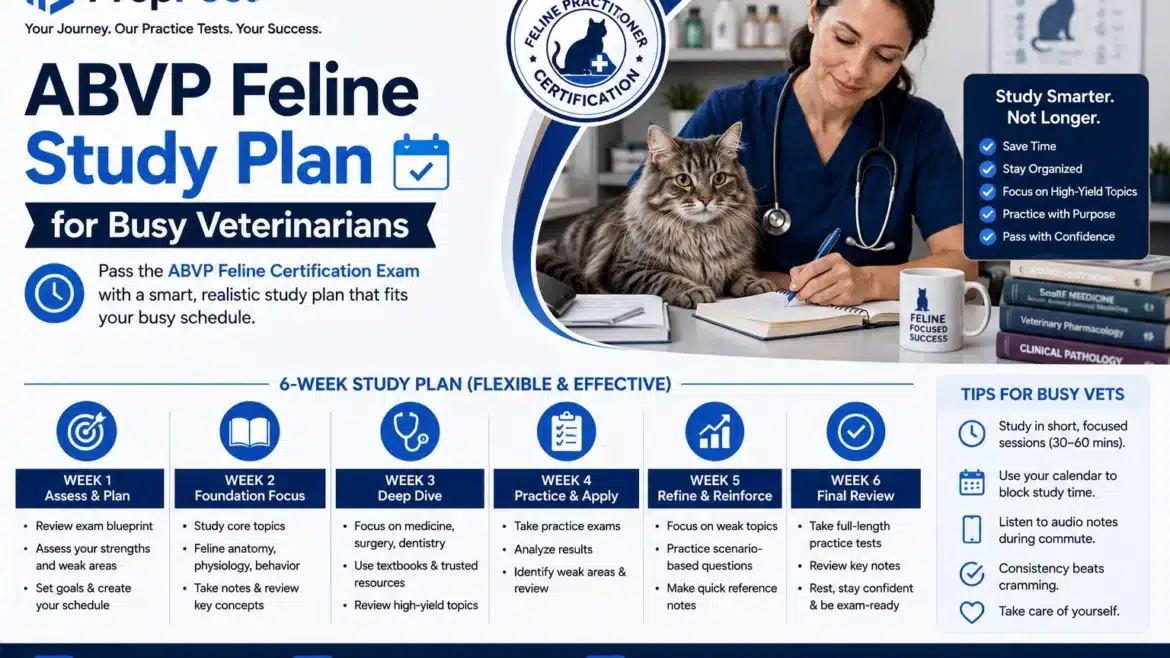

Preparing for the American Board of Veterinary Practitioners (ABVP) Feline certification exam while managing a full clinical schedule can seem overwhelming. Between appointments, surgeries, emergency cases, client communication, and continuing education, finding uninterrupted study time is often one of the biggest challenges veterinarians face.
The good news is that successful preparation doesn’t require putting your career on hold. A realistic study plan built around consistent weekly progress allows you to strengthen your knowledge of feline medicine without sacrificing patient care or personal responsibilities. Small, focused study sessions often produce better long-term retention than occasional marathon review sessions.
If you’re still deciding whether board certification aligns with your professional goals, exploring the long-term value of ABVP Feline certification can help you understand how the credential supports professional development and advanced clinical practice.
- How to organize your study schedule around a busy practice.
- Weekly goals that build knowledge progressively.
- How to prioritize high-yield topics.
- Ways to stay motivated throughout preparation.
- Common study mistakes to avoid.
- Practical strategies for long-term retention.
Why a Structured Study Plan Matters
The ABVP Feline certification exam evaluates a broad range of clinical knowledge, making it difficult to prepare effectively without a clear plan. Jumping randomly between topics often leads to uneven preparation and unnecessary stress.
A structured study schedule helps organize complex material into manageable sections, allowing you to review one subject thoroughly before moving to the next. This approach also makes it easier to revisit difficult topics and reinforce what you’ve already learned.
Perhaps most importantly, having a written plan reduces the uncertainty that many candidates experience when preparing for an advanced certification examination.
How Much Time Should You Study Each Week?
There is no universal study schedule because every veterinarian has different professional responsibilities. Some candidates work in busy emergency hospitals, while others maintain predictable appointment schedules. The ideal plan is one you can realistically maintain for several months.
Instead of focusing on a specific number of hours, aim for consistent progress each week. Even shorter study sessions can be highly productive when they involve active learning and regular review.
| Weekly Availability | Suggested Approach |
|---|---|
| 3–5 Hours | Focus on one major topic with regular review sessions. |
| 5–8 Hours | Combine topic review with case-based learning. |
| 8–12 Hours | Include comprehensive review and self-assessment. |
| 12+ Hours | Cover multiple subject areas while revisiting weaker topics. |
Start by Evaluating Your Current Knowledge
Before creating a detailed study schedule, identify your strengths and weaknesses. Every veterinarian enters the certification process with a unique clinical background, and understanding where you need the most improvement allows you to use your study time more effectively.
Ask yourself questions such as:
- Which feline diseases do I encounter most frequently?
- Which body systems require additional review?
- Are there topics I haven’t studied recently?
- How comfortable am I interpreting diagnostic findings?
- Which clinical scenarios feel least familiar?
Answering these questions provides a realistic starting point and helps prioritize the subjects that deserve the greatest attention.
Week 1: Build a Strong Foundation
The first week should focus on organizing your preparation rather than immediately trying to master advanced topics. Gather your study resources, create a realistic schedule, and outline the major areas of feline medicine you plan to review over the coming weeks.
If you’re still uncertain whether you’ve developed sufficient clinical experience for board certification, reviewing the ABVP Feline certification eligibility guide can help clarify the professional background typically expected before pursuing the examination.
During Week 1, concentrate on:
- Creating your study calendar.
- Reviewing examination objectives.
- Organizing textbooks and reference materials.
- Identifying weaker knowledge areas.
- Setting realistic weekly goals.
Week 2: Focus on Core Feline Medicine
Once your study plan is established, begin reviewing the core principles of feline medicine. This includes preventive healthcare, internal medicine, infectious diseases, nutrition, and the clinical reasoning used to evaluate common feline presentations.
Rather than rushing through multiple chapters, concentrate on understanding disease processes, diagnostic pathways, and treatment principles. Building a strong foundation early makes more advanced topics easier to understand in later weeks.
Remember that consistency matters far more than speed. A steady, organized approach allows busy veterinarians to prepare effectively while continuing to provide excellent patient care every day.
Weeks 3–4: Strengthen Clinical Decision-Making
By the third and fourth weeks of your study plan, you should move beyond reviewing individual diseases and begin thinking like you would during a typical clinical appointment. The ABVP Feline certification exam emphasizes applying knowledge to patient cases, making clinical reasoning an essential skill to develop.
As you study each condition, consider how the patient might present, which diagnostic tests would be appropriate, how to interpret the results, and which treatment options best fit the situation. This method connects isolated facts into a complete clinical picture.
| Study Activity | Primary Goal |
|---|---|
| Review Clinical Cases | Improve diagnostic reasoning. |
| Interpret Laboratory Results | Strengthen analytical thinking. |
| Compare Differential Diagnoses | Recognize similar disease presentations. |
| Evaluate Treatment Plans | Practice evidence-based decision-making. |
| Review Follow-Up Care | Understand long-term patient management. |
Weeks 5–6: Identify Knowledge Gaps
Midway through your preparation, take time to evaluate your progress honestly. Most candidates discover that certain subjects feel much more comfortable than others. Recognizing these differences early allows you to adjust your study plan before the examination gets closer.
Instead of spending equal time on every topic, devote additional attention to the areas where your confidence is lowest. Focusing on weaker subjects usually produces greater improvement than repeatedly reviewing material you already understand well.
Balance Studying With Clinical Practice
One advantage busy veterinarians have is the opportunity to reinforce knowledge through daily patient care. Many cases seen during routine appointments naturally relate to subjects covered on the certification examination.
After seeing an interesting feline case, spend a few minutes reviewing the disease, diagnostic approach, treatment recommendations, and current clinical guidelines. Connecting study material with real patients often improves retention far better than reading alone.
Clinical experience and structured review complement one another, allowing your everyday work to become part of your preparation.
Track Your Progress Every Week
A study plan is most effective when you regularly measure your progress. At the end of each week, review what you accomplished, identify topics that still feel challenging, and adjust the following week’s schedule if necessary.
Simple progress tracking also helps maintain motivation throughout several months of preparation. Seeing steady improvement makes long-term goals feel much more achievable.
- Review completed subjects.
- Update your list of weaker topics.
- Adjust study priorities.
- Schedule additional review where needed.
- Celebrate consistent progress, even if it’s gradual.
Don’t Let the Exam Feel Bigger Than It Is
Many candidates become overwhelmed simply by thinking about the breadth of material covered on the examination. Breaking the preparation into weekly milestones makes the process much more manageable.
Instead of trying to master every subject immediately, focus on completing the goals you’ve assigned for the current week. Consistent progress over several months usually produces better results than attempting to learn everything during a few intensive study sessions.
Review Your Understanding Before Moving Forward
Before advancing to the next stage of your study plan, make sure you feel comfortable with the material you’ve already covered. Revisiting difficult concepts is far more beneficial than rushing through new topics without a solid understanding of the fundamentals.
If you’re still concerned about the overall challenge of the certification process, reading our guide on understanding the exam’s level of difficulty can provide realistic expectations and practical advice for approaching the examination with greater confidence.
Final Weeks Before the Examination
As exam day approaches, your focus should gradually shift from learning new material to reinforcing what you’ve already studied. The final weeks are the time to strengthen confidence, review high-yield topics, and continue practicing clinical decision-making rather than trying to memorize large amounts of new information.
A balanced review schedule helps you retain important concepts while reducing unnecessary stress. Continue revisiting weaker subjects, but also spend time reviewing areas where you already feel confident to keep your knowledge fresh.
| Final Review Activity | Purpose |
|---|---|
| Review High-Yield Topics | Reinforce commonly tested concepts. |
| Practice Clinical Scenarios | Improve diagnostic reasoning and decision-making. |
| Revisit Weak Areas | Build confidence before exam day. |
| Review Personal Notes | Refresh key facts and clinical pearls. |
| Maintain Healthy Routines | Support concentration and long-term retention. |
Make Practice Questions Part of Your Weekly Routine
Reading textbooks provides important knowledge, but applying that knowledge is what prepares you for board certification. Working through realistic case-based questions helps you recognize patterns, evaluate clinical findings, and make evidence-based decisions similar to those required during the examination.
After answering each question, spend time reviewing the explanation—even when your answer is correct. Understanding the reasoning behind every option strengthens clinical judgment and helps prevent similar mistakes in the future.
Stay Flexible Throughout Your Study Plan
Even the best study schedule may need adjustments. Busy clinics, emergency cases, vacations, or unexpected personal commitments can interrupt your routine. Missing a study session isn’t a setback—it simply means your schedule should be adjusted rather than abandoned.
Focus on maintaining consistent progress over the long term. A flexible plan that fits your professional life is far more sustainable than an unrealistic schedule that quickly becomes difficult to maintain.
Why Choose PrepPool for Your ABVP Feline Preparation?
Preparing for an advanced veterinary certification requires more than reviewing textbooks alone. PrepPool supports veterinarians with realistic case-based practice questions, detailed answer explanations, and study materials that encourage active learning and stronger clinical reasoning.
Whether you’re reviewing internal medicine, preventive care, infectious diseases, diagnostic interpretation, or emergency medicine, using comprehensive ABVP Feline practice exam resources can help reinforce key concepts, identify weaker areas, and build greater confidence throughout your preparation.
Why Veterinarians Choose PrepPool
- Realistic case-based questions that mirror advanced clinical thinking.
- Detailed answer explanations that support evidence-based learning.
- Coverage of major feline medicine topics commonly reviewed for certification.
- Flexible self-paced study suitable for busy veterinary professionals.
- Resources that help monitor progress and identify knowledge gaps.
- A practical way to build confidence before the ABVP Feline certification exam.
Final Thoughts
Preparing for the ABVP Feline certification exam doesn’t require studying every available resource or spending countless hours each day. Success comes from following a realistic plan, studying consistently, and gradually strengthening your clinical reasoning across the full range of feline medicine.
Every study session contributes to your development as a veterinarian, whether you’re reviewing a familiar topic or tackling a challenging one for the first time. By combining structured learning, practical experience, and regular self-assessment, you’ll be well prepared to approach the examination with confidence.
FAQs
When should I start preparing for the ABVP Feline certification exam?
Most veterinarians benefit from beginning several months before the exam. Starting early allows enough time to review major subject areas, strengthen weaker topics, and maintain a manageable study pace.
How many hours should I study each week?
The ideal schedule depends on your workload and experience. Consistent weekly study sessions are generally more effective than occasional intensive review periods.
Should I study only from textbooks?
No. A balanced approach that combines textbooks, clinical experience, current veterinary literature, and realistic practice questions provides more comprehensive preparation.
How can I stay motivated during a long study plan?
Set achievable weekly goals, monitor your progress, revisit completed topics regularly, and celebrate small milestones to maintain motivation throughout your preparation.
Are practice questions useful even if I answer them incorrectly?
Absolutely. Incorrect answers often reveal important knowledge gaps. Reviewing detailed explanations helps strengthen understanding and improves future clinical decision-making.