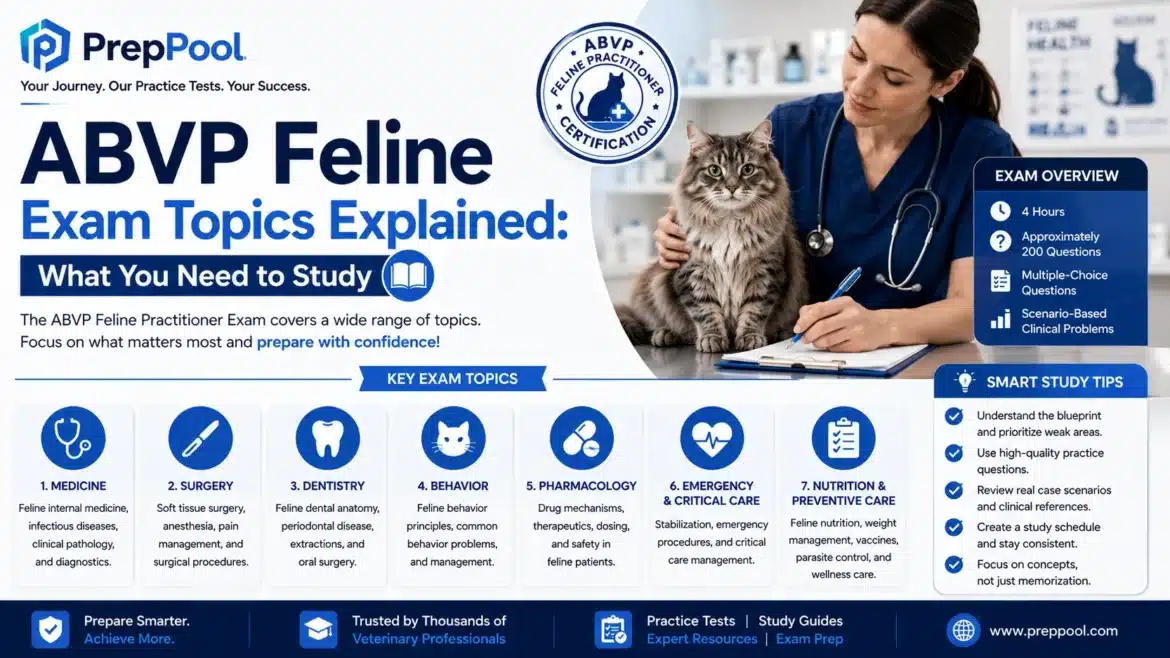

The American Board of Veterinary Practitioners (ABVP) Feline certification exam evaluates your ability to apply advanced clinical knowledge across a wide range of feline health conditions. Unlike exams that focus on memorization alone, the ABVP Feline examination measures how effectively you analyze patient information, interpret diagnostic findings, and make evidence-based clinical decisions.
Because the examination covers multiple disciplines within feline medicine, many candidates wonder where to begin. Understanding the major exam topics before creating a study schedule allows you to organize your preparation more effectively and avoid spending too much time on one subject while overlooking another.
If you’re considering board certification but haven’t yet decided whether it’s the right step for your career, our guide on the professional benefits of ABVP Feline board certification explains how this credential can support long-term professional growth and advanced clinical practice.
- The major subject areas covered on the ABVP Feline exam.
- Which topics deserve the most study time.
- How different clinical disciplines work together.
- Ways to organize your review efficiently.
- How to prioritize high-yield areas without neglecting others.
The Exam Covers the Full Scope of Feline Medicine
The ABVP Feline certification is designed for experienced veterinarians who provide comprehensive feline care. As a result, the examination draws questions from many areas of veterinary medicine rather than focusing on one specialty.
Successful candidates demonstrate an understanding of disease recognition, diagnostic evaluation, therapeutic planning, preventive care, and long-term patient management. The ability to integrate knowledge across multiple disciplines is one of the defining characteristics of the examination.
| Major Category | Examples of Topics |
|---|---|
| Internal Medicine | Systemic diseases, chronic illness, diagnostic evaluation. |
| Preventive Care | Vaccination, wellness programs, parasite prevention. |
| Emergency Medicine | Stabilization, triage, emergency treatment. |
| Diagnostic Medicine | Laboratory interpretation and imaging. |
| Surgery & Anesthesia | Perioperative care and pain management. |
| Nutrition & Behavior | Dietary management and behavioral health. |
Internal Medicine Forms a Large Portion of Your Preparation
Internal medicine is one of the broadest areas you’ll review during your preparation. It includes evaluating complex feline diseases, recognizing subtle clinical signs, selecting appropriate diagnostic tests, and developing evidence-based treatment plans.
Rather than studying diseases individually, try grouping related conditions together. This makes it easier to compare clinical presentations, understand differential diagnoses, and recognize common patterns encountered in practice.
Topics commonly reviewed include:
- Endocrine disorders.
- Renal and urinary diseases.
- Gastrointestinal conditions.
- Respiratory disorders.
- Cardiovascular disease.
- Hepatic disorders.
Diagnostic Skills Are Essential
Strong diagnostic reasoning is a hallmark of successful ABVP candidates. The examination often requires interpreting laboratory data, evaluating imaging findings, and determining which diagnostic procedures are most appropriate for a particular patient.
When reviewing diagnostic topics, focus on understanding why specific tests are chosen, how results influence clinical decisions, and how different findings contribute to the overall diagnostic picture.
Emergency and Critical Care Requires Clinical Judgment
Emergency medicine extends beyond recognizing life-threatening conditions. Candidates should understand patient stabilization, prioritization of care, fluid therapy, monitoring, and emergency decision-making in realistic clinical situations.
The emphasis is on selecting appropriate interventions while considering the patient’s overall condition rather than simply recalling emergency protocols.
Organize Your Study by Subject Instead of Random Reading
One of the most effective ways to prepare is by studying related topics together. Organizing your review into logical sections helps reinforce clinical connections and makes long-term retention much easier.
If you’re still building your preparation schedule, following a structured ABVP Feline study schedule can help you divide these subjects into manageable weekly goals while balancing the demands of clinical practice.
Preventive Medicine Is More Than Routine Wellness
Preventive medicine is a core component of feline practice and deserves consistent attention during your exam preparation. While wellness examinations and vaccination protocols are important, preventive care also includes risk assessment, parasite control, nutrition, weight management, senior health screening, and educating owners about maintaining lifelong feline health.
The ABVP Feline certification exam may present clinical scenarios that require selecting appropriate preventive recommendations based on a cat’s age, lifestyle, medical history, and environmental risk factors.
| Preventive Care Area | Knowledge Expected |
|---|---|
| Vaccination | Select appropriate protocols based on individual risk. |
| Parasite Prevention | Understand prevention strategies and client recommendations. |
| Nutrition | Recommend diets for different life stages and medical conditions. |
| Weight Management | Recognize obesity risks and develop management plans. |
| Senior Care | Identify age-related health concerns and screening priorities. |
Diagnostic Imaging and Laboratory Interpretation
Diagnostic information plays a central role in clinical decision-making. Candidates should be comfortable interpreting laboratory findings alongside patient history, physical examination results, and imaging studies rather than viewing each result in isolation.
Your preparation should include understanding how diagnostic tests contribute to confirming or ruling out differential diagnoses, monitoring disease progression, and evaluating treatment effectiveness.
Review topics such as:
- Complete blood counts and serum chemistry profiles.
- Urinalysis and urine culture interpretation.
- Diagnostic imaging principles.
- Cytology and pathology basics.
- Choosing appropriate diagnostic tests.
Nutrition, Pain Management, and Client Communication
Successful feline practitioners understand that excellent patient care extends beyond diagnosing disease. Nutrition supports both wellness and disease management, pain control improves patient recovery and quality of life, and effective communication helps owners understand treatment recommendations and long-term care plans.
Although these subjects may receive less attention during preparation than internal medicine, they remain important components of comprehensive feline practice.
Behavioral Medicine and Welfare
Behavioral concerns are among the most common reasons owners seek veterinary advice. Candidates should understand normal feline behavior, environmental influences, stress reduction, enrichment strategies, and common behavioral disorders that affect both patient welfare and the human-animal bond.
Preparing for these topics requires understanding practical management strategies rather than memorizing isolated behavioral facts.
How to Prioritize Your Review
Because the examination covers many clinical disciplines, it isn’t realistic to spend identical amounts of time on every subject. Instead, prioritize the areas that appear most frequently in feline practice while still ensuring that every major topic receives adequate attention.
A balanced review schedule might look like this:
- Internal medicine and clinical reasoning.
- Diagnostic testing and interpretation.
- Emergency and critical care.
- Preventive medicine and nutrition.
- Surgery, anesthesia, and pain management.
- Behavior, welfare, and client communication.
Know Your Strengths and Weaknesses
Every veterinarian approaches the ABVP Feline examination with a different clinical background. Some candidates routinely manage complex internal medicine cases, while others have greater experience in surgery, preventive care, or emergency medicine.
Identifying your weaker subject areas early allows you to allocate more study time where it will have the greatest impact. A personalized review plan is usually much more effective than treating every topic equally.
Understanding the Breadth of the Examination
The wide range of topics is one reason many veterinarians initially view the certification process as challenging. Fortunately, understanding what makes the ABVP Feline exam challenging can help you develop realistic expectations and approach your preparation with greater confidence instead of unnecessary anxiety.
Turn Knowledge Into Clinical Decision-Making
Reviewing exam topics is only the first step. The ABVP Feline certification exam is designed to assess how well you apply knowledge in realistic clinical situations, not simply how many facts you can remember. As you study each subject, challenge yourself to think through the entire patient journey—from the initial presentation to diagnosis, treatment, follow-up care, and long-term management.
This approach helps connect related concepts across multiple disciplines and strengthens the clinical reasoning skills expected of board-certified veterinarians.
| Study Method | Benefit |
|---|---|
| Case-Based Learning | Improves clinical reasoning and diagnostic confidence. |
| Topic-by-Topic Review | Builds a strong foundation before moving to advanced concepts. |
| Regular Revision | Strengthens long-term knowledge retention. |
| Practice Questions | Identifies weak areas before exam day. |
| Reviewing Answer Explanations | Develops deeper understanding of clinical decision-making. |
Create a Balanced Weekly Review Schedule
Instead of trying to study every topic every week, divide the content into manageable sections. Rotating through body systems and clinical disciplines helps prevent burnout while ensuring each major subject receives sufficient attention before the examination.
Many successful candidates also reserve one study session each week exclusively for reviewing previously completed material. This simple habit reinforces learning and reduces the need for extensive last-minute revision.
Use Practice Questions to Reinforce Every Topic
Reading textbooks and clinical references provides the foundation for learning, but answering realistic practice questions allows you to apply that knowledge in a way that closely resembles the certification exam.
Well-designed practice questions expose knowledge gaps, improve analytical thinking, and reinforce the connections between patient history, physical examination findings, diagnostic testing, and treatment decisions.
Whenever you answer a question incorrectly, spend time reviewing the explanation rather than simply memorizing the correct answer. Understanding why one option is correct often provides far greater educational value than the score itself.
Why Choose PrepPool for ABVP Feline Exam Preparation?
Preparing for board certification requires resources that support both knowledge development and clinical application. PrepPool provides realistic case-based questions, comprehensive answer explanations, and structured study materials that help veterinarians review the major topics commonly encountered during ABVP Feline exam preparation.
Whether you’re reviewing internal medicine, preventive care, emergency medicine, diagnostic interpretation, surgery, nutrition, or feline behavior, working through realistic ABVP Feline certification practice questions can help strengthen clinical reasoning, identify weaker areas, and prepare more confidently for exam day.
Why Veterinarians Choose PrepPool
- Case-based questions that reflect real feline clinical scenarios.
- Detailed explanations that reinforce evidence-based decision-making.
- Comprehensive coverage of major ABVP Feline exam topics.
- Flexible self-paced learning designed for busy veterinary professionals.
- Resources that help monitor progress and strengthen weaker subject areas.
- A practical study companion throughout your certification journey.
Final Thoughts
The ABVP Feline certification exam covers a broad range of clinical disciplines because feline practice requires veterinarians to integrate knowledge from many areas of medicine. While the scope of the examination may seem extensive, organized preparation makes it much more manageable.
By understanding the major exam topics, creating a structured review plan, and consistently applying your knowledge through clinical cases and practice questions, you’ll build both the confidence and clinical judgment needed to approach the examination successfully.
FAQs
What subjects are covered on the ABVP Feline certification exam?
The examination typically includes internal medicine, preventive care, emergency and critical care, surgery, anesthesia, nutrition, diagnostic imaging, laboratory interpretation, behavior, pain management, and other areas of feline clinical practice.
Which topic should I spend the most time studying?
Internal medicine and clinical reasoning generally require significant attention because they integrate knowledge from multiple body systems. However, every major subject should be included in your overall study plan.
Do I need to study every topic equally?
No. While all major areas deserve review, it’s often more effective to dedicate additional time to subjects where your clinical experience or confidence is limited.
How can I remember such a large amount of information?
Break the material into manageable sections, review topics consistently, revisit previously studied content regularly, and reinforce learning through case discussions and practice questions.
Are practice questions helpful for every exam topic?
Yes. Practice questions encourage active learning, strengthen clinical reasoning, and help you apply knowledge across different areas of feline medicine in a way that closely reflects the certification examination.