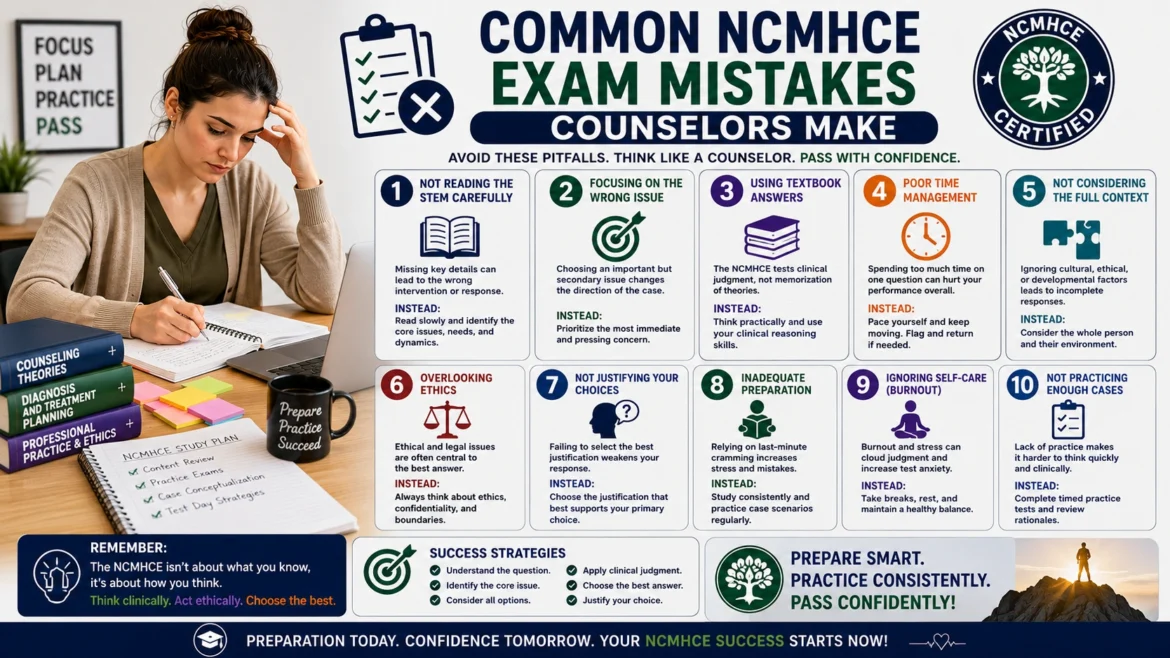

The National Clinical Mental Health Counseling Examination (NCMHCE) is one of the most important professional milestones for aspiring licensed mental health counselors in the United States. Unlike traditional memorization-based exams, the NCMHCE evaluates clinical judgment, decision-making, counseling strategies, and the ability to apply mental health knowledge in realistic client scenarios.
Many candidates enter the preparation process believing their graduate education alone will fully prepare them for the exam. However, the NCMHCE often challenges candidates in ways that feel very different from classroom learning.
The exam focuses heavily on:
- Clinical reasoning
- Client assessment
- Treatment planning
- Ethical decision-making
- Counseling interventions
- Case analysis skills
Because of this, many intelligent and capable counseling professionals struggle due to preparation mistakes rather than lack of knowledge or ability.
Important Insight:The NCMHCE is designed to evaluate how counselors think clinically, not simply how well they memorize counseling theories.
Mistake #1: Treating the Exam Like a Memorization Test
One of the most common mistakes candidates make is approaching the NCMHCE as a traditional fact-based exam instead of a clinical application exam.
Some candidates spend weeks memorizing diagnostic criteria, counseling definitions, and textbook terminology without practicing how to apply that knowledge in real counseling scenarios.
While foundational knowledge is important, the exam primarily evaluates whether candidates can:
- Analyze client situations
- Identify appropriate interventions
- Prioritize counselor responses
- Recognize ethical concerns
- Develop treatment strategies
- Evaluate client risk factors
Clinical reasoning and practical decision-making are central to success.
Candidates who focus only on memorization often feel overwhelmed when faced with complex client scenarios requiring deeper analysis and judgment.
Mistake #2: Ignoring Clinical Simulation Practice
The NCMHCE differs from many other professional exams because it emphasizes case simulations and realistic counseling scenarios. Candidates who avoid simulation-style preparation often struggle adapting to the structure and pacing of the exam.
Clinical simulation practice helps candidates become more comfortable with:
- Reading detailed client cases
- Interpreting emotional and behavioral patterns
- Selecting appropriate counselor interventions
- Identifying ethical concerns
- Evaluating treatment priorities
- Managing counseling scenarios under pressure
Many candidates initially underestimate how mentally demanding continuous scenario analysis can become during longer testing sessions.
Repeated exposure to realistic counseling cases often improves confidence, pacing, and clinical reasoning significantly.
Mistake #3: Weak Time Management During Preparation
Many counseling professionals preparing for licensure exams are simultaneously balancing internships, employment, supervision hours, family responsibilities, and emotional exhaustion from demanding clinical work.
Without a structured preparation routine, studying often becomes inconsistent and stressful.
Some candidates:
- Study heavily for a few days and stop completely
- Delay preparation until the final weeks
- Spend too much time on familiar topics
- Avoid difficult counseling areas
- Study without measurable goals
These habits can create major preparation gaps over time.
Strong candidates usually develop structured study routines that include:
| Study Strategy | Benefit |
|---|---|
| Weekly topic scheduling | Improves organization and consistency. |
| Scenario-based practice | Strengthens clinical reasoning skills. |
| Timed practice sessions | Improves pacing and focus. |
| Rationale review | Builds deeper understanding. |
| Weak-area tracking | Helps target difficult topics efficiently. |
Consistent preparation often produces much stronger long-term retention compared to short-term cramming.
Preparation Tip:Even short daily study sessions can improve counseling judgment and memory retention more effectively than occasional marathon study days.
Mistake #4: Overlooking Ethical Decision-Making
Ethics plays a major role in professional counseling practice, and the NCMHCE frequently evaluates whether candidates can recognize ethical concerns within complex client situations.
Some candidates focus heavily on counseling techniques while underestimating the importance of:
- Client confidentiality
- Professional boundaries
- Mandatory reporting responsibilities
- Cultural sensitivity
- Informed consent
- Dual relationship concerns
- Client safety risks
Ethical mistakes in real counseling environments can have serious consequences for both clients and professionals.
The exam often challenges candidates to select the safest and most ethically appropriate counselor response in difficult situations.
Understanding ethical reasoning is therefore just as important as understanding counseling interventions themselves.
Mistake #5: Failing to Analyze Answer Rationales
Many candidates focus only on whether answers are correct or incorrect during practice exams. However, one of the most valuable parts of exam preparation is carefully reviewing why specific answers are appropriate.
Detailed rationale analysis helps candidates understand:
- Why certain counseling approaches are preferred
- How clinical priorities are determined
- Why alternative interventions may be ineffective
- How risk assessment influences decisions
- What ethical concerns affect treatment planning
This deeper understanding strengthens clinical reasoning far more effectively than memorizing isolated facts.
Strong counselors learn to think critically about client care rather than simply selecting answers mechanically.
Mistake #6: Allowing Anxiety to Control Preparation
Licensure exams naturally create stress because they directly affect career progression and professional opportunities. Unfortunately, anxiety can negatively impact concentration, confidence, and memory retention if not managed properly.
Many candidates experience:
- Fear of failure
- Overthinking during practice tests
- Difficulty concentrating
- Self-doubt
- Mental fatigue
- Burnout from excessive studying
These emotional pressures can interfere with learning efficiency and exam performance.
Healthy preparation usually includes balanced routines, realistic study expectations, breaks, sleep management, and gradual exposure to realistic exam-style scenarios.
Many counseling candidates preparing for licensure strengthen confidence and clinical reasoning by working through realistic NCMHCE exam practice test scenarios that mirror the structure and complexity of actual counseling case simulations.
Mistake #7: Focusing Too Much on Theory Instead of Application
Many counseling candidates spend excessive time reviewing counseling theories without practicing how those theories apply in realistic client situations.
While understanding theoretical approaches is important, the NCMHCE primarily evaluates practical clinical decision-making rather than academic memorization alone.
Candidates may understand concepts such as:
- Cognitive behavioral therapy
- Person-centered counseling
- Solution-focused therapy
- Family systems approaches
- Behavioral interventions
However, the real challenge involves recognizing when and how to apply those approaches appropriately during client care scenarios.
The exam often presents emotionally complex situations where candidates must:
- Identify client priorities
- Assess emotional risk
- Select appropriate interventions
- Respond ethically
- Evaluate treatment progress
Strong preparation therefore requires active case analysis and realistic counseling application practice.
Clinical Insight:The NCMHCE measures how counselors apply professional judgment in real-world situations, not simply how much theory they can memorize.
Mistake #8: Ignoring Weak Counseling Areas
Many candidates naturally study topics they already understand well because reviewing familiar material feels more comfortable and less stressful.
Unfortunately, avoiding weaker content areas can create serious preparation gaps.
Common weak areas may include:
- Crisis intervention
- Substance use counseling
- Assessment interpretation
- Ethical dilemmas
- Trauma-informed care
- Career counseling
- Group counseling principles
The exam may include scenarios requiring strong understanding across multiple counseling domains simultaneously.
Balanced preparation is important because real counseling practice involves working with diverse client situations and complex emotional challenges.
Strong candidates regularly track weak areas and intentionally spend additional time improving them.
Mistake #9: Not Practicing Under Realistic Exam Conditions
Some candidates prepare extensively but never simulate actual exam conditions before test day. As a result, they may experience unexpected stress and mental fatigue during the real exam.
The NCMHCE requires sustained concentration because candidates must continuously evaluate detailed counseling scenarios and make careful decisions over extended periods.
Realistic practice sessions help candidates improve:
- Mental endurance
- Pacing strategies
- Question interpretation
- Focus under pressure
- Clinical reasoning speed
- Emotional control during difficult scenarios
Timed practice also helps candidates recognize how quickly mental fatigue can affect judgment if pacing strategies are weak.
Repeated exposure to realistic counseling simulations often makes the actual testing environment feel less intimidating.
Mistake #10: Overanalyzing Every Question
Many counseling professionals naturally think deeply about emotional complexity, interpersonal dynamics, and client behavior patterns. While this skill is valuable clinically, excessive overanalysis during exams can create problems.
Some candidates:
- Second-guess correct answers repeatedly
- Spend too much time on one scenario
- Read hidden meaning into straightforward questions
- Change answers unnecessarily
- Lose confidence after difficult questions
Strong preparation helps candidates develop balanced decision-making strategies that combine careful analysis with efficient pacing.
Counselors preparing effectively often become more confident identifying the “best clinical response” without becoming trapped in excessive doubt.
Exam Strategy:The goal is selecting the most clinically appropriate and ethical intervention based on the information provided, not imagining every possible counseling outcome.
Why Emotional Burnout Affects Exam Performance
Mental health counseling is emotionally demanding work. Many candidates preparing for the NCMHCE are simultaneously supporting clients through trauma, anxiety, depression, grief, addiction, and crisis situations while also managing their own professional stress.
Emotional exhaustion can negatively affect:
- Memory retention
- Concentration
- Motivation
- Decision-making ability
- Testing confidence
Burnout often becomes worse when candidates attempt unrealistic study schedules without rest or emotional balance.
Healthy preparation usually includes:
- Reasonable study goals
- Scheduled breaks
- Sleep management
- Stress reduction routines
- Balanced expectations
Protecting mental wellness during preparation is important because emotional stability directly affects cognitive performance.
The Importance of Clinical Judgment in Counseling
One reason the NCMHCE feels challenging for many candidates is because counseling situations rarely involve perfectly clear answers.
Real client scenarios often include:
- Multiple emotional concerns
- Complicated family dynamics
- Cultural considerations
- Ethical uncertainty
- Safety concerns
- Conflicting treatment priorities
The exam reflects these real-world counseling realities.
Candidates must demonstrate the ability to think critically, prioritize client safety, and select interventions that align with ethical and professional counseling standards.
Clinical judgment becomes especially important during:
- Risk assessment
- Crisis intervention
- Suicidal ideation scenarios
- Trauma-focused counseling
- Substance abuse cases
- Family conflict situations
Strong counselors learn to balance empathy, structure, ethics, and clinical reasoning simultaneously.
How Consistent Practice Improves Counseling Confidence
Many successful candidates gradually build confidence through repeated exposure to realistic counseling scenarios instead of relying solely on textbook review.
Scenario-based preparation helps strengthen:
| Skill Area | How Practice Helps |
|---|---|
| Clinical Judgment | Improves treatment planning decisions. |
| Ethical Reasoning | Strengthens professional decision-making. |
| Assessment Skills | Improves recognition of client concerns. |
| Confidence | Reduces uncertainty during difficult scenarios. |
| Pacing | Improves time management during testing. |
Over time, repeated counseling scenario analysis often helps candidates think more calmly and confidently during both exams and real clinical practice situations.
Final Thoughts
Many common NCMHCE preparation mistakes are preventable with the right study approach, consistent practice habits, and realistic expectations.
Strong candidates typically focus on:
- Clinical reasoning development
- Scenario-based learning
- Ethical decision-making
- Balanced study routines
- Weak-area improvement
- Long-term consistency
The NCMHCE is ultimately designed to evaluate whether candidates can provide safe, ethical, and effective mental health counseling in real-world situations.
Preparation should therefore strengthen both professional knowledge and practical counseling judgment at the same time.
How Poor Risk Assessment Preparation Creates Problems
Risk assessment remains one of the most important responsibilities in professional mental health counseling. The NCMHCE frequently evaluates whether candidates can recognize situations involving client danger, emotional instability, or urgent intervention needs.
Some candidates struggle because they underestimate the complexity of counseling risk assessment scenarios.
The exam may require counselors to evaluate:
- Suicidal ideation
- Self-harm concerns
- Substance abuse risks
- Domestic violence situations
- Child or elder abuse indicators
- Crisis intervention priorities
- Safety planning decisions
Strong preparation requires more than memorizing procedures. Candidates must understand how to balance empathy, ethics, safety, and professional judgment simultaneously.
Real counseling environments often involve emotionally complex situations where rapid but thoughtful decisions directly affect client wellbeing.
Clinical Reminder:Risk assessment questions often test whether counselors can identify the safest and most ethical response during emotionally high-pressure client situations.
Why Candidates Struggle With “Best Answer” Questions
One challenge unique to counseling exams is that multiple answer choices may appear partially correct. Candidates are often required to choose the “best” counselor response rather than a perfect answer.
This creates difficulty for candidates who expect clear-cut textbook solutions.
For example, counseling scenarios may involve:
- Multiple emotional concerns
- Incomplete client information
- Conflicting treatment priorities
- Cultural considerations
- Ethical uncertainty
- Complex relationship dynamics
The NCMHCE evaluates whether candidates can select the intervention that is most clinically appropriate, ethical, and beneficial for the client based on available information.
Developing this level of judgment requires repeated exposure to realistic counseling cases and thoughtful rationale analysis.
Mistake #11: Neglecting Cultural Competency Topics
Cultural awareness plays a major role in modern mental health counseling. Candidates who overlook multicultural counseling principles may struggle with scenarios involving diverse client backgrounds and experiences.
The exam may evaluate whether counselors can provide culturally sensitive care involving:
- Different belief systems
- Family dynamics
- Communication styles
- Religious considerations
- Trauma experiences
- Socioeconomic challenges
- Identity-related concerns
Strong counselors recognize that treatment planning and communication approaches must be adapted respectfully for each client’s unique background and experiences.
Ethical counseling requires both clinical competence and cultural sensitivity.
Mistake #12: Studying Without Reflecting on Real Client Scenarios
Many counseling professionals improve preparation significantly when they connect study material with real clinical experiences from internships, supervision, or counseling practice.
Real-world reflection helps candidates:
- Strengthen emotional understanding
- Improve intervention reasoning
- Recognize counseling patterns
- Apply theory more effectively
- Understand ethical complexities
For example, reflecting on an actual crisis counseling interaction may improve understanding far more effectively than memorizing a textbook definition alone.
Connecting preparation to realistic counseling experiences often makes exam scenarios feel more natural and clinically meaningful.
Preparation Insight:The strongest counseling preparation combines theoretical knowledge, ethical understanding, and practical clinical reflection together.
Why Emotional Intelligence Matters During the Exam
The NCMHCE evaluates more than technical counseling knowledge. Many scenarios require emotional awareness, empathy, communication sensitivity, and ethical professionalism.
Candidates who rush through questions mechanically may overlook important emotional or relational details within client cases.
Strong counselors learn to recognize:
- Emotional distress patterns
- Trauma indicators
- Relationship dynamics
- Behavioral warning signs
- Client resistance
- Communication barriers
This emotional intelligence helps counselors choose interventions that support both client safety and therapeutic trust.
Because counseling relationships involve human complexity, successful preparation often requires thoughtful analysis rather than simple memorization.
The Importance of Building Long-Term Counseling Confidence
Licensure exams represent more than professional testing requirements. For many mental health counselors, the preparation process becomes part of building long-term professional confidence and identity.
As candidates strengthen clinical reasoning and counseling judgment, they often become more confident in:
- Client communication
- Treatment planning
- Crisis response
- Ethical decision-making
- Assessment interpretation
- Professional documentation
This growing confidence benefits both counselors and the clients they serve.
Many successful counseling professionals describe the preparation process as an important transition from academic learning into more independent clinical thinking.
How Strong Preparation Supports Real Counseling Practice
The ultimate purpose of licensure preparation is not simply passing an exam. The deeper goal is preparing counselors to provide safe, ethical, and effective mental health support within real clinical environments.
Strong preparation helps counselors become better equipped to:
- Manage difficult client situations
- Recognize emotional risk factors
- Respond calmly during crises
- Develop effective treatment plans
- Communicate professionally
- Maintain ethical standards
These skills remain essential throughout an entire counseling career.
Many candidates preparing for mental health counseling licensure strengthen confidence and clinical decision-making by consistently reviewing realistic counseling scenarios and practicing application-based learning instead of relying solely on passive reading methods.
Frequently Asked Questions (FAQs)
What is the most common NCMHCE preparation mistake?
One of the biggest mistakes is focusing too heavily on memorization instead of developing clinical reasoning and counseling application skills.
Why are clinical simulations important for the NCMHCE?
Clinical simulations help candidates practice analyzing realistic counseling scenarios, treatment planning, ethical decision-making, and crisis response strategies.
Does the NCMHCE focus heavily on ethics?
Yes. Ethical decision-making, client safety, confidentiality, and professional boundaries are important parts of many counseling scenarios.
How can candidates reduce exam anxiety?
Consistent preparation, realistic practice testing, balanced study schedules, and repeated exposure to counseling scenarios often improve confidence and reduce anxiety.
Why is clinical judgment important for mental health counselors?
Clinical judgment helps counselors evaluate client needs, prioritize safety, select effective interventions, and respond ethically in complex emotional situations.