
Before investing time and effort into preparing for the Certified Transport Registered Nurse (CTRN) examination, one of the most common questions registered nurses ask is simple: Am I eligible to take the exam?
The answer depends on several factors, including your nursing license, clinical experience, and familiarity with transport nursing. While many nurses assume they need years of flight nursing experience before applying, the eligibility process is often more straightforward than expected. Understanding the requirements early can help you build a realistic career plan and prepare with confidence.
This guide explains who the CTRN certification is designed for, what qualifications are typically expected, how clinical experience influences exam readiness, and what steps you can take if you are still working toward becoming a transport nurse.
If you’re already planning your certification journey, reviewing realistic transport nursing exam questions alongside your eligibility research can help you understand the knowledge expected of successful candidates.
- Understand who the CTRN certification is intended for.
- Learn the basic eligibility requirements.
- Discover whether transport experience is recommended.
- Find out if emergency or ICU nurses can pursue certification.
- Avoid common misconceptions about exam qualifications.
What Is the Purpose of the CTRN Certification?
The CTRN credential recognizes registered nurses who possess advanced knowledge in transporting critically ill and injured patients. Unlike certifications that focus solely on emergency departments or intensive care units, this specialty emphasizes patient care during movement between healthcare facilities or from emergency scenes to specialized treatment centers.
Transport nurses work in challenging environments where patient conditions can change rapidly. They may accompany patients in ground ambulances, rotor-wing aircraft, or fixed-wing medical transport, often caring for individuals who require continuous monitoring, advanced airway management, cardiovascular support, or emergency interventions.
The certification serves as an independent validation that a nurse understands the principles, clinical decision-making, and patient safety considerations associated with transport medicine.
Who Is the CTRN Exam Designed For?
The examination is primarily intended for registered nurses who participate in the care and transport of critically ill or injured patients. Many candidates already have experience working in emergency medicine, intensive care, trauma services, or dedicated transport programs before pursuing certification.
Typical professionals who consider earning the credential include:
- Critical care transport nurses
- Flight nurses
- Ground ambulance transport nurses
- Emergency department nurses
- Trauma nurses
- Adult intensive care nurses
- Pediatric critical care nurses
- Neonatal transport specialists
- Mobile intensive care unit nurses
Although candidates often come from transport-specific roles, many experienced ICU and emergency nurses pursue the certification as they prepare to transition into transport medicine.
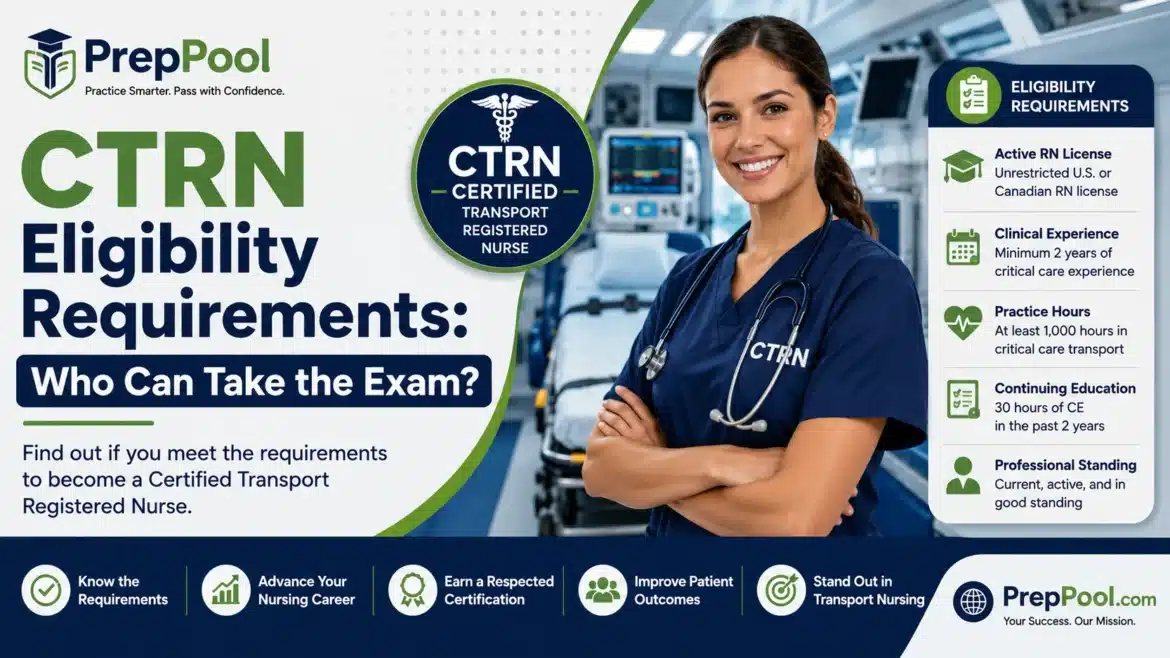
Basic CTRN Eligibility Requirements
One of the reasons the CTRN certification is respected throughout the United States is that it is intended for licensed nursing professionals who already possess a solid clinical foundation. While eligibility policies should always be confirmed through the official certification organization, several general qualifications are commonly expected.
| Requirement | Why It Matters |
|---|---|
| Active Registered Nurse License | Confirms legal authorization to practice professional nursing. |
| Clinical Nursing Experience | Builds assessment and critical thinking skills. |
| Knowledge of Critical Care Concepts | Supports safe patient management during transport. |
| Transport Nursing Familiarity | Improves understanding of operational and clinical challenges. |
| Professional Commitment | Demonstrates readiness for specialty certification. |
Meeting the minimum eligibility requirements is only the beginning. The nurses who perform well on the examination are usually those who combine practical experience with consistent study and a thorough understanding of transport-specific clinical situations.
Do You Need Transport Nursing Experience?
This is one of the most frequently asked questions among nurses considering certification.
While many successful candidates already work in transport programs, practical transport experience provides valuable exposure to situations that are difficult to replicate in traditional hospital settings. Caring for patients inside a moving ambulance or aircraft introduces challenges related to communication, equipment limitations, environmental conditions, and rapid clinical decision-making.
For nurses who have not yet joined a transport team, experience in emergency departments, trauma centers, cardiac intensive care units, surgical ICUs, or pediatric intensive care settings can provide an excellent foundation for future transport nursing responsibilities.
Can Emergency Department Nurses Take the CTRN Exam?
Emergency department nurses frequently develop many of the competencies associated with transport medicine. Daily responsibilities often include trauma assessment, rapid triage, airway stabilization, cardiac emergencies, stroke recognition, and collaboration with multidisciplinary teams.
Because emergency nurses regularly manage unstable patients under significant time pressure, they often possess a strong clinical foundation for future transport nursing practice. Many eventually expand their careers into flight programs or critical care transport services before earning specialty certification.
Is ICU Experience Helpful Before Pursuing Certification?
Intensive care nurses also bring valuable expertise to transport medicine. Continuous patient monitoring, management of complex medical equipment, vasoactive medication administration, ventilator care, and recognition of subtle clinical changes are all essential components of safe patient transport.
Although working in an ICU differs from caring for patients during transport, the advanced assessment and critical thinking developed in intensive care environments provide an excellent starting point for nurses interested in this specialty.
Common Misconceptions About CTRN Eligibility
Misinformation can discourage qualified nurses from pursuing certification. Understanding what is—and isn’t—required helps you make informed career decisions.
- You do not necessarily need to be a flight nurse to begin preparing for the CTRN examination.
- Years of transport experience are valuable, but preparation should begin well before applying for certification.
- Emergency and intensive care experience often provide an excellent clinical foundation.
- Successful candidates focus on developing transport-specific knowledge rather than relying solely on workplace experience.
- Eligibility should always be verified using the current official certification requirements before scheduling the examination.
Whether you’re already working on a transport team or planning your transition into this specialty, understanding the eligibility requirements is the first step toward building a successful certification journey. With the right combination of clinical experience, focused preparation, and continuous learning, you can position yourself for long-term success in transport nursing.
How Clinical Experience Helps You Meet CTRN Expectations
Although meeting the eligibility requirements is important, eligibility alone does not guarantee exam readiness. The CTRN certification is built around real-world transport nursing scenarios, meaning candidates benefit significantly from hands-on experience caring for critically ill patients.
Every patient transport presents unique challenges. A nurse may be responsible for managing ventilated patients during an interfacility transfer in the morning and assisting with a trauma transport later that day. These experiences strengthen clinical judgment, improve prioritization skills, and develop the confidence needed to make rapid decisions under pressure.
If you are still exploring whether transport nursing aligns with your long-term goals, our complete CTRN career guide explains how certification can support professional growth, career advancement, and long-term opportunities in transport medicine.
What Clinical Skills Should You Develop Before Taking the Exam?
The examination evaluates more than theoretical nursing knowledge. Candidates should understand how to apply evidence-based care while adapting to the unique challenges of patient transport.
Developing the following competencies can improve both clinical performance and exam readiness.
| Essential Skill | Why It Matters |
|---|---|
| Advanced Patient Assessment | Supports early recognition of patient deterioration. |
| Critical Thinking | Helps prioritize interventions during rapidly changing situations. |
| Ventilator Management | Important for transporting critically ill respiratory patients. |
| Cardiac Monitoring | Improves recognition of rhythm changes and instability. |
| Medication Administration | Ensures safe use of emergency and critical care medications. |
| Communication | Promotes effective collaboration between transport and hospital teams. |
| Leadership | Supports coordinated decision-making during complex transports. |
Which Nursing Background Best Prepares You for CTRN Certification?
There is no single career pathway that guarantees success. Transport nursing attracts professionals from a variety of specialties, each bringing valuable clinical experience.
| Nursing Specialty | Relevant Experience for Transport Nursing |
|---|---|
| Emergency Department | Rapid assessment, trauma care, triage, emergency stabilization. |
| Adult ICU | Ventilator management, hemodynamic monitoring, critical care. |
| Pediatric ICU | Advanced pediatric assessment and emergency interventions. |
| Neonatal ICU | Care of high-risk newborns and neonatal emergencies. |
| Trauma Services | Management of multisystem injuries and emergency procedures. |
| Critical Care Transport | Direct experience with transport operations and patient transfers. |
Can New Registered Nurses Pursue CTRN Certification?
Many newly licensed registered nurses are interested in transport nursing because of its fast-paced environment and opportunities to care for critically ill patients. However, most professionals recommend first developing a strong foundation in emergency or critical care before pursuing specialty certification.
Early career experience allows nurses to become comfortable with advanced patient assessments, emergency medications, invasive monitoring, ventilator management, and interdisciplinary communication. These experiences often make future certification preparation more manageable and meaningful.
Rather than rushing toward certification immediately after obtaining an RN license, many nurses focus on gaining practical experience while gradually building transport-specific knowledge through continuing education and structured study.
How to Strengthen Your Eligibility Before Applying
If you are not yet ready to schedule the examination, there are several practical steps you can take to improve your qualifications and prepare for future certification.
- Gain experience in emergency, trauma, or intensive care nursing.
- Seek opportunities to observe or work with transport teams.
- Participate in continuing nursing education related to critical care.
- Review evidence-based transport nursing guidelines.
- Practice interpreting complex patient scenarios.
- Build confidence in airway, cardiovascular, and neurological assessment.
- Create a long-term study schedule before applying for certification.
Mistakes to Avoid When Evaluating Your Eligibility
Many nurses delay certification because they mistakenly believe they are unqualified, while others underestimate the preparation required. Avoiding these common misconceptions can save valuable time.
- Assuming only flight nurses can earn the CTRN credential.
- Ignoring transport-specific knowledge while focusing only on hospital-based nursing.
- Waiting until after registering for the exam to begin studying.
- Relying exclusively on clinical experience without structured review.
- Overlooking pediatric or neonatal transport concepts.
- Failing to verify the most current eligibility information before applying.
Building a Strong Foundation for Certification Success
Meeting the eligibility requirements is an important milestone, but becoming a confident transport nurse requires ongoing professional development. Every shift, patient interaction, and educational opportunity contributes to the knowledge and clinical judgment expected of specialty-certified nurses.
Whether your experience comes from an emergency department, intensive care unit, trauma service, or an established transport program, focusing on continuous improvement will better prepare you for both the examination and the real-world responsibilities of transport nursing.
As your clinical experience grows, pairing it with organized study resources and realistic practice questions can help reinforce key concepts, strengthen critical thinking, and increase confidence before exam day.
How to Know You’re Ready for the CTRN Certification Exam
Many nurses ask the same question after reviewing the eligibility requirements: When is the right time to schedule the exam? There isn’t a universal answer because every candidate brings a different level of experience and confidence. Instead of focusing only on the number of years you’ve worked, evaluate whether you consistently apply critical thinking in complex patient situations and feel comfortable managing emergencies during transport.
If you can confidently assess unstable patients, prioritize interventions, communicate effectively with multidisciplinary teams, and adapt to changing clinical conditions, you are likely building the foundation expected of a successful CTRN candidate.
- ✓ Comfortable performing comprehensive patient assessments.
- ✓ Familiar with emergency and critical care interventions.
- ✓ Understand transport-specific patient safety principles.
- ✓ Able to interpret changing patient conditions quickly.
- ✓ Have followed a structured study plan covering all major exam topics.
- ✓ Regularly practice with scenario-based questions to evaluate knowledge.
Preparing for Success Beyond Meeting Eligibility
Eligibility allows you to apply for the examination, but preparation determines how confidently you perform on exam day. Successful candidates often use multiple learning methods instead of relying on a single resource.
A balanced preparation strategy may include:
- Reviewing transport nursing concepts regularly.
- Studying current evidence-based clinical practices.
- Analyzing patient case studies.
- Practicing clinical decision-making through realistic scenarios.
- Taking full-length practice exams to build endurance.
- Tracking weak areas and revisiting them consistently.
Developing a routine that combines reading, active recall, and practice questions helps reinforce knowledge far more effectively than passive studying alone.
Why Specialty Certification Is a Valuable Professional Investment
Earning the CTRN credential demonstrates dedication to professional excellence and lifelong learning. In a healthcare environment where patient needs continue to become more complex, specialty-certified nurses contribute valuable expertise to transport teams responsible for delivering safe, high-quality care during critical transfers.
Certification also reflects personal commitment. It shows employers, colleagues, and patients that you have invested additional time in expanding your knowledge beyond minimum licensing requirements.
For many nurses, the process of preparing for certification improves confidence in daily practice by reinforcing clinical reasoning, strengthening assessment skills, and encouraging continuous professional development.
Why Choose PrepPool for CTRN Exam Preparation?
Once you’ve confirmed that you meet the eligibility requirements, the next step is preparing efficiently and confidently. PrepPool provides study resources designed to help nurses reinforce transport nursing concepts through realistic practice questions and detailed answer explanations.
Rather than simply memorizing information, candidates can strengthen clinical reasoning by working through scenario-based questions that reflect the types of decisions transport nurses encounter in real practice.
Why Nurses Choose PrepPool
- Comprehensive collection of realistic CTRN-style practice questions.
- Detailed explanations that reinforce important clinical concepts.
- Coverage of major transport nursing knowledge areas.
- Self-paced learning that fits busy nursing schedules.
- Helpful resource for identifying strengths and improving weaker topics before exam day.
Ready to strengthen your preparation? Explore the PrepPool CTRN practice resources to build confidence and prepare more effectively for the certification exam.
Final Thoughts
Understanding the CTRN eligibility requirements is the first step toward earning one of transport nursing’s most respected specialty credentials. While an active RN license and relevant clinical experience form the foundation, true readiness comes from combining hands-on practice with structured study and a commitment to continuous learning.
Whether you’re currently working in an emergency department, intensive care unit, trauma center, or transport program, investing in your knowledge today can help prepare you for future certification and continued professional growth. By building strong clinical skills, staying current with evidence-based practice, and preparing with high-quality study materials, you’ll be better equipped to meet the challenges of transport nursing with confidence.
FAQs
Do I need to be a flight nurse to take the CTRN exam?
No. While many flight nurses earn the CTRN credential, registered nurses from emergency departments, intensive care units, trauma services, and critical care transport programs may also pursue certification if they meet the applicable eligibility requirements.
Is transport nursing experience required before taking the CTRN exam?
Transport experience is highly valuable because the examination focuses on patient care during transport. Candidates should always review the current eligibility requirements published by the official certification organization before applying.
Can ICU or emergency nurses prepare for the CTRN certification?
Yes. Many ICU and emergency department nurses build the advanced assessment and critical care skills that provide an excellent foundation for transport nursing and future certification.
What is the best way to prepare after confirming eligibility?
Create a structured study plan, review transport nursing concepts consistently, practice scenario-based questions, evaluate weaker knowledge areas, and reinforce learning with comprehensive review materials.
Why is the CTRN certification respected by employers?
The credential demonstrates advanced transport nursing knowledge, commitment to professional development, and dedication to delivering safe, high-quality care for critically ill patients during transport, making it a valuable specialty certification within the nursing profession.