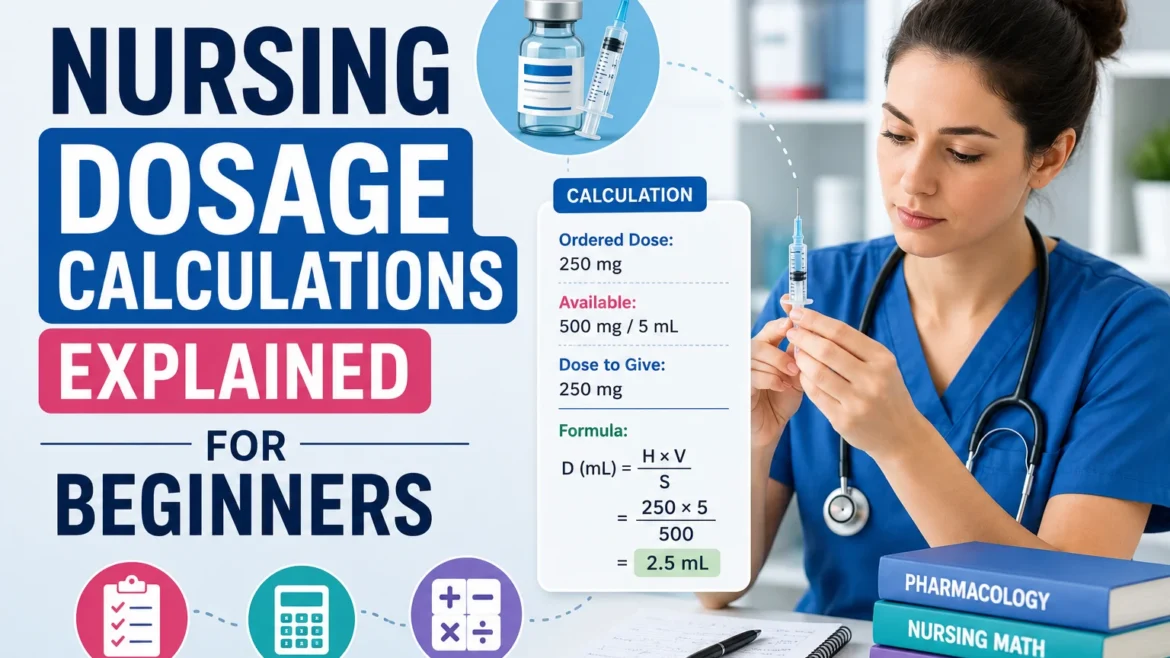

However, most nursing dosage calculations become much easier once students stop trying to memorize random formulas and instead understand the logic behind each step.
Nursing math is not about solving advanced equations. It is about learning how to calculate medications safely and consistently.
Most Common Nursing Dosage Topics:
- Tablet dosage calculations
- Liquid medication dosing
- Weight-based medications
- IV flow-rate calculations
- Unit conversions
- Ratios and proportions
Why Dosage Calculations Matter So Much
Nurses administer medications regularly during patient care, which means calculation accuracy directly affects patient safety.
This is why nursing schools place heavy emphasis on:
- Step-by-step accuracy
- Medication interpretation
- Unit consistency
- Safe dosage reasoning
The goal is not to make students fearful. The goal is to help future nurses develop safe habits before entering real clinical environments.
Important Beginner Mindset:Most dosage-calculation mistakes happen because students rush, skip steps, or panic — not because the math itself is impossible.
The Basic Dosage Formula Beginners Learn First
One of the most common nursing dosage formulas is:
This formula helps students calculate how much medication should be administered based on the medication available.
Simple Example
A doctor orders 500 mg of medication.
The medication available is 250 mg tablets.
Using the formula:
The patient would receive 2 tablets.
Why Students Get Confused During Calculations
Many beginners understand the formula but still become confused because nursing dosage problems contain multiple pieces of information.
Students commonly struggle when:
- Units do not match
- Questions contain extra information
- Decimals appear unexpectedly
- Medication labels look overwhelming
This is why experienced instructors encourage students to slow down and organize information carefully before calculating.
Understanding Unit Conversions
Unit conversions are extremely important in nursing calculations because medication orders and available medications may use different measurement units.
Common conversions include:
Students who forget conversions often arrive at incorrect dosage answers even when the mathematical process itself is correct.
Real Clinical Example
During early medication training, one nursing student calculated a dosage correctly but forgot to convert pounds to kilograms before beginning the problem.
The math looked accurate, but the final medication amount would have been incorrect because the patient’s weight unit was never converted properly.
This is one reason nursing instructors repeatedly emphasize checking units before solving dosage problems.
Many nursing students build confidence faster using step-by-step nursing dosage calculation exercises because repeated exposure to realistic medication problems helps calculations feel more manageable over time.
How to Read Medication Labels Correctly
One of the biggest challenges beginners face is understanding how to read medication labels without becoming overwhelmed by the numbers and abbreviations.
Medication labels often contain:
- Drug concentration
- Dosage strength
- Administration instructions
- Total volume information
- Measurement units
Students sometimes rush directly into the calculation before fully understanding the label itself, which increases the risk of dosage errors.
Helpful Beginner Tip:Before solving any dosage problem, first identify the ordered dose, the available medication strength, and the measurement units involved.
Liquid Medication Dosage Example
Liquid medications are common in nursing calculations because some medications are administered in milliliters rather than tablets.
Example:
- Ordered dose: 250 mg
- Medication available: 125 mg per 5 mL
Using the dosage formula:
The patient would receive 10 mL.
Problems like this become much easier when students organize the information step-by-step instead of trying to calculate mentally.
Why Beginners Often Struggle With Decimals
Decimals create anxiety for many nursing students because small placement mistakes can completely change medication amounts.
For example:
- 0.5 mg is very different from 5 mg
- 1.0 mL is different from 10 mL
This is why nursing instructors strongly emphasize careful decimal placement and reviewing calculations before finalizing answers.
Understanding Weight-Based Dosage Calculations
Some medications are calculated based on patient weight, especially in pediatric and specialty-care situations.
These calculations usually involve:
- Converting pounds to kilograms
- Multiplying dosage amounts per kilogram
- Checking maximum safe dosage limits
One common nursing conversion students memorize early is:
Understanding why conversions matter is much more important than memorizing them mechanically.
How Stress Affects Dosage Calculations
Many students understand dosage math during relaxed study sessions but struggle once timed tests or clinical simulations begin.
Stress often causes students to:
- Skip calculation steps
- Misread medication labels
- Forget conversions
- Second-guess correct answers
This is one reason nursing programs encourage repeated practice before clinical medication administration begins.
Students who want to avoid frequent dosage-calculation problems can review the most common nursing math mistakes that affect medication accuracy before moving into more advanced dosage topics.
Why Nursing Programs Emphasize Calculation Practice
Nursing math is not taught simply as a classroom requirement. It prepares students for real patient-care responsibilities where calculation accuracy matters daily.
Strong dosage-calculation skills help future nurses:
- Administer medications safely
- Reduce medication errors
- Build confidence during clinical training
- Think carefully under pressure
Students who understand how nursing math connects directly to medication safety and patient care often approach dosage calculations with much stronger focus and purpose.
How to Double-Check Dosage Calculations Safely
One of the most important habits nursing students can develop is learning how to double-check calculations before administering medications.
Experienced nurses rarely rely on quick guesses or mental math alone when patient safety is involved.
Strong calculation-review habits include:
- Checking unit conversions carefully
- Reviewing decimal placement
- Comparing medication labels twice
- Confirming dosage reasonableness
- Reworking difficult calculations slowly
These habits help reduce preventable medication errors and build safer clinical decision-making skills.
Important Safety Reminder:If a dosage answer looks unusually large or unusually small, students should pause and review the entire calculation again carefully.
Why IV Flow Rate Calculations Matter
As students progress through nursing education, they eventually begin learning IV flow-rate calculations.
These calculations help determine how quickly fluids or medications should infuse into a patient.
Basic IV calculations may involve:
- Total fluid volume
- Infusion time
- Drops per minute
- Milliliters per hour
A simple IV flow-rate formula often taught to beginners is:
Although IV calculations can initially feel intimidating, they become much easier once students understand the step-by-step logic behind the formulas.
Why Step-by-Step Thinking Improves Accuracy
Many nursing students lose confidence because they try solving dosage problems mentally or too quickly.
Step-by-step organization helps students:
- Reduce calculation confusion
- Catch unit-conversion mistakes
- Improve medication interpretation
- Build confidence gradually
Students who consistently write each step clearly often improve accuracy much faster than those relying on rushed mental calculations.
How Realistic Practice Changes Confidence
Many beginners initially believe dosage calculations will always feel stressful.
However, repeated exposure to realistic nursing scenarios often changes how students think about medication math completely.
Practice-based preparation helps students become more comfortable with:
- Medication labels
- Conversions and decimals
- Dosage formulas
- Clinical-style questions
- Timed nursing exams
Over time, calculations start feeling more like organized problem-solving instead of high-pressure guesswork.
Why Nursing Dosage Calculations Become Easier Over Time
Most nursing students struggle at the beginning because dosage calculations combine math, stress, and patient-care responsibility all together.
However, confidence usually improves once students:
- Practice consistently
- Understand formulas logically
- Slow down during calculations
- Review mistakes carefully
- Build safe calculation habits
With repetition and realistic preparation, many students eventually realize nursing calculations are far more manageable than they first believed.
Final Thoughts on Nursing Dosage Calculations
Nursing dosage calculations are important because they directly support medication safety, patient care accuracy, and responsible clinical practice.
Although many beginners feel intimidated initially, strong dosage-calculation skills are usually built through repetition, step-by-step reasoning, and realistic practice exposure.
Nursing programs emphasize dosage calculations not to create fear, but to help future nurses develop safe and confident medication habits before entering clinical environments.
With consistent practice and careful problem-solving habits, nursing dosage calculations gradually become much more approachable and less stressful over time.
Frequently Asked Questions (FAQs)
What is the easiest way to learn nursing dosage calculations?
Most beginners improve by practicing step-by-step problems consistently and understanding the logic behind formulas instead of memorizing randomly.
Why do nursing students struggle with dosage calculations?
Stress, unit conversions, decimal placement, and medication-label interpretation often create confusion for beginners.
Are dosage calculations important in real nursing jobs?
Yes. Nurses use dosage calculations regularly when administering medications and managing patient treatments.
What should students check before finalizing a dosage answer?
Students should review units, decimal placement, medication labels, and whether the final dosage appears reasonable.
How can I become more confident with nursing calculations?
Consistent realistic practice, reviewing mistakes carefully, and slowing down during calculations usually improve confidence significantly.