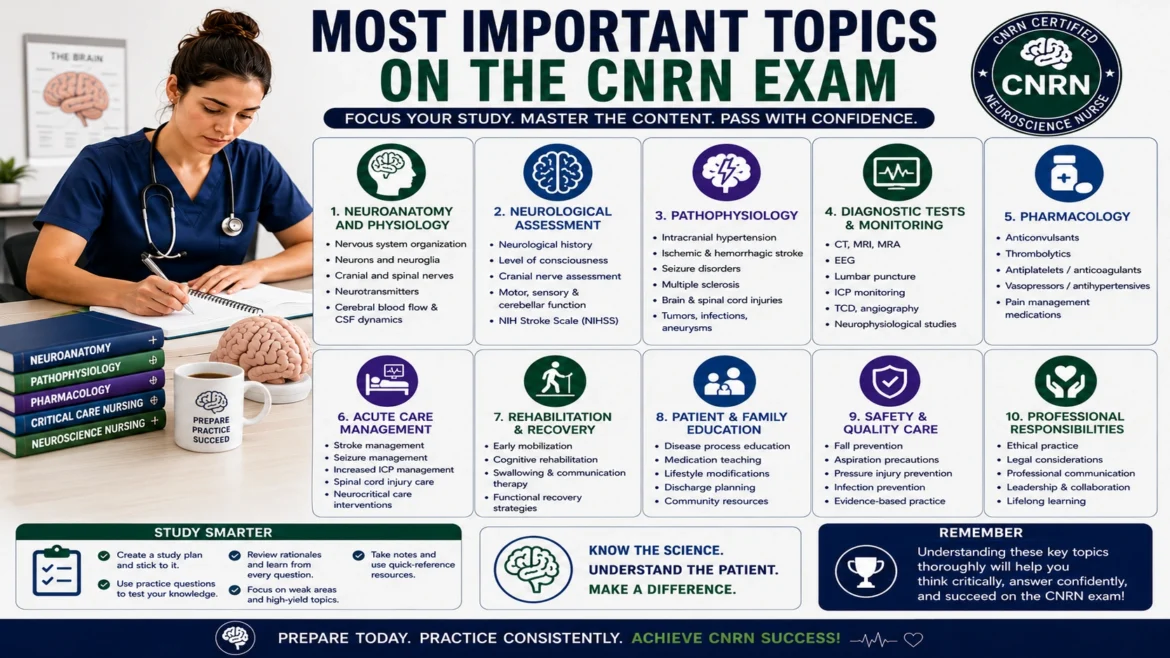

Understanding the Most Important CNRN Exam Topics
The Certified Neuroscience Registered Nurse (CNRN) exam evaluates specialized neurological nursing knowledge required for safe and effective patient care in neuroscience-focused healthcare settings. Many nurses preparing for certification quickly realize that the exam covers a wide range of complex topics involving neurological assessment, emergency interventions, neurocritical care, rehabilitation, and patient safety.
Because the exam includes both theoretical knowledge and clinical application, candidates often struggle to identify which topics deserve the most attention during preparation.
While every section matters, some neuroscience nursing concepts consistently play a major role in both certification exams and real clinical practice environments.
Preparation Insight:Strong CNRN candidates focus heavily on high-yield neurological topics that require both clinical understanding and critical thinking application.
Why Topic Prioritization Matters During Preparation
One of the biggest mistakes candidates make is trying to study every neuroscience concept with equal intensity. Because neuroscience nursing covers such a large amount of material, preparation becomes more effective when candidates prioritize major high-impact clinical areas first.
Prioritization helps nurses:
- Study more efficiently
- Reduce overwhelm
- Strengthen critical concepts faster
- Improve retention
- Build clinical confidence gradually
Many successful candidates begin by mastering the neurological conditions and assessment skills most commonly encountered in neuroscience nursing practice.
Stroke Management and Cerebrovascular Care
Stroke care remains one of the most important areas in neuroscience nursing because rapid recognition and intervention directly affect patient outcomes.
The CNRN exam often evaluates whether candidates understand:
- Ischemic stroke symptoms
- Hemorrhagic stroke complications
- Time-sensitive interventions
- Neurological deterioration signs
- Stroke risk factors
- Post-stroke monitoring priorities
- Patient rehabilitation basics
Because stroke emergencies require immediate action, neuroscience nurses must recognize subtle neurological changes quickly and communicate effectively with interdisciplinary teams.
For example, delayed recognition of worsening neurological deficits may reduce treatment options and negatively affect recovery outcomes.
Strong stroke management knowledge is essential not only for exam success but also for real-world patient safety.
Neurological Assessment Skills
Neurological assessment is considered one of the core foundations of neuroscience nursing practice. Small changes in neurological status may indicate serious complications requiring immediate intervention.
The certification exam frequently tests a nurse’s ability to interpret assessment findings accurately and identify dangerous changes in patient condition.
Important assessment topics often include:
- Level of consciousness changes
- Glasgow Coma Scale interpretation
- Pupil assessment findings
- Cranial nerve function
- Motor strength evaluation
- Sensory deficit recognition
- Speech and cognitive assessment
Strong neurological assessment skills help nurses identify deterioration earlier and respond appropriately during emergencies.
Clinical Reality:In neurocritical care environments, subtle neurological changes may appear hours before severe deterioration becomes obvious. Early recognition can significantly improve patient outcomes.
Intracranial Pressure and Brain Injury Management
Intracranial pressure (ICP) management is another major topic area because elevated pressure inside the skull can quickly become life-threatening.
Neuroscience nurses caring for traumatic brain injuries, hemorrhagic strokes, tumors, or neurosurgical patients must understand how ICP affects brain function and patient stability.
Candidates should feel comfortable with:
- Signs of increased intracranial pressure
- Cerebral perfusion concepts
- Neurological deterioration indicators
- Brain herniation warning signs
- Patient positioning principles
- ICP monitoring basics
- Emergency intervention priorities
The exam may present patient scenarios requiring candidates to identify early warning signs before catastrophic neurological decline occurs.
Understanding the relationship between brain swelling, cerebral blood flow, and neurological function is especially important for both critical care practice and certification readiness.
Seizure Disorders and Emergency Neurological Response
Seizure management is another essential neuroscience nursing topic because seizures may occur suddenly and require rapid intervention to protect patient safety.
The CNRN exam may evaluate knowledge involving:
- Different seizure types
- Status epilepticus management
- Airway protection priorities
- Medication administration principles
- Postictal assessment findings
- Safety precautions during seizures
- Neurological monitoring after seizure activity
In real clinical settings, nurses must respond calmly and efficiently during seizure emergencies while protecting patients from injury and monitoring neurological changes carefully.
Repeated exposure to seizure scenarios through study review and practice questions often improves confidence significantly.
Neuro Pharmacology Fundamentals
Medication management plays a major role in neuroscience nursing because neurological patients frequently require high-risk medications affecting brain function, circulation, seizures, sedation, and neurological recovery.
Candidates should understand major neuro-related medications and their clinical implications, including:
| Medication Area | Why It Matters |
|---|---|
| Anticonvulsants | Used to manage seizure activity safely. |
| Sedatives | Affect neurological assessments and patient monitoring. |
| Osmotic Agents | Help manage intracranial pressure. |
| Thrombolytics | Critical in acute ischemic stroke treatment. |
| Blood Pressure Medications | Important for stroke and cerebral perfusion management. |
Neuro pharmacology questions often test patient safety awareness, medication effects, contraindications, and monitoring priorities.
Spinal Cord Injuries and Neurological Trauma
Spinal cord injuries remain another important topic because trauma-related neurological emergencies require specialized nursing interventions and monitoring.
Candidates should understand:
- Spinal shock basics
- Respiratory complications
- Autonomic dysreflexia
- Mobility considerations
- Sensory and motor deficits
- Patient safety interventions
- Long-term rehabilitation concerns
Trauma-focused neurological care often involves rapid assessments, interdisciplinary coordination, and careful monitoring for life-threatening complications.
Many neuroscience nurses strengthen their preparation by using realistic CNRN certification practice questions that focus on stroke care, neurological assessments, seizure management, neurocritical care, and other high-priority neuroscience nursing topics commonly seen during certification exams.
Neurosurgical Patient Care and Post-Operative Monitoring
Neurosurgical nursing care is another important focus area because patients recovering from neurological surgery often require intensive monitoring and rapid intervention if complications develop.
The CNRN exam may evaluate whether candidates understand how to care for patients following procedures involving:
- Brain tumor removal
- Craniotomies
- Spinal surgeries
- Aneurysm repair
- Shunt placement
- Neurosurgical trauma intervention
Neurosurgical patients can deteriorate quickly if neurological complications are not recognized early.
Important post-operative nursing priorities may include:
- Frequent neurological assessments
- Monitoring for increased intracranial pressure
- Recognizing infection symptoms
- Assessing changes in consciousness
- Pain management
- Fluid and electrolyte monitoring
- Preventing secondary complications
The certification exam often tests clinical judgment regarding which assessment findings require immediate intervention.
Clinical Priority:Small neurological changes following neurosurgery can indicate serious complications such as bleeding, swelling, or worsening intracranial pressure.
Neurocritical Care Concepts
Neurocritical care combines advanced neurological monitoring with intensive critical care management. Nurses working in neuro ICU environments often care for highly unstable patients requiring rapid assessment and complex interventions.
The CNRN exam commonly includes neurocritical care principles because these environments demand advanced clinical reasoning and strong prioritization skills.
Important neurocritical care topics may include:
- Ventilator considerations in neurological patients
- Hemodynamic monitoring
- Cerebral perfusion pressure
- Sedation management
- Neurological emergency response
- Brain injury stabilization
- Continuous neurological reassessment
Because critically ill neurological patients can decline rapidly, neuroscience nurses must continuously evaluate assessment findings and respond efficiently under pressure.
These complex care environments are one reason the CNRN certification places such strong emphasis on clinical judgment and patient safety.
Neuro Diagnostics and Imaging Basics
Understanding neurological diagnostics is important because neuroscience nurses frequently care for patients undergoing advanced imaging and diagnostic testing.
Although nurses are not expected to interpret imaging studies at a physician level, candidates should understand the purpose and nursing implications of common neurological diagnostic procedures.
Key diagnostic areas may include:
- CT scans
- MRI procedures
- Electroencephalograms (EEG)
- Cerebral angiography
- Lumbar punctures
- Intracranial pressure monitoring systems
Questions may focus on:
- Patient preparation
- Monitoring responsibilities
- Complication awareness
- Post-procedure care
- Safety considerations
Understanding why these diagnostic procedures are performed and how they affect patient care helps strengthen both exam readiness and clinical confidence.
Rehabilitation and Long-Term Neurological Recovery
Many neurological patients require extended rehabilitation following strokes, spinal injuries, traumatic brain injuries, or neurosurgical procedures.
The CNRN exam may evaluate a nurse’s understanding of rehabilitation principles because recovery often continues long after the acute care phase ends.
Important rehabilitation concepts may include:
- Mobility support
- Patient independence goals
- Speech and swallowing concerns
- Cognitive rehabilitation
- Family education
- Prevention of secondary complications
- Interdisciplinary rehabilitation planning
Neuroscience nurses frequently help patients adapt physically and emotionally to major life changes caused by neurological injuries or illnesses.
This aspect of neuroscience nursing requires patience, communication skills, and long-term patient advocacy.
Why Prioritization Questions Matter So Much
Prioritization remains one of the most difficult areas for many candidates because neurological patients often present with multiple urgent problems simultaneously.
The certification exam frequently challenges candidates to determine:
- Which patient requires attention first
- Which intervention is safest initially
- What assessment finding is most dangerous
- Which complication requires immediate escalation
- How to respond during emergencies
Strong prioritization skills develop through repeated exposure to realistic neurological scenarios.
In real clinical practice, neuroscience nurses constantly balance competing priorities while protecting patient safety and responding to rapidly changing conditions.
Exam Insight:Prioritization questions often test whether candidates can recognize subtle but dangerous neurological changes before they become catastrophic.
The Importance of Patient Safety in Neuroscience Nursing
Patient safety principles appear throughout nearly every major CNRN exam topic. Neurological patients are often vulnerable to rapid deterioration, falls, airway compromise, seizures, aspiration, and life-threatening complications.
Candidates should consistently think about safety during every neurological scenario.
Important safety considerations may involve:
- Airway protection
- Fall prevention
- Seizure precautions
- Monitoring neurological decline
- Medication safety
- Preventing secondary brain injury
- Protecting spinal stability
Questions often require candidates to identify the safest nursing action in complex clinical situations.
This emphasis reflects real-world neuroscience nursing responsibilities where early intervention and careful monitoring can significantly improve patient outcomes.
Building a Smarter Topic-Focused Study Strategy
Because neuroscience nursing covers so many clinical areas, topic-focused studying often improves retention and reduces overwhelm.
Many successful candidates organize preparation by concentrating on one major neurological category at a time.
For example:
| Study Week | Primary Focus |
|---|---|
| Week 1 | Stroke and cerebrovascular care |
| Week 2 | Neurological assessments |
| Week 3 | Brain injury and intracranial pressure |
| Week 4 | Seizure disorders and neuro pharmacology |
| Week 5 | Neurocritical care and trauma |
This organized structure helps candidates build stronger conceptual understanding gradually while reinforcing long-term retention.
How Strong Topic Knowledge Improves Clinical Confidence
Certification preparation should ultimately improve real-world neurological nursing performance, not simply help candidates pass an exam.
As nurses strengthen understanding of major neuroscience topics, they often become more confident in:
- Recognizing neurological emergencies
- Communicating with providers
- Performing assessments
- Managing critical interventions
- Supporting patients and families
- Responding calmly during crises
This growing confidence benefits both nurses and the patients they care for daily.
Strong neuroscience preparation builds the clinical reasoning foundation required for safe neurological care in high-pressure healthcare environments.
How High-Yield Topics Improve Exam Readiness
Many neuroscience nursing candidates feel overwhelmed during preparation because the CNRN exam covers such a broad range of neurological concepts. Focusing heavily on high-yield topics helps simplify preparation while strengthening the areas most likely to influence both exam performance and real clinical practice.
High-yield neurological topics usually involve conditions and situations nurses encounter frequently in neuroscience care settings, including:
- Stroke emergencies
- Neurological deterioration
- Traumatic brain injuries
- Seizure management
- Neurocritical care monitoring
- Post-operative neurosurgical care
These clinical areas often require fast decision-making, careful monitoring, and strong prioritization skills.
By mastering these core concepts first, candidates often build confidence faster and improve their ability to handle more advanced neurological scenarios later in the preparation process.
Study Approach:Focusing on foundational neuroscience topics early can make advanced neurological concepts easier to understand later during preparation.
Why Neurological Prioritization Skills Are Essential
One major difference between general nursing exams and neuroscience certification exams is the strong emphasis on neurological prioritization and rapid clinical judgment.
Neurological patients can decline very quickly. Small changes in assessment findings may indicate dangerous complications requiring immediate intervention.
Because of this, candidates should become comfortable determining:
- Which patient requires attention first
- Which symptoms are most dangerous
- Which intervention should occur immediately
- When providers must be notified urgently
- How to prevent worsening neurological injury
The ability to prioritize effectively often separates strong candidates from those who struggle with application-based scenarios.
Repeated exposure to neurological case studies and realistic patient situations can strengthen these critical thinking abilities significantly.
The Importance of Understanding Pathophysiology
Many nurses preparing for the CNRN exam discover that understanding neurological pathophysiology makes clinical reasoning much easier.
Instead of memorizing isolated symptoms, candidates who understand how neurological conditions affect the brain and nervous system can often analyze scenarios more effectively.
For example:
- Understanding cerebral edema helps explain rising intracranial pressure symptoms
- Understanding ischemia clarifies stroke progression patterns
- Understanding spinal cord injury physiology supports emergency intervention decisions
- Understanding seizure activity improves medication and airway management reasoning
This deeper understanding improves both memory retention and clinical application.
Strong neuroscience nurses think beyond memorization and focus on why neurological changes occur physiologically.
How Topic-Based Practice Questions Strengthen Learning
Topic-focused practice questions can dramatically improve retention because they reinforce clinical reasoning repeatedly within the same neurological category.
For example, candidates may complete focused practice sessions involving:
- Stroke assessment scenarios
- Seizure emergencies
- Intracranial pressure monitoring
- Neuro pharmacology safety
- Neurological trauma cases
This focused repetition helps nurses recognize important patterns faster and apply concepts more confidently.
Many candidates notice stronger improvement when they combine content review with active question-based learning instead of relying only on passive reading.
Learning Tip:Practicing neurological scenarios repeatedly can improve both memory recall and response speed during high-pressure exam situations.
Common High-Yield Areas Candidates Often Underestimate
Some neuroscience topics appear deceptively simple initially but become challenging during complex patient scenarios.
Areas commonly underestimated include:
| Topic Area | Why Candidates Struggle |
|---|---|
| Neuro Assessments | Requires interpretation, not simple memorization. |
| Prioritization | Involves rapid clinical judgment under pressure. |
| Intracranial Pressure | Symptoms may appear subtle early. |
| Neuro Pharmacology | Medication safety and side effects require strong understanding. |
| Stroke Progression | Questions often involve evolving symptoms and interventions. |
Recognizing these commonly challenging areas early allows candidates to dedicate additional study time before exam day.
How Consistency Improves Long-Term Retention
Neuroscience nursing information can feel overwhelming when candidates attempt to absorb large amounts of content rapidly. Consistency often produces much stronger results than short-term intensive cramming.
Regular exposure to neuroscience concepts helps reinforce:
- Clinical reasoning pathways
- Neurological terminology
- Assessment interpretation
- Emergency intervention logic
- Patient safety awareness
Even shorter study sessions repeated consistently throughout the week can improve retention significantly over time.
Many successful candidates create routines involving:
- Daily neurological review
- Focused practice questions
- Rationale analysis
- Weekly topic review sessions
- Timed exam simulations
This gradual reinforcement approach often improves both confidence and knowledge retention.
Why Strong Topic Knowledge Matters Beyond the Exam
The purpose of neuroscience certification preparation extends far beyond passing a professional exam. Advanced topic knowledge directly supports safer patient care and stronger clinical performance in neurological healthcare environments.
Neuroscience nurses frequently encounter:
- Stroke alerts
- Traumatic injuries
- Seizure emergencies
- Neurocritical care instability
- Rapid neurological decline
- Complex rehabilitation challenges
Strong foundational knowledge helps nurses respond more confidently during these high-pressure situations.
Many nurses pursuing certification also benefit from understanding the broader neuroscience nursing journey, including specialization pathways, professional growth opportunities, and long-term certification preparation strategies. Educational resources such as this detailed guide for neuroscience nursing certification preparation can help candidates better understand the overall certification process while building a stronger study foundation.
The Role of Active Learning in Neuroscience Preparation
Active learning remains one of the most effective methods for mastering difficult neurological concepts because it forces candidates to engage directly with clinical reasoning instead of reviewing information passively.
Effective active learning methods may include:
- Scenario-based practice testing
- Case study analysis
- Teaching concepts aloud
- Creating neuro assessment charts
- Reviewing detailed rationales
- Timed neurological quizzes
Many candidates preparing for advanced neuroscience certification improve confidence faster when they regularly use realistic scenario-based testing methods. Learning resources focused on improving neuroscience exam preparation through practice testing can help strengthen critical thinking, retention, and neurological application skills before exam day.
Frequently Asked Questions (FAQs)
What are the most important topics on the CNRN exam?
Major focus areas often include stroke management, neurological assessments, intracranial pressure, seizure disorders, neurocritical care, and neuro pharmacology.
Why is stroke care heavily emphasized during preparation?
Stroke emergencies require rapid recognition and intervention, making stroke management one of the most critical neuroscience nursing responsibilities.
Are neurological assessment skills important for the CNRN exam?
Yes. Accurate neurological assessments help nurses recognize deterioration early and are heavily tested in neuroscience certification scenarios.
How can candidates study neuroscience topics more effectively?
Topic-focused review combined with practice questions, rationale analysis, and active learning methods often improves retention and clinical reasoning.
Why do prioritization questions feel difficult?
Prioritization questions require candidates to analyze patient safety, recognize emergencies, and select the most urgent intervention under pressure.