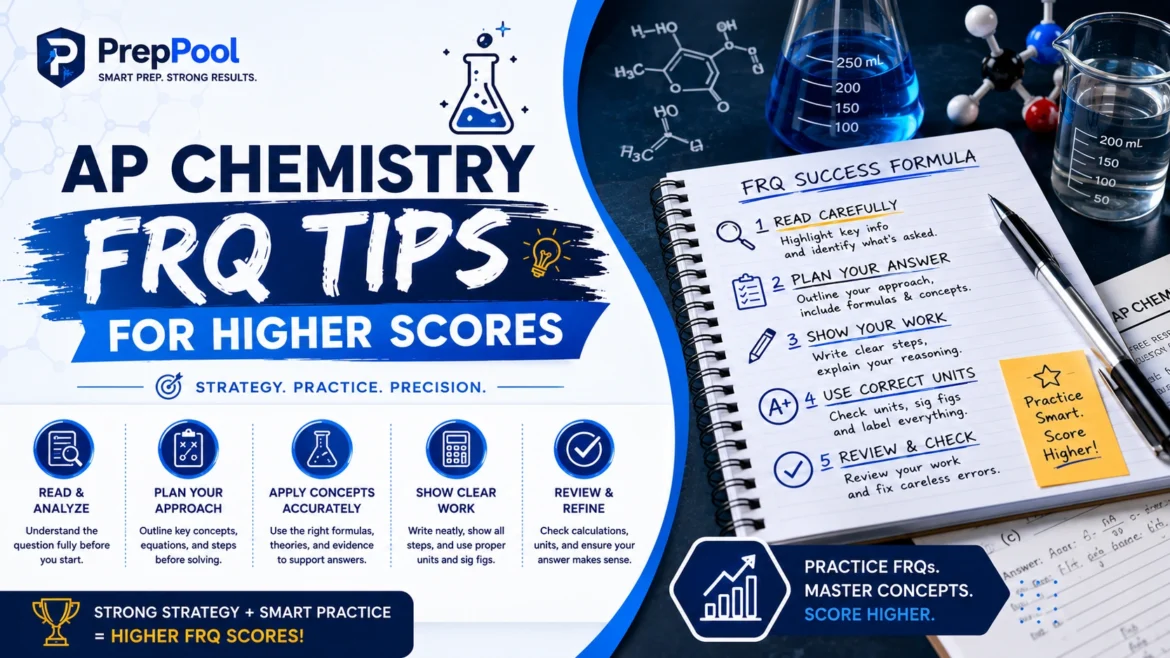

AP Chemistry FRQs are designed to measure deeper understanding rather than simple memorization. Students are expected to apply chemistry concepts, justify conclusions, analyze reactions, and solve multi-step problems under time pressure.
While FRQs can initially feel intimidating, students who practice strategically often improve their scores dramatically over time.
- Chemistry calculations
- Scientific reasoning
- Laboratory interpretation
- Data analysis
- Reaction predictions
- Concept application
Why AP Chemistry FRQs Feel Difficult for Many Students
Many students struggle with FRQs because the section requires much more than choosing an answer from multiple options. Students must explain their thinking clearly while solving chemistry problems accurately and efficiently.
Unlike standard classroom quizzes, AP Chemistry FRQs often combine multiple scientific concepts into one question. Students may need to perform calculations, interpret laboratory results, explain molecular behavior, and justify conclusions within a single response.
Time pressure can also make FRQs feel overwhelming, especially for students who are not used to writing scientific explanations quickly.
Understanding the Structure of AP Chemistry FRQs
AP Chemistry free-response sections usually contain both long and short questions covering multiple chemistry units. Students are expected to demonstrate scientific understanding through organized reasoning and calculations.
| FRQ Component | What Students Must Do |
|---|---|
| Calculations | Show step-by-step chemistry work |
| Scientific Explanations | Justify reasoning clearly |
| Laboratory Analysis | Interpret experiments and data |
| Concept Application | Apply chemistry principles logically |
| Graph Interpretation | Analyze scientific trends and patterns |
Students who understand the structure of FRQs often feel less overwhelmed during the actual exam.
Why Scientific Reasoning Matters More Than Memorization
AP Chemistry FRQs are designed to reward understanding and logical reasoning rather than memorized definitions alone.
For example, students may be asked to predict how equilibrium systems respond to changes in temperature or concentration. Instead of simply recalling formulas, students must explain why reactions shift in specific directions based on scientific principles.
This is why active learning and concept mastery are far more important than memorizing isolated facts.
How to Improve AP Chemistry FRQ Writing Skills
Many students understand chemistry concepts mentally but lose points because their written explanations are unclear or incomplete.
Scientific writing skills improve through practice and repetition. Students should focus on organizing answers logically and using accurate chemistry vocabulary consistently.
- Write complete scientific explanations
- Show all calculation steps clearly
- Use chemistry terminology correctly
- Avoid vague or incomplete reasoning
- Practice explaining concepts in writing
Students who regularly practice written chemistry explanations usually become much more comfortable during timed FRQ sections.
Why Showing Work Is Extremely Important
One of the biggest AP Chemistry FRQ mistakes students make is skipping calculation steps or writing incomplete solutions.
AP exam scoring guidelines often award partial credit for correct reasoning and organized calculations, even when the final answer is incorrect.
Students who show work clearly increase their chances of earning valuable points throughout the exam.
Common AP Chemistry FRQ Topics Students Should Practice
Certain chemistry concepts appear repeatedly throughout AP Chemistry FRQs because they require deeper analytical thinking and scientific interpretation.
| High-Value FRQ Topic | Why It Matters |
|---|---|
| Equilibrium | Tests conceptual reasoning and calculations |
| Acids and Bases | Frequently appears in calculations and explanations |
| Thermodynamics | Requires energy analysis and interpretation |
| Kinetics | Focuses on reaction rates and experimental data |
| Laboratory Analysis | Measures scientific reasoning and data interpretation |
Students who repeatedly practice these core chemistry areas usually feel much more prepared for advanced FRQ questions.
Why Laboratory Questions Matter So Much in FRQs
Laboratory interpretation is one of the most important components of AP Chemistry FRQs. Students are often asked to analyze experiments, identify variables, interpret graphs, and evaluate scientific results.
Many students focus heavily on calculations while underestimating laboratory-based questions. However, experimental reasoning plays a major role throughout the AP Chemistry exam.
Students who review laboratory concepts consistently often perform much better on application-based FRQs.
How to Practice AP Chemistry FRQs Effectively
Many students spend hours reviewing chemistry notes but never practice realistic free-response questions under timed conditions. This creates problems because FRQs require organization, speed, scientific reasoning, and written communication skills that improve only through active practice.
Students preparing for higher AP Chemistry scores should regularly complete timed FRQ sessions throughout the school year instead of waiting until exam season.
- Practice under realistic time limits
- Review official scoring expectations
- Analyze incorrect answers carefully
- Rewrite weak explanations clearly
- Focus on difficult chemistry topics consistently
- Practice laboratory interpretation regularly
Students who consistently solve realistic chemistry problems often improve both confidence and writing accuracy over time through structured AP Chemistry Practice Test – 6000+ Questions & Answers Bank.
Why Time Management Is Critical During FRQs
Time pressure is one of the biggest reasons students lose points during AP Chemistry FRQs. Some students spend too long on one difficult calculation and later rush through easier questions unnecessarily.
Successful students usually develop pacing strategies before exam day through repeated timed practice.
| Time Management Problem | Better Strategy |
|---|---|
| Overthinking difficult questions | Move forward and return later |
| Writing overly long explanations | Keep scientific reasoning concise |
| Skipping calculation steps | Organize work clearly and efficiently |
| Ignoring pacing completely | Practice with timers regularly |
Students who learn how to manage time effectively usually feel much calmer during the actual AP Chemistry exam.
How to Write Strong Scientific Explanations
One of the biggest differences between weak and strong FRQ responses is the quality of scientific explanations. AP Chemistry graders look for logical reasoning supported by chemistry principles rather than vague statements.
Strong scientific explanations usually:
- Use chemistry vocabulary accurately
- Explain reaction behavior logically
- Connect evidence to conclusions clearly
- Avoid unnecessary wording
- Focus directly on the question asked
Students who practice explaining chemistry concepts in their own words often improve FRQ performance significantly.
Why Reviewing Mistakes Improves FRQ Scores Faster
Many students complete FRQs but never carefully analyze what went wrong afterward. However, reviewing mistakes is one of the fastest ways to improve chemistry reasoning and writing accuracy.
Students should review:
- Incorrect calculations
- Weak scientific explanations
- Laboratory interpretation errors
- Missed units or formulas
- Incomplete reasoning steps
Students who repeatedly review mistakes usually identify patterns that help prevent future scoring errors.
Common AP Chemistry FRQ Mistakes Students Make
Many AP Chemistry students lose points because of avoidable habits rather than lack of chemistry knowledge. Weak organization, rushed calculations, incomplete explanations, and poor pacing can all reduce FRQ scores significantly.
Students who want to improve their overall chemistry preparation can also review these detailed insights about common AP Chemistry mistakes students make during exam preparation.
Why AP Chemistry FRQs Build Real Scientific Thinking Skills
One reason AP Chemistry FRQs feel challenging is because they simulate real scientific problem solving. Scientists, engineers, pharmacists, and healthcare professionals must often explain reasoning, analyze evidence, and interpret data logically.
AP Chemistry FRQs help students begin developing those same analytical and communication skills before college.
Students are not simply memorizing chemistry facts. They are learning how to think scientifically and communicate conclusions clearly.
How AP Chemistry Preparation Helps Future STEM Students
Strong AP Chemistry preparation can provide valuable advantages for students planning careers in medicine, engineering, biotechnology, pharmacy, nursing, environmental science, and research.
Many students exploring advanced science pathways also study how AP Chemistry supports future STEM students and prepares them for college-level scientific coursework.
The scientific reasoning and analytical skills developed through AP Chemistry FRQs often remain valuable long after the exam itself.
How Confidence Improves AP Chemistry FRQ Performance
Confidence plays a major role during difficult AP Chemistry FRQs. Students who panic under time pressure often make avoidable mistakes even when they understand the chemistry concepts correctly.
Confidence usually develops from preparation and repetition. The more students practice scientific writing, calculations, and laboratory interpretation, the more comfortable they become handling advanced chemistry questions.
Students who consistently practice FRQs often notice significant improvements in both speed and accuracy before exam season.
Final Thoughts on AP Chemistry FRQ Success
AP Chemistry FRQs challenge students because they require scientific reasoning, organized writing, laboratory interpretation, and careful calculations under time pressure. However, students who practice actively and prepare consistently often improve far more than they expect.
Strong FRQ performance usually comes from repetition, mistake analysis, time management practice, and deep conceptual understanding rather than memorization alone.
Students who develop strong FRQ skills not only improve AP Chemistry scores but also strengthen scientific thinking abilities that support future STEM education and careers.
Frequently Asked Questions About AP Chemistry FRQs
Why are AP Chemistry FRQs difficult?
AP Chemistry FRQs are challenging because they require calculations, scientific explanations, laboratory interpretation, and analytical reasoning under time pressure.
How can students improve AP Chemistry FRQ scores?
Students usually improve by practicing timed FRQs regularly, reviewing mistakes carefully, and strengthening scientific writing skills consistently.
Do AP Chemistry FRQs give partial credit?
Yes, AP Chemistry FRQs often award partial credit for correct reasoning, organized calculations, and scientific explanations even if the final answer is incomplete.
What AP Chemistry topics appear most often in FRQs?
Equilibrium, acids and bases, thermodynamics, kinetics, stoichiometry, and laboratory analysis commonly appear throughout AP Chemistry FRQs.
Should students practice AP Chemistry FRQs under timed conditions?
Yes, timed practice helps students improve pacing, reduce exam stress, and become more comfortable solving advanced chemistry problems efficiently.
Why Difficult Chemistry Topics Appear Frequently in FRQs
AP Chemistry FRQs often focus heavily on advanced chemistry topics because these questions measure deeper scientific understanding rather than simple memorization. Students are expected to apply concepts logically and explain reaction behavior using scientific evidence.
Topics like equilibrium, thermodynamics, kinetics, acids and bases, and electrochemistry appear frequently because they require analytical reasoning and multi-step problem solving.
Students who want stronger FRQ performance often spend additional time reviewing advanced concepts through resources explaining the hardest AP Chemistry topics students struggle with.
- Chemical equilibrium systems
- Acid-base calculations
- Laboratory analysis questions
- Reaction rate interpretation
- Thermodynamics explanations
- Experimental reasoning
How Top Students Approach AP Chemistry FRQs
Students who consistently score well on AP Chemistry FRQs usually follow disciplined preparation habits throughout the school year. They do not simply memorize formulas. Instead, they practice scientific reasoning repeatedly until chemistry concepts feel more natural and connected.
Strong AP Chemistry students often:
- Practice timed FRQs regularly
- Review scoring guidelines carefully
- Analyze mistakes in detail
- Focus on weak chemistry areas consistently
- Practice laboratory interpretation frequently
- Improve scientific writing gradually
Many students aiming for top AP Chemistry scores also study advanced preparation strategies used by high-performing students learning how to get a 5 on AP Chemistry.
Why Active Learning Improves FRQ Performance Faster
Passive review methods may feel comfortable, but they rarely prepare students effectively for difficult AP Chemistry FRQs. Reading notes repeatedly does not build the scientific reasoning and problem-solving skills needed during timed written responses.
Active learning methods usually produce much faster improvement because students engage directly with chemistry concepts and calculations.
| Passive Learning | Active Learning |
|---|---|
| Rereading chemistry notes | Solving chemistry problems |
| Highlighting textbooks | Writing scientific explanations |
| Watching videos passively | Practicing timed FRQs |
| Memorizing formulas | Applying concepts logically |
Students who actively solve chemistry questions usually become much more comfortable with scientific reasoning under exam pressure.
How AP Chemistry FRQs Prepare Students for College Science Courses
One reason AP Chemistry FRQs are so demanding is because they are designed to simulate college-level scientific thinking. University STEM programs require students to analyze information, justify conclusions, interpret data, and solve unfamiliar scientific problems regularly.
AP Chemistry FRQs help students begin developing these skills before entering college engineering, medicine, pharmacy, biotechnology, or research programs.
Students who improve scientific writing and analytical reasoning during AP Chemistry often transition more confidently into advanced university science courses later.
Why Consistency Matters More Than Last-Minute Cramming
Many students underestimate how much repetition and consistency influence AP Chemistry FRQ performance. Scientific reasoning skills develop gradually through repeated exposure to chemistry problems and written explanations.
Last-minute cramming may temporarily improve memorization, but it rarely builds the deeper understanding needed for complex FRQs.
How Confidence Affects AP Chemistry FRQ Scores
Confidence plays a major role during difficult AP Chemistry FRQs. Students who panic during calculations or overthink scientific explanations often make avoidable mistakes under time pressure.
Confidence usually develops through:
- Repeated chemistry practice
- Improved calculation accuracy
- Familiarity with FRQ structure
- Better time management
- Stronger conceptual understanding
Students who trust their preparation often remain calmer and more organized during challenging chemistry questions.
Final Takeaway on AP Chemistry FRQ Preparation
AP Chemistry FRQs are challenging because they require students to combine scientific reasoning, chemistry calculations, laboratory interpretation, and written communication into one advanced exam section. However, students who prepare actively and consistently often improve dramatically over time.
Strong FRQ performance usually comes from realistic practice, mistake analysis, time management, and conceptual understanding rather than memorization alone.
Students who build strong AP Chemistry FRQ skills not only improve exam performance but also strengthen long-term scientific thinking abilities that support future STEM education and career success.