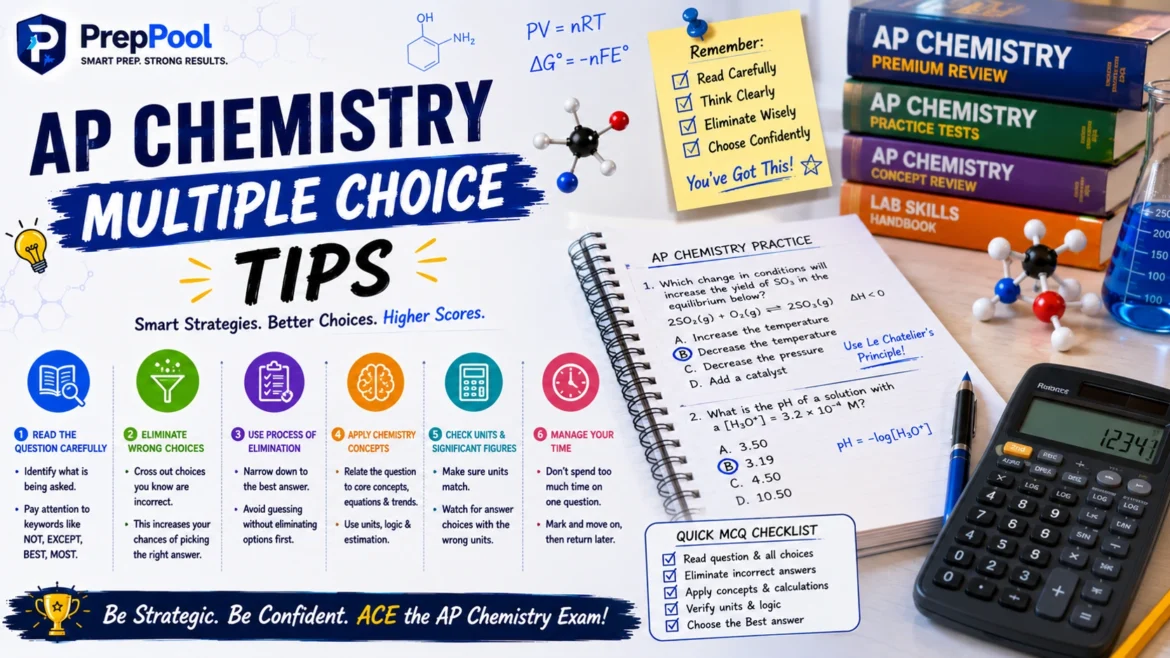

Some students understand chemistry concepts well during homework assignments but struggle to answer questions efficiently during timed exams. Others lose points because of rushed calculations, misreading questions, or weak time management.
The good news is that strong multiple-choice performance can improve significantly with the right preparation strategies and consistent practice.
- Chemistry calculations
- Scientific reasoning
- Laboratory interpretation
- Reaction analysis
- Concept application
- Time management under pressure
Why AP Chemistry Multiple-Choice Questions Feel Difficult
AP Chemistry multiple-choice questions often combine several scientific concepts into one problem. Students may need to analyze reaction behavior, interpret data, perform calculations, and eliminate misleading answer choices within a short amount of time.
Unlike traditional classroom quizzes, AP Chemistry questions frequently test whether students truly understand chemical relationships instead of memorized definitions alone.
This is why active learning and repeated chemistry practice are far more effective than passive review methods.
Why Scientific Reasoning Matters More Than Memorization
Many AP Chemistry students initially focus heavily on memorizing formulas and vocabulary. While basic memorization can help with foundational understanding, AP Chemistry multiple-choice questions usually require deeper scientific reasoning.
Students are often expected to:
- Predict reaction behavior
- Interpret laboratory data
- Analyze equilibrium systems
- Evaluate energy changes
- Apply chemistry concepts logically
Students who focus on understanding scientific relationships instead of memorizing isolated facts often perform much better on advanced multiple-choice questions.
| Weak Study Strategy | Better AP Chemistry Strategy |
|---|---|
| Memorizing answers | Understanding chemistry concepts deeply |
| Passive rereading | Timed chemistry problem solving |
| Ignoring mistakes | Reviewing incorrect answers carefully |
| Studying only before tests | Consistent chemistry practice weekly |
How Time Management Affects AP Chemistry Scores
Time pressure is one of the biggest challenges during AP Chemistry multiple-choice sections. Some students spend too much time on difficult calculations and later rush through easier questions unnecessarily.
Strong time management helps students:
- Reduce exam stress
- Maintain focus during difficult problems
- Answer more questions accurately
- Avoid panic during calculations
- Improve pacing across the exam
Students who practice under realistic timing conditions often feel significantly more confident during the actual AP Chemistry exam.
Why Practice Questions Improve Multiple-Choice Performance
Many students improve multiple-choice scores dramatically once they begin practicing realistic chemistry questions consistently throughout the school year.
Practice questions help students:
- Recognize common exam patterns
- Strengthen chemistry calculations
- Improve scientific reasoning
- Build confidence under pressure
- Identify weak chemistry topics early
One of the most effective ways students strengthen chemistry reasoning is through structured AP Chemistry practice exams and review questions designed around realistic exam difficulty.
How to Eliminate Wrong Answer Choices Effectively
Many AP Chemistry multiple-choice questions contain distracting answer options that appear correct initially. Students who learn elimination strategies often improve scores significantly.
Strong elimination techniques include:
- Removing chemically impossible answers first
- Checking units carefully
- Reviewing sign errors in calculations
- Comparing answer choices logically
- Using scientific reasoning before guessing
Even when students feel unsure about the final answer, elimination strategies often improve the chances of selecting the correct option.
Why Calculation Accuracy Matters in AP Chemistry MCQs
Many AP Chemistry multiple-choice questions include calculations involving stoichiometry, gas laws, equilibrium systems, thermodynamics, acids and bases, and electrochemistry.
Students often lose points because of:
- Unit conversion mistakes
- Calculator errors
- Misreading variables
- Rushing calculations
- Incorrect formula selection
Consistent calculation practice usually improves both speed and accuracy significantly over time.
How to Improve AP Chemistry Multiple-Choice Speed
Many AP Chemistry students understand concepts reasonably well but struggle to finish multiple-choice sections on time. Slow pacing often happens because students overanalyze difficult questions or spend too much time checking calculations repeatedly.
Speed improves gradually through repeated chemistry exposure and realistic timed practice sessions.
- Practice timed chemistry question sets
- Review formulas consistently
- Strengthen weak chemistry topics
- Reduce unnecessary calculator usage
- Learn common AP Chemistry patterns
Students who consistently practice realistic chemistry questions usually become faster and more accurate over time.
Why Reviewing Mistakes Improves MCQ Scores Faster
Many students repeatedly complete chemistry practice questions without analyzing why they answered incorrectly. However, mistake review is one of the most valuable parts of AP Chemistry preparation.
Incorrect answers often reveal:
- Weak scientific reasoning
- Calculation errors
- Concept misunderstandings
- Poor pacing habits
- Laboratory interpretation confusion
Students who carefully analyze incorrect answers usually improve much faster than students who simply move to new questions immediately.
Students wanting to strengthen preparation habits and avoid avoidable chemistry errors can also review these insights about frequent AP Chemistry exam mistakes students commonly make during preparation.
How Difficult Chemistry Topics Affect Multiple-Choice Performance
Some AP Chemistry units naturally create more difficulty during multiple-choice sections because they require advanced scientific reasoning and multi-step analysis.
| Difficult Chemistry Topic | Why Students Struggle |
|---|---|
| Equilibrium | Requires conceptual reasoning and calculations |
| Thermodynamics | Abstract energy concepts and analysis |
| Kinetics | Reaction rate interpretation and graphs |
| Electrochemistry | Electron flow and redox reasoning |
| Acids and Bases | Equilibrium and pH calculations combined |
Students reviewing advanced chemistry concepts often benefit from these explanations covering challenging AP Chemistry units and concepts before intensive exam preparation.
Why Active Learning Improves AP Chemistry MCQs
Passive study habits such as rereading notes repeatedly may feel productive initially, but they rarely prepare students effectively for difficult AP Chemistry multiple-choice questions.
Active learning methods improve:
- Scientific reasoning
- Reaction analysis skills
- Calculation accuracy
- Concept retention
- Exam confidence
Students who actively solve chemistry problems and review scientific explanations usually perform much better during timed exams.
How High-Scoring Students Approach Multiple-Choice Questions
Students who consistently earn strong AP Chemistry scores usually approach multiple-choice sections strategically instead of emotionally.
Strong AP Chemistry students often:
- Practice realistic exam questions weekly
- Review incorrect answers carefully
- Strengthen weaker chemistry topics consistently
- Improve calculation organization
- Practice scientific reasoning regularly
Many ambitious students also study advanced preparation habits used by students exploring high-scoring AP Chemistry exam strategies before exam season.
Why Laboratory Interpretation Matters in MCQs
Many AP Chemistry multiple-choice questions focus on laboratory reasoning rather than straightforward memorization. Students may need to analyze graphs, interpret experiments, identify variables, or evaluate scientific conclusions.
Laboratory-based chemistry questions often test:
- Experimental reasoning
- Data interpretation
- Reaction analysis
- Scientific observation
- Analytical thinking
Students who regularly review laboratory concepts often feel more comfortable during application-based chemistry questions.
How AP Chemistry Builds Future STEM Skills
AP Chemistry multiple-choice preparation develops valuable scientific thinking skills that remain useful long after the exam itself.
Students strengthen:
- Problem-solving ability
- Analytical reasoning
- Scientific interpretation
- Time management
- Logical decision-making
Students interested in medicine, engineering, biotechnology, pharmacy, environmental science, and research often benefit greatly from advanced chemistry preparation before college.
Many students planning future science careers also explore how AP Chemistry supports long-term STEM preparation and university-level scientific learning.
Final Thoughts on AP Chemistry Multiple-Choice Preparation
AP Chemistry multiple-choice questions challenge students because they combine scientific reasoning, calculations, laboratory interpretation, and time management into one demanding exam section.
Students who practice actively, review mistakes carefully, and strengthen weak chemistry concepts consistently often improve much more than they initially expect.
Strong multiple-choice performance usually develops through realistic practice, deeper conceptual understanding, and disciplined preparation habits throughout the school year.
Frequently Asked Questions About AP Chemistry MCQs
Why are AP Chemistry multiple-choice questions difficult?
AP Chemistry MCQs require scientific reasoning, calculations, laboratory interpretation, and concept application under strict time pressure.
How can students improve AP Chemistry multiple-choice scores?
Students usually improve by practicing realistic chemistry questions, reviewing mistakes carefully, and strengthening weak chemistry concepts consistently.
Should students practice AP Chemistry MCQs under timed conditions?
Yes, timed practice improves pacing, calculation speed, confidence, and exam-day time management significantly.
What topics appear most often in AP Chemistry MCQs?
Equilibrium, acids and bases, thermodynamics, kinetics, stoichiometry, laboratory analysis, and electrochemistry frequently appear in AP Chemistry MCQs.
Is memorization enough for AP Chemistry multiple-choice success?
No, strong AP Chemistry performance usually requires scientific reasoning, concept application, and analytical thinking rather than memorization alone.
Why AP Chemistry Multiple-Choice Questions Require Strategic Thinking
Many students approach AP Chemistry multiple-choice sections as simple memorization tests, but the exam is designed to evaluate much deeper scientific understanding. Questions often combine calculations, conceptual reasoning, laboratory interpretation, and reaction analysis within a single scenario.
Strategic thinking becomes especially important because students must quickly decide:
- Which chemistry concept applies
- Whether calculations are necessary
- How to eliminate incorrect answers
- Which scientific relationships matter most
- How much time to spend on each question
Students who practice scientific reasoning consistently often feel much more comfortable navigating difficult chemistry questions during the actual exam.
How FRQ Practice Can Improve Multiple-Choice Scores
Surprisingly, practicing free-response questions can also strengthen AP Chemistry multiple-choice performance. FRQs force students to explain scientific reasoning clearly, organize calculations carefully, and analyze chemistry concepts more deeply.
This deeper understanding often improves multiple-choice accuracy because students become better at recognizing reaction patterns and scientific relationships.
Students looking to strengthen scientific writing and reasoning skills often review these detailed AP Chemistry free-response preparation techniques before major exams.
Why Consistent Study Habits Improve MCQ Performance
AP Chemistry concepts build continuously throughout the school year, which means inconsistent study habits can create larger problems later when advanced topics rely on earlier foundational understanding.
Students who study chemistry consistently often:
- Retain concepts more effectively
- Improve calculation speed gradually
- Feel less stressed before exams
- Strengthen scientific reasoning naturally
- Handle difficult chemistry topics more confidently
Many students balancing demanding schedules also benefit from these realistic AP Chemistry study strategies for busy learners trying to maintain consistent preparation habits.
| Inconsistent Preparation | Consistent Preparation |
|---|---|
| Last-minute cramming | Weekly chemistry review sessions |
| Passive note rereading | Active chemistry problem solving |
| Avoiding weak topics | Targeted concept review |
| Rare timed practice | Regular exam-style sessions |
Why Practice Tests Are Essential for AP Chemistry MCQs
Practice tests expose students to realistic exam pressure while helping them strengthen pacing, chemistry reasoning, and calculation accuracy simultaneously.
Full-length practice sessions help students:
- Improve mental stamina
- Recognize recurring chemistry patterns
- Reduce exam anxiety
- Strengthen scientific interpretation
- Identify weak chemistry units early
Many students improve overall AP Chemistry performance through these effective chemistry exam practice strategies designed around realistic exam preparation.
How Formula Understanding Helps Multiple-Choice Accuracy
Many AP Chemistry multiple-choice questions involve formulas related to equilibrium, thermodynamics, kinetics, electrochemistry, and acid-base systems.
Students who understand formulas conceptually usually solve problems faster because they recognize scientific relationships instead of relying only on memorization.
Strong formula understanding helps students:
- Select equations correctly
- Reduce calculation mistakes
- Interpret variables logically
- Analyze chemistry systems faster
- Improve confidence during calculations
Students wanting stronger calculation confidence often review these explanations covering the AP Chemistry formula sheet and equation usage before timed practice sessions.
Why Confidence Improves AP Chemistry Exam Performance
Confidence plays a major role during AP Chemistry multiple-choice sections because panic and stress can increase careless mistakes significantly.
Students who practice consistently usually become:
- Calmer during difficult questions
- Faster with calculations
- More organized under pressure
- Better at eliminating wrong answers
- More comfortable with scientific reasoning
Confidence often develops gradually through repeated chemistry exposure rather than sudden improvement overnight.
How AP Chemistry MCQs Build Long-Term STEM Skills
AP Chemistry multiple-choice preparation develops valuable skills that remain useful far beyond the exam itself. Students strengthen analytical thinking, scientific interpretation, time management, and logical reasoning abilities used throughout college STEM programs and scientific careers.
These same skills support future success in:
- Medicine
- Engineering
- Biotechnology
- Pharmacy
- Environmental science
- Scientific research
Students who actively practice chemistry reasoning throughout high school often transition more confidently into advanced university science coursework later.
Final Takeaway on AP Chemistry Multiple-Choice Tips
AP Chemistry multiple-choice questions challenge students because they combine scientific reasoning, calculations, laboratory interpretation, and time management into one demanding exam section.
Students who prepare actively, review mistakes consistently, and practice realistic chemistry questions regularly often improve far more than they initially expect.
Strong multiple-choice performance usually develops through disciplined preparation, active learning, strategic practice, and deeper chemistry understanding built gradually throughout the school year.