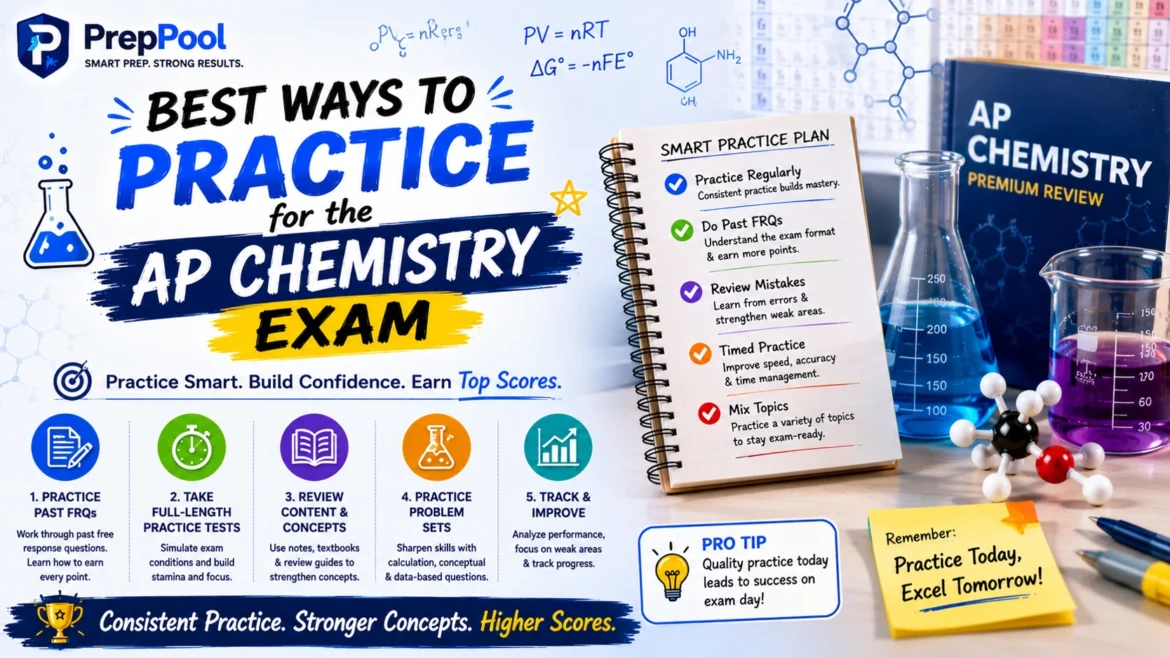

Strong AP Chemistry performance usually comes from active practice, repeated problem solving, and consistent exposure to exam-style questions throughout the school year.
Students preparing for AP Chemistry often ask the same important question: what is the best way to practice effectively without wasting time?
The answer is not studying longer. The answer is practicing smarter.
- Improves scientific reasoning
- Builds confidence under pressure
- Strengthens calculation accuracy
- Improves FRQ performance
- Reveals weak chemistry topics
- Develops time management skills
Why Passive Studying Does Not Work Well for AP Chemistry
Many students spend hours rereading notes, highlighting textbooks, or watching chemistry videos repeatedly. While these activities may help introduce concepts, passive review alone rarely develops the analytical thinking needed for AP Chemistry success.
AP Chemistry questions are designed to test application, reasoning, and scientific interpretation rather than memorization alone.
Students improve much faster when they actively solve chemistry problems and apply concepts to realistic scientific situations.
| Passive Study Method | Active Practice Method |
|---|---|
| Rereading notes | Solving chemistry calculations |
| Highlighting textbooks | Practicing FRQs |
| Watching videos passively | Analyzing laboratory questions |
| Memorizing formulas | Applying chemistry concepts logically |
Why Practice Questions Are Essential for AP Chemistry
Practice questions help students experience how AP Chemistry concepts appear on real exams. Instead of reviewing isolated textbook definitions, students learn how to apply chemistry knowledge under realistic testing conditions.
One of the most effective ways students improve chemistry performance is through structured AP Chemistry practice test questions and answers with explanations that simulate realistic exam difficulty and scientific reasoning.
Regular chemistry practice helps students:
- Recognize common exam patterns
- Improve calculation speed
- Strengthen conceptual understanding
- Reduce exam anxiety
- Identify weak chemistry topics early
How Often Students Should Practice AP Chemistry
Consistency matters far more than occasional marathon study sessions. Students usually retain chemistry concepts more effectively when they practice regularly throughout the week.
- Daily short chemistry review sessions
- Weekly timed FRQ practice
- Regular calculation drills
- Laboratory concept review
- Weekend full-length practice sessions
Even 20–30 minutes of focused chemistry practice daily can produce major improvement over several months.
Why Timed Practice Improves AP Chemistry Scores
Many students understand chemistry concepts well during homework sessions but struggle during timed exams because they are unfamiliar with pacing under pressure.
Timed practice helps students:
- Develop faster problem-solving skills
- Improve time management
- Reduce exam panic
- Build mental stamina
- Increase confidence during difficult sections
Students who regularly practice under realistic timing conditions often feel significantly more prepared on actual exam day.
How to Practice AP Chemistry Without Feeling Overwhelmed
Many students become discouraged because AP Chemistry includes large amounts of scientific content, advanced calculations, and laboratory interpretation. Trying to practice everything at once often creates frustration and mental exhaustion.
A more effective strategy is focusing on smaller chemistry goals consistently throughout the week.
- Practice one weak topic at a time
- Use shorter focused study sessions
- Review incorrect answers carefully
- Rotate between calculations and conceptual review
- Practice laboratory interpretation weekly
Students who break difficult chemistry topics into smaller sections usually improve much faster while reducing study stress significantly.
Why Reviewing Mistakes Is One of the Best Practice Methods
Many students repeatedly solve chemistry questions without analyzing why they answered incorrectly. However, mistake analysis is one of the most valuable parts of AP Chemistry preparation.
Incorrect answers often reveal:
- Weak chemistry foundations
- Calculation errors
- Scientific reasoning confusion
- Poor time management
- Laboratory interpretation problems
Students who want to strengthen study habits and reduce avoidable exam errors can also review these detailed insights about mistakes AP Chemistry students should avoid during exam preparation.
How Laboratory Practice Improves AP Chemistry Performance
Many students focus heavily on chemistry calculations while underestimating laboratory-based questions. However, AP Chemistry exams regularly include experimental analysis, graph interpretation, scientific reasoning, and data evaluation.
Strong laboratory practice helps students:
- Interpret scientific data accurately
- Understand experimental design
- Analyze reaction behavior logically
- Strengthen FRQ performance
- Improve scientific reasoning skills
Students who consistently review laboratory concepts often perform much better on higher-level chemistry questions.
Why AP Chemistry Practice Should Include FRQs
Free-response questions are one of the most important parts of AP Chemistry preparation because they require students to explain scientific reasoning clearly while solving chemistry problems under time pressure.
Students who practice FRQs regularly usually become more comfortable with:
- Scientific writing
- Organized calculations
- Laboratory interpretation
- Chemical reasoning
- Time management during exams
Regular FRQ practice also helps students feel more confident during difficult exam sections.
How Top AP Chemistry Students Practice Differently
Students who earn strong AP Chemistry scores often practice differently from struggling students. Instead of memorizing isolated formulas, they focus on applying chemistry concepts repeatedly in realistic situations.
| Less Effective Practice | High-Performance Practice |
|---|---|
| Memorizing answers | Understanding chemistry reasoning |
| Passive reading | Timed problem solving |
| Ignoring difficult concepts | Reviewing weak topics consistently |
| Studying only before tests | Weekly chemistry practice routines |
Many ambitious students also study advanced preparation methods used by students learning effective strategies for scoring a 5 on AP Chemistry.
How Practice Builds Long-Term Chemistry Confidence
Confidence in AP Chemistry usually develops gradually through repeated exposure to difficult concepts and realistic exam questions.
Students who practice regularly often notice:
- Faster calculation speed
- Better scientific reasoning
- Improved reaction analysis
- Stronger FRQ organization
- Less exam anxiety
Confidence becomes especially important during timed AP Chemistry exams because stress and panic can increase careless mistakes even when students understand the material.
Why AP Chemistry Practice Helps Future STEM Students
AP Chemistry practice develops much more than exam knowledge alone. Students strengthen analytical thinking, scientific reasoning, data interpretation, and problem-solving abilities that remain valuable in future STEM education and careers.
Students planning careers in medicine, engineering, nursing, biotechnology, environmental science, pharmacy, and research often benefit greatly from advanced chemistry preparation before college.
Many students interested in long-term scientific success also explore how AP Chemistry prepares students for STEM pathways and college-level science coursework.
Final Thoughts on the Best Ways to Practice for AP Chemistry
Effective AP Chemistry practice is not about studying endlessly every day. Strong improvement usually comes from consistent problem solving, active learning, mistake analysis, laboratory review, and realistic exam preparation.
Students who practice chemistry actively and consistently throughout the school year often develop stronger confidence, better scientific reasoning, and improved exam performance over time.
AP Chemistry may feel challenging initially, but smart practice habits can make difficult topics far more manageable while preparing students for future STEM success.
Frequently Asked Questions About AP Chemistry Practice
1. What is the best way to practice for AP Chemistry?
The best AP Chemistry practice usually includes active problem solving, timed FRQs, laboratory review, and consistent chemistry calculations throughout the school year.
2. How often should students practice AP Chemistry?
Short daily practice sessions combined with weekly timed review sessions are often more effective than occasional marathon study sessions.
3. Why are practice questions important for AP Chemistry?
Practice questions help students apply chemistry concepts, improve scientific reasoning, strengthen calculations, and prepare for realistic exam conditions.
4. Should AP Chemistry students practice FRQs regularly?
Yes, FRQ practice improves scientific writing, reasoning, calculation organization, and time management during the AP Chemistry exam.
5. Can students improve AP Chemistry scores through practice alone?
Regular practice combined with concept review and mistake analysis can significantly improve AP Chemistry understanding, confidence, and exam performance.
Why Difficult AP Chemistry Topics Require Different Practice Methods
Not all AP Chemistry topics should be practiced the same way. Some units require heavy calculation work, while others depend more on scientific reasoning, laboratory interpretation, or conceptual analysis.
Students often improve faster when they adjust practice methods based on the type of chemistry topic they are studying.
| Chemistry Topic | Best Practice Method |
|---|---|
| Stoichiometry | Repeated calculation drills |
| Equilibrium | Reaction-shift analysis practice |
| Thermodynamics | Concept explanation and diagrams |
| Kinetics | Graph interpretation and rate analysis |
| Acids and Bases | pH calculations and equilibrium review |
Students struggling with advanced chemistry concepts often benefit from reviewing these explanations covering advanced AP Chemistry topics explained clearly before continuing intensive exam practice.
How FRQ Practice Strengthens Scientific Reasoning
Free-response questions are one of the most valuable practice tools because they require students to organize scientific thinking instead of simply recognizing answer choices.
FRQ preparation improves:
- Scientific writing clarity
- Calculation organization
- Laboratory interpretation skills
- Chemical reasoning accuracy
- Confidence during timed exams
Students wanting stronger written-response performance often review these detailed AP Chemistry FRQ scoring strategies and scientific writing techniques before exam season.
Why Consistency Beats Cramming in AP Chemistry
Many students try to compensate for limited preparation time by cramming heavily before quizzes or exams. Unfortunately, chemistry understanding usually develops much more effectively through gradual repetition and active learning over time.
Consistent chemistry practice improves:
- Long-term memory retention
- Calculation speed
- Reaction analysis skills
- Scientific reasoning
- Exam confidence
Students who practice regularly throughout the school year often feel far less stressed during AP exam season.
How Busy Students Can Practice AP Chemistry Efficiently
Many AP Chemistry students balance sports, extracurricular activities, part-time jobs, SAT preparation, and multiple advanced classes simultaneously. Because of this, efficient practice strategies become extremely important.
Students with demanding schedules often improve more effectively through shorter focused study sessions instead of exhausting marathon review periods.
Students looking for realistic scheduling and productivity strategies can also review these practical AP Chemistry study methods for busy students balancing multiple responsibilities.
Why Reviewing Weak Topics Improves Scores Faster
Many students repeatedly practice chemistry topics they already understand because those questions feel more comfortable. However, stronger score improvement usually comes from reviewing weaker concepts directly.
Students should identify:
- Frequently missed question types
- Weak calculation areas
- Confusing chemistry concepts
- Laboratory interpretation problems
- Time management weaknesses
Targeted review often produces faster score improvement than random chemistry practice alone.
How Practice Builds Long-Term STEM Skills
AP Chemistry practice strengthens much more than exam preparation alone. Students develop analytical reasoning, scientific interpretation, time management, and problem-solving abilities that remain valuable in college and future careers.
These same skills are heavily used in:
- Medicine
- Engineering
- Biotechnology
- Environmental science
- Research programs
- Healthcare careers
Students who actively practice chemistry concepts throughout high school often transition more confidently into university STEM coursework later.
Why Confidence Improves Through Practice
Confidence in AP Chemistry usually develops gradually through repeated exposure to difficult calculations, laboratory interpretation, and scientific reasoning questions.
Students who practice consistently often notice:
- Reduced exam anxiety
- Faster reaction analysis
- Improved chemistry calculations
- Better organization during FRQs
- Stronger scientific reasoning
Confidence becomes especially important during timed AP Chemistry exams because calm students usually make fewer careless mistakes under pressure.
Final Takeaway on Practicing for AP Chemistry
The best AP Chemistry practice methods focus on active learning, realistic problem solving, scientific reasoning, laboratory interpretation, and consistent review rather than passive memorization alone.
Students who practice strategically throughout the school year often build stronger confidence, better chemistry understanding, and improved exam performance over time.
AP Chemistry can feel demanding initially, but disciplined practice habits and efficient study strategies can help students master difficult concepts while preparing successfully for future STEM opportunities.