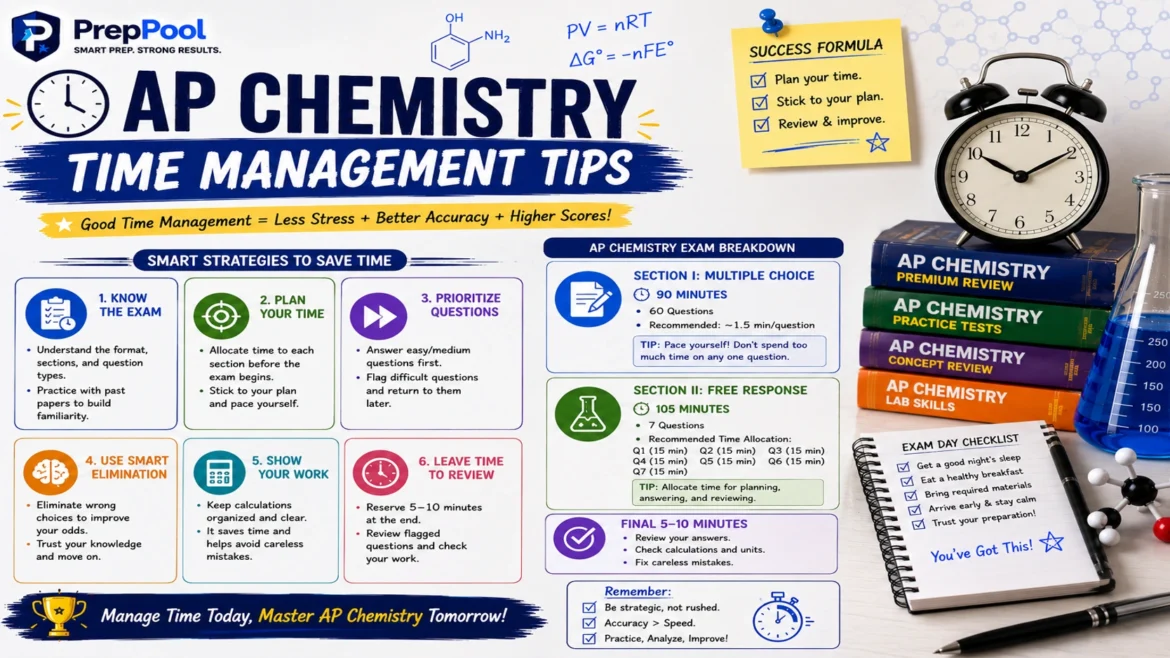

AP Chemistry requires students to balance scientific reasoning, calculations, laboratory interpretation, and written explanations under strict timing conditions. Without strong pacing strategies, even well-prepared students can struggle during the exam.
The good news is that time management skills can improve significantly through consistent practice and smarter preparation habits.
- Reduces exam stress
- Improves question accuracy
- Prevents rushed calculations
- Helps students finish sections
- Builds confidence under pressure
- Improves pacing during FRQs
Why Students Run Out of Time in AP Chemistry
Many AP Chemistry students lose valuable time because they spend too long on difficult questions early in the exam. Others repeatedly check calculations, overanalyze answer choices, or struggle to organize free-response explanations efficiently.
Time pressure becomes especially difficult because AP Chemistry questions often involve multiple scientific concepts within a single problem.
Students may need to:
- Interpret chemical reactions
- Perform calculations
- Analyze graphs or data
- Explain scientific reasoning
- Evaluate laboratory scenarios
Without pacing practice, these tasks can quickly become overwhelming during timed exams.
Why Timed Practice Improves AP Chemistry Performance
One of the most effective ways to improve AP Chemistry time management is through realistic timed practice sessions. Students who regularly practice under exam conditions usually become more comfortable solving chemistry problems efficiently.
Timed chemistry practice helps students:
- Develop faster calculation skills
- Reduce exam anxiety
- Improve pacing naturally
- Strengthen scientific reasoning speed
- Build confidence during difficult questions
Many students improve significantly by solving structured AP Chemistry timed practice questions that simulate realistic exam difficulty and pacing.
How to Pace Yourself During AP Chemistry Multiple-Choice Questions
Multiple-choice sections often create major timing problems because students become trapped on difficult calculations or confusing conceptual questions.
Strong pacing strategies usually involve:
- Answering easier questions first
- Skipping extremely difficult problems temporarily
- Avoiding excessive calculator checking
- Using elimination strategies efficiently
- Monitoring time consistently
Why FRQs Create Time Pressure for Many Students
Free-response questions can feel especially stressful because students must organize calculations, explain chemistry concepts clearly, and justify scientific reasoning within limited time.
Many students lose points because they:
- Write explanations that are too long
- Organize calculations poorly
- Overthink difficult sections
- Spend too much time on one FRQ
- Panic during laboratory analysis questions
Efficient FRQ pacing improves when students practice concise scientific writing and organized calculation methods consistently.
| Weak FRQ Habit | Better Time Management Habit |
|---|---|
| Writing unnecessary details | Keeping explanations focused |
| Skipping organized calculations | Showing steps clearly and quickly |
| Panicking during difficult questions | Moving strategically between sections |
| Ignoring pacing completely | Monitoring exam timing regularly |
How Consistency Improves Chemistry Speed
Many students believe faster chemistry performance comes from natural talent alone, but calculation speed and scientific reasoning usually improve gradually through repetition and active practice.
Students who consistently solve chemistry problems often become:
- Faster with calculations
- More confident with formulas
- Better at recognizing chemistry patterns
- More organized during FRQs
- Less anxious during exams
Speed develops naturally when chemistry concepts become more familiar through repeated exposure and realistic exam preparation.
Why Organization Helps Save Time During AP Chemistry Exams
Poor organization often creates unnecessary mistakes and wasted time during AP Chemistry exams. Students who organize calculations and scientific reasoning clearly usually work more efficiently under pressure.
Organized chemistry work helps students:
- Reduce calculation mistakes
- Track formulas more easily
- Review answers faster
- Improve scientific clarity
- Stay calmer during difficult sections
Small organizational improvements can significantly increase overall chemistry efficiency during timed testing conditions.
How Difficult Chemistry Topics Slow Students Down
Some AP Chemistry units naturally require more time because they involve multi-step calculations, scientific reasoning, laboratory analysis, and conceptual interpretation simultaneously.
Students often lose valuable exam time when they feel uncertain about advanced chemistry concepts or struggle to identify the correct problem-solving approach quickly.
| Advanced Topic | Why It Slows Students Down |
|---|---|
| Equilibrium | Requires conceptual reasoning and calculations |
| Thermodynamics | Complex energy interpretation |
| Kinetics | Graph and reaction-rate analysis |
| Electrochemistry | Multi-step reaction reasoning |
| Acids and Bases | Combined equilibrium and calculation work |
Students reviewing advanced chemistry concepts often improve pacing faster after strengthening these challenging AP Chemistry subject areas through targeted practice.
Why Reviewing Mistakes Improves Timing Skills
Many students repeatedly practice chemistry problems without analyzing why they lost time or answered incorrectly. However, reviewing mistakes is one of the fastest ways to improve both chemistry accuracy and pacing.
Mistake review often reveals:
- Weak chemistry foundations
- Calculation inefficiencies
- Slow formula recognition
- Scientific reasoning confusion
- Poor exam pacing habits
Students wanting to improve preparation efficiency and reduce avoidable chemistry errors can also explore these explanations covering mistakes AP Chemistry students should avoid during exam preparation.
How FRQ Practice Improves AP Chemistry Pacing
Free-response questions are one of the best ways to improve AP Chemistry time management because they force students to organize scientific reasoning efficiently under pressure.
Students who regularly practice FRQs usually improve:
- Scientific writing speed
- Calculation organization
- Laboratory interpretation efficiency
- Reaction analysis skills
- Overall exam pacing confidence
Many students strengthen timing and written-response performance through these detailed AP Chemistry FRQ pacing and scoring techniques before exam season.
Why Consistent Study Habits Improve Exam Speed
Students who study chemistry inconsistently often spend more time during exams because formulas, calculations, and scientific reasoning patterns feel unfamiliar under pressure.
Consistent chemistry review improves:
- Reaction recognition speed
- Calculation accuracy
- Formula familiarity
- Scientific interpretation
- Confidence during timed sections
Students balancing heavy schedules often benefit from these realistic AP Chemistry study approaches for busy students trying to maintain long-term consistency.
How High-Scoring Students Manage Time Differently
Students who earn strong AP Chemistry scores usually approach time management strategically instead of emotionally. Rather than panicking during difficult sections, they stay focused on maximizing overall scoring opportunities.
Strong AP Chemistry students often:
- Practice under timed conditions regularly
- Skip extremely difficult questions temporarily
- Monitor pacing throughout exams
- Keep scientific explanations concise
- Review weaker chemistry concepts consistently
Many ambitious students also study advanced preparation habits used by students learning effective AP Chemistry score improvement methods before the exam.
| Weak Timing Habit | High-Performance Strategy |
|---|---|
| Overthinking difficult questions | Moving strategically through sections |
| Rushing calculations carelessly | Maintaining organized work |
| Ignoring pacing completely | Tracking time regularly |
| Writing overly long explanations | Using concise scientific reasoning |
Why AP Chemistry Time Management Matters Beyond the Exam
Time management skills developed during AP Chemistry preparation remain valuable long after the exam itself. Scientific careers frequently require professionals to solve technical problems, analyze data, and make decisions efficiently under pressure.
Students preparing for medicine, engineering, biotechnology, pharmacy, environmental science, and research often benefit greatly from strong analytical pacing and scientific organization skills.
Many future STEM students also explore how advanced chemistry preparation supports STEM readiness and university-level scientific learning.
How Confidence Reduces Time Pressure in AP Chemistry
Confidence plays a major role during AP Chemistry exams because stress and panic can dramatically slow scientific reasoning and increase careless mistakes.
Students who practice consistently often become:
- Faster with calculations
- More comfortable with formulas
- Calmer during difficult questions
- Better at eliminating wrong answers
- More organized during FRQs
Confidence usually develops gradually through repeated chemistry exposure and realistic timed preparation rather than sudden improvement overnight.
Final Thoughts on AP Chemistry Time Management
Strong AP Chemistry time management usually comes from consistent practice, realistic pacing strategies, organized scientific reasoning, and repeated exposure to exam-style questions.
Students who strengthen weak chemistry topics, review mistakes carefully, and practice under timed conditions often improve both accuracy and efficiency significantly over time.
AP Chemistry exams may feel demanding initially, but disciplined preparation and smarter pacing strategies can help students perform more confidently while reducing unnecessary exam stress.
Frequently Asked Questions About AP Chemistry Time Management
Why do students run out of time on AP Chemistry exams?
Many students lose time because of difficult calculations, weak pacing strategies, overthinking questions, and poor organization during FRQs.
How can students improve AP Chemistry pacing?
Students usually improve pacing through timed practice sessions, consistent chemistry review, and better calculation organization habits.
Should students skip difficult AP Chemistry questions temporarily?
Yes, temporarily skipping extremely difficult questions can help students maximize scoring opportunities and reduce unnecessary time loss.
Why is timed practice important for AP Chemistry?
Timed practice improves calculation speed, scientific reasoning efficiency, confidence, and overall exam readiness under pressure.
Can chemistry confidence improve time management?
Yes, confident students often solve chemistry problems more efficiently and make fewer panic-related mistakes during exams.
Why Practice Habits Directly Affect AP Chemistry Timing
Many students underestimate how strongly practice habits influence exam pacing. Students who practice chemistry inconsistently often spend extra time during exams because reaction patterns, formulas, and scientific reasoning feel unfamiliar under pressure.
Strong practice habits help students:
- Recognize chemistry concepts faster
- Improve calculation efficiency
- Strengthen scientific reasoning
- Reduce hesitation during exams
- Build long-term chemistry confidence
Students who regularly solve realistic chemistry questions often improve timing naturally through repeated scientific exposure and active learning.
Many students strengthen pacing and confidence through these effective AP Chemistry practice methods designed around realistic exam preparation.
How Formula Familiarity Saves Time During Exams
Students who struggle to recognize formulas quickly often lose valuable time during AP Chemistry calculations. Searching repeatedly through equations or second-guessing variable relationships can slow pacing significantly.
Strong formula familiarity helps students:
- Select equations faster
- Reduce calculation mistakes
- Improve reaction analysis
- Increase scientific confidence
- Work more efficiently under pressure
Many students improve chemistry calculation speed after reviewing these explanations covering the AP Chemistry formula sheet and equation strategies before timed practice sessions.
Why Multiple-Choice Strategies Improve Time Management
Multiple-choice sections often determine whether students maintain strong pacing throughout the AP Chemistry exam. Students who panic during difficult questions may waste valuable time early and later rush through easier problems unnecessarily.
Strategic multiple-choice habits often include:
- Eliminating impossible answers first
- Skipping extremely difficult problems temporarily
- Managing calculator use efficiently
- Monitoring pacing consistently
- Using scientific reasoning logically
Students wanting stronger exam pacing often benefit from these detailed AP Chemistry multiple-choice timing strategies and question-solving techniques.
| Poor Timing Habit | Smarter Exam Strategy |
|---|---|
| Overthinking one difficult problem | Moving strategically between questions |
| Repeatedly checking calculations | Working confidently and efficiently |
| Ignoring exam pacing | Tracking timing regularly |
| Rushing through easier questions later | Maintaining balanced pacing throughout |
How Self-Study Students Can Improve AP Chemistry Timing
Independent learners sometimes struggle with pacing because they practice chemistry without realistic timing conditions. Without exam simulation, students may feel shocked by the speed required during the real AP Chemistry exam.
Self-studying students often improve timing significantly when they:
- Use timed chemistry sessions weekly
- Review mistakes consistently
- Strengthen weak chemistry units
- Practice organized calculations
- Build realistic study schedules
Students preparing independently often improve pacing and consistency through these practical AP Chemistry self-study preparation methods designed for independent learners.
Why Staying Calm Improves AP Chemistry Speed
Stress and panic often slow chemistry reasoning dramatically during exams. Students who feel overwhelmed may reread questions repeatedly, second-guess formulas, or make careless calculation mistakes under pressure.
Calm students generally:
- Think more logically
- Organize calculations better
- Recognize chemistry patterns faster
- Manage pacing more effectively
- Make fewer avoidable mistakes
Confidence usually develops gradually through repeated chemistry exposure and realistic practice rather than memorization alone.
How AP Chemistry Time Management Helps Beyond the Exam
Strong time management and scientific organization skills remain valuable throughout college STEM programs and future technical careers. Students learn how to solve problems efficiently, analyze information carefully, and stay organized under pressure.
These same abilities support future success in:
- Medicine
- Engineering
- Biotechnology
- Pharmacy
- Environmental science
- Scientific research
Students who develop strong chemistry pacing and analytical thinking skills often transition more confidently into advanced university science courses later.
Final Takeaway on AP Chemistry Time Management Tips
AP Chemistry time management improves through realistic practice, organized scientific reasoning, active learning, and consistent exposure to exam-style chemistry problems.
Students who strengthen weak topics, practice timed chemistry sessions regularly, and stay calm during difficult questions often improve both pacing and overall exam performance significantly.
Effective pacing is not about rushing through chemistry problems carelessly. It is about building confidence, familiarity, and scientific efficiency gradually through disciplined preparation and smart study habits.